The road to net zero. The $275 trillion bet

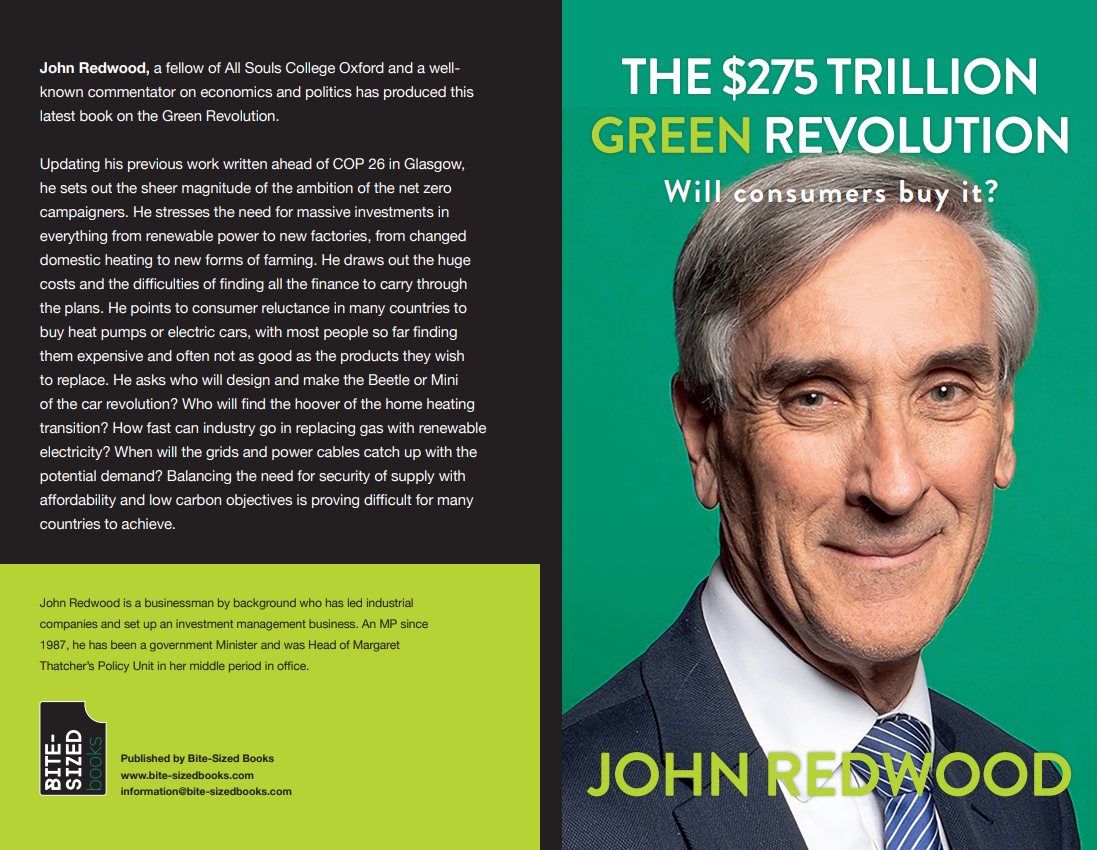
I am bringing out a short book updating my work on green policy. Titled “The $275 trillion Green Revolution. Will consumers buy it? “it is published by Bite sized books and available on Amazon here: https://www.amazon.co.uk/275-Trillion-Green-Revolution-Consumers/dp/1738558428/ref=sr_1_1?crid=3RC5ABLGBLE5Q&dib=eyJ2IjoiMSJ9.MhlzOxY1chcW2WlWoSkhZD5sZpuILHQfDW061MBLpTkaRxrfT2uc_njXk5hxfh8ai4JjHGzAJ_uz66TOSHcJOlUqxMql0zDVfrQpZfOW0RIr3pMYf54GpLnqgwli7y4Jm3Mm4WCOZCk14IANoeqqc3FAixqnCvz5swKzl6H_gBHsCnNzUUGWlJT_Uwaolg2d2iJCjeaLteCcfFtmZjaZsK0dbb3BCHZjEmrrnOE8vXg.JtAVgfOd9pzJKfUEX_Av8HjAV4WOiBbKUkHX4O8kkEc&dib_tag=se&keywords=John+redwood&qid=1712055538&sprefix=john+redwood%2Caps%2C121&sr=8-1

It looks at two main problems  with this top down movement led  by an international Treaty based elite and by most national governments. It asks how will this all be paid for. It sets out how consumers currently do not buy into the products the governments want them to adopt, from battery cars to heat pumps and from smart meters to non meat diets. It takes the Mc Kinsey global forecast of expenditure needed for transition in the period 2021 to 2050.

Dear Colleague letter – Special Educational Needs

I am glad that that the Govt has made this much needed funding available as I have long supported more support for children with special educational needs.  I am pleased that the children with SEN in my constituency will benefit from this funding.  I know from my work with constituents how important it is for their children to be able to access the right support so that they can realise their potential and thrive.


26 March 2024

Dear Colleague,


SPECIAL EDUCATIONAL NEEDS AND DISABILITIES AND ALTERNATIVE PROVISION IMPROVEMENT IN ENGLAND: DELIVERY PROGRESS

Today, I am announcing £850 million of capital allocations to local authorities to support the creation of new places for children and young people with Special Educational Needs and Disabilities (SEND) or who require alternative provision, forming the final part of our £2.6 billion investment in high needs capital between 2022 and 2025. This overall funding is triple our investment compared to just 3 years ago.

Along with the funding already provided, it will mean this government is delivering over 60,000 new places for children with SEND or who require alternative provision since 2010. 30 successful applications to run special free schools have been announced today. We will also announce the location of 15 new special free schools by May.

https://questions-statements.parliament.uk/written-statements/detail/2024-03-26/hcws384

We’re delivering on our plan to ensure every child gets the right support at the right time. That is why we are providing significant investment into the high needs revenue budget, which in 2024-25 will have increased by over 60% since 2019-20 to over £10.5 billion.

To improve workforce capacity and capability, we will be training up to 7,000 more early years special educational need coordinators, and 400 more educational psychologists.

In January, we published a new initial teacher training and early career framework which includes new and updated content on SEND.

We have also recently announced that scholarship funding will be available to support participants undertaking the new mandatory National Professional Qualification for Special Educational Needs Co-ordinators (NPQ for SENCOs) in autumn 2024.

In addition, we are supporting schools to better meet the needs of neurodiverse children through the £13 million Partnerships for Inclusion of Neurodiversity in Schools (PINS) programme. The programme will bring together specialist staff (for example speech and language therapists, and occupational therapists) and expert parents into mainstream primary schools to upskill teachers and other staff to better support neurodiverse children.

To support more young people with SEND to transition into sustained, paid employment, we are investing c£18 million until 2025 to build capacity in the Supported Internships Programme. Initial data from our delivery partner indicates that over 3000 young people are taking part in an internship this year.

I want to thank you for the work you do in your constituencies to support families of children with SEND and in alternative provision.

I also want to thank the children, parents, sector leaders and organisations for the support, challenge, and advice they have given us. We will continue to draw on their experiences and expertise as we refine and deliver our reforms.

Please do not hesitate to contact me should you want any further detail.

Yours sincerely,

The Rt Hon Gillian Keegan MP

Secretary of State for Education
Government energy policy

This site normally sets out government policy and provides proposals to change or improve it. I run just two articles explaining aspects of Labour policy and some of you complain. Yet at the same time some write in to tell me they will not vote Conservative even if that means a Labour government .They should at least be willing to think about and discuss Labour policy as current polls say Labour can win the election. It is also worth thinking about  how the official opposition would like the government to change things as they can try to get rebel Conservatives to help them.

There is now a substantial and I urge growing gap between Labour and Conservative over the road to net zero. Conservatives now recognise the  need for more gas generated electricity for the time being to keep the lights on. Labour wants to close all those stations by 2030 and depend on renewables. How would they keep the lights on when the wind does not blow and the sun does not shine? Conservatives want to get more of our own oil and gas out of the North Sea. Labour want to ban all new oil and gas development at home and import instead. More home energy means more well paid jobs and more tax revenue at home.

The government has said it sees it needs to be realistic about net zero. That means letting people buy petrol cars and gas boilers  for longer. It means waiting until much more nuclear power is available, still a decade away at best.It means taking synthetic fuels and hydrogen more seriously as possible runners. Believing you can get to net zero on power generation by 2030 and rely on more windfarms cannot work.

The government need to amend their lecturing taxing and subsidising in favour of various car and heating systems that are not  as green or as good as some Ministers seem to think.


Labour’s expensive fantasy land for 2030

Labour’s plans to phase out all gas and coal power stations by 2030 requires the UK to accelerate its build of wind farms, solar panels, nuclear power, and battery storage. It would also require a big expansion of the grid. They propose a nationalised industry to do much of this work as it would require huge subsidies and managed prices for the power. Claire Coutinho is right to highlight the huge cost of some £116 bn of trying to do this and to question the feasibility and wisdom.

It is of course totally unrealistic. Nuclear power will be considerably lower  by 2030 following the closures of existing power stations. It is not possible to decide now to put in extra nuclear power stations and have them producing power by 2030. Putting more and more windfarms in as they plan does not solve the problem of keeping the lights on on a windless day. Saying they can put in sufficient storage is more easily stated than delivered. Relying on big batteries would require a colossal programme of building them. Finding enough pump storage locations would not be likely. There is also the small matter of the grid which would need major enhancement against a background of long and complex planning procedures and many local communities wishing to protect their landscape or divert power lines from settlements and important buildings.

We need more affordable and reliable power. Balancing price and security of supply against environmental objectives is a crucial part of success in energy policy. Labour just goes for the environmental without a thought about keeping the lights on, helping business  be competitive and controlling people’s power bills. Combined cycle gas power still represents some of the cheapest and most reliable power, which is why our system needs what it has and needs some more for the transitional period,whilst nuclear, synthetic fuel, hydrogen and renewables become more affordable and practical propositions for more of our demand.

Visit to Luckley House school

On Friday 22 March I accepted an invitation to speak to the Six Form Politics and history students and staff at Luckley House.

As the only speaker I kept off current UK party politics in its pre election period. I gave them a talk about the US and European elections setting out the  main views of the different parties and groupings and discussing the constitutional background in a balanced way. I was asked some interesting questions about the usefulness of historical understanding in modern politics, about how the  machinery of government worked with advisers and electorates seeking to influence outcomes, and about the role of independent bodies .

That Rachel Reeves lecture

I will spare you a party political response to the Reeves Mais lecture. Various journalists have described its vacuity, verbosity and timidity. I want to set out the big issues that directly affect UK growth, productivity, jobs and incomes that she ignored or knows nothing about.

1 The big role of the Bank of England in creating the instability in inflation  and output she condemns. A Bank which buys up £845 bn of bonds to keep money too loose is bound to cause inflation. When it then goes on to hike rates and to sell £130 bn of bonds at big losses it is likely to sabotage growth. She supports this wayward conduct.

2. She rightly criticises poor UK productivity. She fails to reveal the collapse of public sector productivity since 2019 or to show UK private sector factories have competitive productivity. Not a single proposal for turning round public sector productivity.

3. The labour market is talked about with no mention of large scale migration. Will she join me in wanting to ban work permits for migrants to fill low wage vacancies? Will she back government plans to cut legal migration by 300,000 and demand they go further?

4. She sees green investment and jobs as central. How much would her accelerated net zero policies cost? How would she avoid creating many new jobs in China that has cornered the market in big batteries, turbines and solar panels? How would she keep the lights on? Is she going to make us all go electric?


Who will rid us of these hopeless “independent” bodies?

Politicians of all parties have this century been in a hurry to shed responsibilities for anything difficult. There has been a rush to create more arms length bodies from government and to transfer more powers and money to the many quangos we already had. The politicians thought that this would remove them from responsibility for outcomes, and  would improve outcomes. Neither of these ideas came true.

The Bank of England is responsible for monetary policy and inflation. It has a prime aim of keeping inflation to 2%. It let it go to 11% by debauching the currency but most politicians declined to criticise or comment. The government got blamed for the inflation, and the government joined the Bank in  blaming  the Ukraine war.

NHS England with its high paid CEO and large Board and top management team is responsible for running the NHS, for recruiting, grading, rostering  and paying all the many staff. A series of strikes hit the NHS. The executives denied all responsibility for staff relations, pay and grading and said the dispute was a matter between Ministers and the Unions. It is difficult for Ministers to resolve the disputes when they cannot hire, promote, regrade, alter shift patterns or reward anyone in the NHS as all that is controlled by senior executives.Whatever goes wrong in the NHS the senior executives  always blame a lack of money, however much extra  the government provides. The government gives large sums to get the waiting lists down only to see them go up.

The arms length Post Office is regulated and monitored by UK Government Investments. They approved senior management, paid them large salaries and bonuses and just watched as they lost a stunning £1400 million as well as sending many innocent staff to prison for fraud and wrong accounting  they did not carry out. Ministers intervened to try to get criminal charges quashed and compensation paid, only to find the Post Office was still holding back in many cases.

The Rail Regulator, HS 2  and the nationalised Network Rail run by well paid senior executives have presided over a big loss of passenger numbers and revenue, and  have racked up huge losses for taxpayers .Parts of HS 2 have had to be cancelled owing to the absurdly large overruns on cost and timetable. Ministers are blamed for the results.

This could be a very long list. Many cases would reinforce the obvious points of these first three. High pay is a  reward for poor outcomes. No-one makes the senior managers responsible. Opposition parties have no interest in criticising the managers or holding them to account before they go so wrong, but delight in blaming the government when they do. Government is too cautious about intervening, fearing the Opposition would complain if they did. Both sides mouth the doctrine of independence, with the Opposition contradicting it often in the same interview by blaming Ministers for failures.  So overpaid managers get away with disaster after disaster and the taxpayer ends up with a huge bill.

Parliament and Ministers need to go back to accepting responsibility. They need to monitor, influence and if necessary change these top managers before disaster strikes. If someone wants private sector levels of CEO pay to run  the railways or the Post office they should expect private sector levels of surveillance and should expect no bonus or the sack if they make big errors. Ministers need to institute regular review meetings and proper reporting to them as shareholders or leading stakeholders in these bodies, so they see problems as they develop and require fixes before they get out of hand. Those few of us who warned of the likely inflation or sided with the sub post masters were ignored.

Cleaning up the litter

This morning I joined volunteers in Swallowfield to help pick up litter. I had soon filled a large rubbish bag with old drink cans, food wrappings, crisp packets and other debris.

Thanks to all those who turned out to help. The place looked a lot tidier as we piled up the bags of rubbish.

Winning elections

Conservative briefers are saying the party needs to be united to win the election. I have good news for them. Parties with plenty of internal rows  and disagreements always win, as the two main parties who usually win always  have MPs who disagree with the leadership. Today’s Labour party is badly split over Israel and the Middle East , over a faster move to net zero and over Rachel Reeves OBR austerity  economics but that has not stopped them doing well in opinion polls.

In the  last 50 years there have been two leaders who have won three elections in a row, a remarkable achievement. Margaret Thatcher did so despite facing continuous opposition from a significant group of MPs called the Wets. They regularly briefed disobliging comments about her personally as well as attacking her policies. They rebelled in Parliament on various measures. They put up a stalking horse candidate against her for leadership. They backed Heseltine as a replacement.He resigned from government to promote himself. She kept winning because she set out and enacted a clear vision of UK revival, economic growth and wider ownership.

Tony Blair kept winning despite facing many media stories of  his Chancellor’s disagreements and briefings from pro Brown people that wanted the  Chancellor to take over. He had to deal with a left wing group of MPs who thought he was not nearly  socialist enough. He persevered with the low tax rates the Conservatives left him and avoided recession . Eventually he was persuaded out before his Chancellor’s policies put us into a banking crash and deep recession.

If an election were a contest of who is the more united party Labour would be discovered as very split. The truth is millions of former Conservative voters are  undecided or currently saying they may stay at home or spoil their ballot paper or vote for someone who cannot win. They do not want a Labour government and see that Labour government would double up on those  very policies of this government that they do not like.

To win the Conservative leadership needs to do more things this group likes and voted for. Start with getting migration well down as now promised and cut back the woke state  to free money for more tax cuts. Let people make more of their own choices. Champion the big Conservative success of halving unemployment  and allowing so much job growth.

The Bank gets it wrong again

The Bank of England forecast inflation at 2% when it was going on to hit 11%. So clearly it does not understand inflation and has little ability to forecast it accurately as it is required to do. It tells us the inflation was caused by the Ukraine war and energy prices which it could not predict. So how come inflation was already 3 times target before the invasion? That main part of the inflation was not caused by the war. How come Japan and China kept inflation down to around 2% despite having to import much dearer energy as a result of the war?

N ow we are told they cannot risk lower rates because there could be more trouble in  the Red Sea. Freight rates and insurance rates are already well up and much shipping has been diverted to the long route, so markets know all about that pressure on prices. Meanwhile the money supply has been squeezed, credit is dear and scarcer, mortgage demand has fallen and the Bank ignores all these obvious signs that inflation will come down.


Worst of all is the gross distortion of its balance sheet. They bought far too many bonds at crazy prices in 2021 only now to want to sell them at huge losses and send the taxpayer the bill. Why? The ECB that made the same inflationary mistake is not doubling the error by selling bonds in the market. The Fed is not getting reimbursement from its Treasury. Only the Bank insists on double austerity with squeezed money and less public spending or tax cuts as the taxpayer picks up the bill of the UK’s uniquely bad bond investor, the Bank of England. Never has the Bank lost so much money so quickly for no good purpose.

We need an urgent change of Bank policy, Stop selling the bonds. Cut the base rate by 25 bp. Switzerland, Poland, Hungary, Brazil, China have started cutting their rates.