Sir David Amess

David was a long-standing friend and colleague. His senseless murder leaves his family devastated, his friends bereft and his constituents without a dedicated MP. He went to great lengths to help his constituents and to represent his area. He was always kind, hard working and willing to engage with people of wide ranging views. He was a great campaigner and a helpful mentor to new MPs.

His tragic death will not stop MPs talking directly to people or being active in their constituencies. There have been too many murders of MPs during recent decades, when MPs strive to ensure the nation’s disagreements and passions are settled through votes and arguments, not violence.

Update on Access to GP Services

I have received the enclosed update from the Government:

Dear John

I am writing to you following publication of Our plan for improving access for patients and supporting general practice.

First and foremost, I’d like to thank our GPs for the outstanding work they’ve done during the most difficult 18 months in living memory. Throughout the pandemic, General Practice was forced to adapt in order to continue delivering care to our communities, keep vital services going and put millions of jabs in arms.

As we emerge from the pandemic it is vital that we continue to support General Practice teams to provide the best possible care to patients. I’m determined to ensure that patients are able to see their GP in the way they want, no matter where they live. The plan we have announced today is a statement of recovery and reform, not just for this winter but for the years to come.

We are investing £250m in a Winter Access Fund to improve the availability of GP practices and increase the number of face-to-face appointments, while also investing in technology to make it easier for patients to see or speak to their GP. Although the latest data shows that there are 1,200 more full time equivalent GPs serving our communities than there were two years ago, we will not be complacent when it comes to our recruitment efforts.

Last year a record-breaking number of doctors started training as GPs, and we’re committed to further increasing the number of training places to 4,000 a year. We will draw on our fantastic community pharmacists and their teams through greater use of the NHS Community Pharmacist Consultation Service, allowing them to use their expertise to advise and treat more patients, freeing up more of GPs valuable time to look after patients.

The UK Health Security Agency has carried out a review of Covid control measures for GPs and primary care providers, and has published recommendations which will further enable face to face consultations, where it is safe to do so.

We’re making practices more accountable to the communities they serve by automatically sending patients a message following their appointment to give them the opportunity to rate their experiences of accessing support. GP appointment data will also be published at a practice level by spring next year, with the NHS increasing its oversight of practices with the most acute access issues.

We know how challenging the past 18 months have been for GPs and their teams, including the disgraceful incidences of staff facing abuse and violence while trying to do their jobs.

This Government has zero tolerance for this utterly unacceptable behaviour. To support practices we are providing £5m of capital funding for them to invest in extra security measures.

Our plan recognises that General Practice is the cornerstone of our NHS, and demonstrates this Government’s commitment to helping staff deliver for patients. The full plan can be found here: Coronavirus » Our plan for improving access for patients and supporting general practice (england.nhs.uk)

Yours ever,

SAJID JAVID
Secretary of State for Health and Social Care
Ingredients of an industrial strategy

If we want to rebuild industry that we have lost and attract modern industry to make the new materials and products the world is discovering there are some basics government needs to do.

It needs to ensure good transport and communications in industrial locations. As monopoly provider of roads and railway lines it needs to ensure sufficient accessible capacity. It needs to allow or encourage high quality high capacity broadband.

It needs to continue to strive for excellence in school and College education. It needs to work with schools and Colleges over how they help people gain qualifications and interests that can lead on to well paid jobs in industry.

It should pump prime good ideas for new technologies, working with Universities and company labs. It should provide a market for innovations, buying them for use in the public sector. New drugs are a good example, bought into the NHS, or new vehicles bought into the MOD.

It needs to use its planning and licence granting powers well so industry can establish and expand in suitable places and can tap local sources of raw material and energy as appropriate.

It needs to avoid rushing to nationalise. There has been a long history of nationalised industries in the UK under  governments of all persuasions sacking employees, overcharging customers and losing large sums for taxpayers to reimburse.

It needs to avoid imposing unduly complex controls and interventions, which invariably lead to worse outcomes and demands for yet more offsetting interventions.


Time to grow more of our own food

I notice in my local supermarkets a keen enthusiasm to display the Union flag on many  foods the retailer can claim are home grown. There is a marked reluctance to celebrate the EU origins of continental food with an EU flag, or even to put a Dutch flag on the salad items and a Spanish flag on the vegetables that come from there. This makes it a bit more difficult for home grown food enthusiasts to spot the import. It implies the supermarkets think there are plenty of people who want to buy UK food, but  not enough who will insist on EU food so they seek to disguise it.

Our time in the Common Agricultural Policy lost us a lot of market share. As recently as the mid 1980s the UK grew 84% of its own temperate food, but this had slumped to 60% last year. The EU did its best to speed the demise of sections of UK agriculture. They provided grants to remove UK orchards to give continental apples and pears a freer run at our market, on the proviso that the farmer could not replant with new fruit trees. They kept our milk industry short of quota, forcing us to import more higher value products like yoghurt and cheese from the continent. Even pro EU John Major went into battle against the severity of their beef policy in response to an unfortunate outbreak of disease.

Now we are free to grow and rear more of our own food we should do so. The Environment Department should make cutting the food miles a crucial part of its green agenda. It should tailor grant schemes to encourage new plantings, investment in mechanised nurture and harvesting, and support for on farm reservoirs and soil improvement programmes. The NFU have raised their standard over the opportunities. The Netherlands supply much of our salad stuff and flowers. They have  no weather advantage over us, so we should get on and invest in competitive production with suitable government assistance of the kind they have enjoyed.

It is not a green policy to pay our landowners not to farm our land and then to import our food from hundreds of miles away with the need for so much transport, chilling and packaging to get it to us.


The Business Department needs to promote UK energy to promote UK industry

I attach below my proposal to the Business Secretary:


Levelling up requires the UK to attract and retain more investment in industry as well as services. One of the main requirements to keep and attract industry is a plentiful supply of affordable energy. This may well in the future be renewable electricity or hydrogen gas made using renewable electricity, but for the next few years industry remains heavily dependent on gas.

This means we either allow more UK gas to be produced and supplied on longer term contract at affordable prices, or watch as more of our industry is closed down and replaced with imports from countries that do have cheaper gas. If you want to make glass, ceramics, paper, steel, cement, plastics or many other products you need gas. Importing it from somewhere else does not reduce the carbon footprint. It usually  increases it.

The UK energy policy in recent years has been to close down our coal power stations,to avoid building much new gas generating capacity and to rely more and more on imports. We need Norwegian, Qatari and EU gas in increasing quantities to keep our plants open. When there is a worldwide gas shortage our partial dependence on imported gas at world spot prices causes particular stress. We need increasing amounts of EU and Norwegian electricity.

We compound the difficulties of the steel industry by failing to mine a specialist coal we have in the U.K. and need for steel output. The chemical industry of course relies on oil and gas feedstock for much of what it does, but we have not allowed sufficient production and a close working relationship  between the energy industry at home and the chemical industry. Germany has a larger chemical industry without a home gas and oil industry which should have placed it at a disadvantage but Germany does cut energy prices for industry and relies on a lot more coal in the total mix.

Shouldn’t we trust the market more and grant the permits for UK exploration and development of domestic oil and gas? Wouldn’t that reduce CO2 by cutting dependence on imports from coal based systems like Germany and China  and from the extra transport it takes to bring the goods to us?


Newsnight

Some of you say you want to know about media engagements.  This morning BBC Newsnight invited me on for tonight. They wanted to know if I was happy to talk about energy or the Northern Ireland Protocol and I said Yes, either or both. Chasing them this afternoon for the details they then said they had changed their mind and cancelled it. No idea why, as I would imagine they would have to follow at least one of those stories.

They then said they did want me but after a long preliminary private  interview  decided my views were not suitable so they cancelled me again. They seemed to want me to adopt caricature austerity views which I have never held.

Visit to Floreat Montague Primary School on 24 September 2021

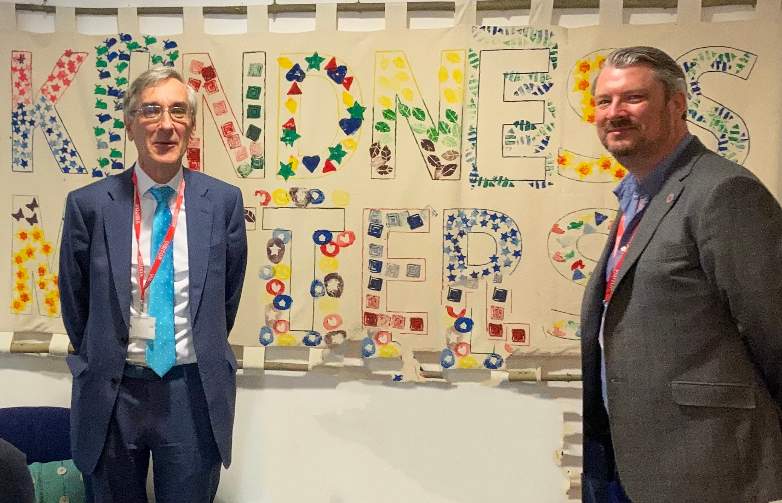
I visited Floreat Montague on Friday 24 September. I met and talked to a number of pupils, and was hosted by the Chairman of the Board John Hutt and the Headteacher, Patrick Pritchett. Councillor Gregor Murray from the local ward who is also a parent joined the visit.

There was an initial discussion about raising standards and the ethos of the school. I praised the use of synthetic phonics as the best way of encouraging good reading and writing at an early age. I also discussed the way project work around stated themes or tasks can be used to allow pupils in a class of varied abilities to participate fully and achieve good outcomes. I was pleased to see the school’s emphasis on kindness and engaging with all pupils.

During the tour of the school a couple of boys were energetic in their enthusiasm for football, and most engaging over opportunities for them to play and to follow Premier League teams. There was a Question and answer session with four of the older pupils selected for the task of interviewing me . I asked them to comment on what they most liked about their school, on what improvement they would like to see and which lessons or activities engaged them the most. The pupils asked about electric cars, charger points, plastic waste in the oceans, sustainability and cycleways. I explained government policy and my own thoughts in line with the views set out on this website.

I was grateful for the welcome to Floreat Montague, and pleased to talk to pupils about their lives in the school and about their interest in issues affecting the local community and the wider world. I wish the school every success as it expands, completes its exciting history mural project and enriches the lives of all pupils who pass through.

If gas is dear you need more of it or a better alternative

The Business Secretary was the Energy Minister, and is now the boss of the Energy Minister. His disagreements with the Treasury over whether he can offer any subsidy to hard pressed manufacturers need not prevent him helping the energy using industries very directly. He should invite them in with the gas supply industry and the UK gas producers and discuss how going forward the UK can produce more domestic gas to reduce our reliance on erratic and currently very expensive imported energy.

An industrial user of gas that needs plenty at a competitive price to make steel or glass or paper or ceramics wants some reassurance that going forward they can obtain enough gas at sensible prices to be able to keep their customers. If the government allowed the UK gas industry to find, produce and deliver more of the gas that is available in our islands and seas they could offer more long term contract gas to domestic industry on sensible terms.

The Minister could explain to the green lobby that this is a greener answer as well. It makes little sense to bring gas compressed by use of energy around the world in large tankers needing a lot of diesel to power them to our shores, when local gas could pass down a pipe for a fraction of the power needed for the import. If something is too dear you either need more of it or a substitute. There may be other ways of making steel and paper in due course, but for the time being if we want to save our industries they need cheaper gas.


James Bond and today’s UK

I was gripped by the latest James Bond movie through its action packed twists of plot.

The film is a statement to the world that UK  derived brands and cultural icons can fill cinema seats and entertain millions in many different cultures and countries. I wish it commercial success as it helps the traditional cinema revive after lockdown.

What kind of image of the UK does it project? Whilst viewers would be wise to see it as drama not documentary and will appreciate many of the unrealistic conventions of the 007 genre, there will be those who take away a message about the UK from it.

I was surprised to be warned that the film contained moderate violence. There didn’t seem to be anything moderate about a series of mass murders, mass sanctioned deaths of arms carrying criminals, the use of explosives to enter and control populated buildings and missile strikes on an inhabited island. The story centred as before around the actions of the UK secret services on the  world stage. The Head of the service was happy to authorise killings anywhere in the world in pursuit of dangerous global criminals. There was no reference to the National Security Council and only once was it thought a good idea to mention to the PM some of what they were doing. So it was clearly not a representation of the legal process, rule of law and democratic controls that apply.

Leaving aside the unrealistic idea that officials in the UK can authorise machine gun fights and dangerous car pursuits leading to the death of drivers in overseas countries , the film gave a very positive view of the UK in three crucial respects. The senior officials were very loyal to our country. Our country stands for right and the defeat of evil worldwide criminal gangs throughout the movie. The officials could summon up precise force, equipment and clever innovations to win any war against a criminal  gang however violent and resourceful they might be.  Whether it was in Scandinavia or near Japan, people could be quickly deployed. What’s not to like, unless you are a  criminal.

Just as the film overdid the lack of legal restraints on UK counter action, so I fear it flattered government in its portrait of speed, resource and innovation. Let us hope our senior officials study the  brave and inventive  officials we see in the drama to see how we can increase our success in  the struggle against  violent serious global criminals within the rule of law.

In many ways the cars were the stars. Aston Martin emerged victorious, though its vintage vehicles got lead roles and its latest machine a bit part. Range Rover was present in force. Shrewd product placement should help some UK brands in a competitive luxury market. One of our naval Destroyers  also appeared in action, reminding the world that the navy gives us the capability to intervene anywhere where there is a sea to sail.


Inflation

The main Central Banks of the world have been very relaxed about inflation. They have all argued that as lockdowns end there will be a brief uptick in inflation, which will then subside. The USA has been particularly strong on  this view and has continued with massive dollar creation as well as ultra low interest rates to promote a stronger and quicker recovery. I have always thought they were overdoing it. The ECB has also persevered with a massive Euro creation programme, against more deflationary pressures in  the deficit countries. It is having the predictable inflationary effect on the German economy whilst supplying some boost to the usually sluggish Italian one.  The UK authorities started reining in  earlier than the others and run the risk of slowing growth too much. As a very import dependent economy the UK will import a lot of inflation from the others unless sterling strengthens more.

Some at The ECB and Fed and the Bank of England economist are now saying that maybe inflation is going to go higher and last longer than their institutions have been saying. There is a surprise! What did they expect given the volume of dollars the Fed decided to tip into the system? What should Germany expect given the scale of Euro creation going on? The UK has to beware that fuel inflation is going to be fast thanks to the unacceptable reliance on imported and spot market energy. There will be wage growth as the UK sorts out years of low pay in areas from farming through driving to catering where wages were kept down by many  migrants arriving to take the jobs. We face higher bills for transport, home heating and a range of goods that rely on gas for their manufacture.

The UK needs to work away at reducing its dependence on imports in general, and on imports with highly volatile day to day prices in particular. We have just seen a wild swing in the price of timber, where we import so much of what we need for housebuilding, for biomass power stations and for furniture. Given the passion to grow more trees, why dont we produce more of our own?  We have just had to import a large amount of very expensive gas to combat a shortage of wind in our power system. It makes little sense to pay top prices for imported LNG, dragged around the world in diesel guzzling tankers when we could supply more of our own under long term sensibly priced contracts. Why do we not put in  more gas storage while we are about it, so we can draw on stocks for any temporary high price shock?

The main Central Banks have talked themselves into a corner. If they now think they were too blase about inflation, they need to make sure their adjustments to the amount of money they create is not at the same time allied to rises in rates as this would likely tip economies into stagflation or even into recession. It’s a tricky path. The Fed has most to do to decelerate from a  very inflationary stance. The ECB has more excuse to wean itself off money creation more gently, as the southern economies are more sluggish. It will leave Germany suffering from a nasty inflation, needing to buy in a lot of foreign fossil fuel to keep the factories turning.The Bank of England has already announced an end to money creation.