Ofcom consultation

I receive a great deal of correspondence from my constituents about poor service from telephone and internet providers. I am aware how much delays in getting repairs done, missed appointments and starting a new service costs in terms of time and money.

I have received the communication below from the Chief Executive of Ofcom. They are consulting on proposals to require phone and broadband providers to pay automatic compensation in these cases. The consultation ends on 5 June and you can access it at: https://www.ofcom.org.uk/consultations-and-statements/category-1/automatic-compensation

“Ofcom has today set out new proposals to require phone and broadband providers to pay automatic compensation – either a cash payment, or a credit on a bill – to customers who suffer slow repairs, missed appointments or delays to starting new services.

When a customer’s landline or broadband goes wrong, that is frustrating enough without having to fight to get fair compensation from the phone company. So we are proposing new rules to force providers to pay money back to customers automatically, whenever repairs or installations don’t happen on time, or when people wait in for an engineer who doesn’t turn up. This would mean customers are properly compensated, while providers will be incentivised to work harder to improve their service.

Compensation payments would be set by Ofcom, and designed to reflect the degree of harm suffered by consumers. Here is how Ofcom’s automatic compensation scheme would work:
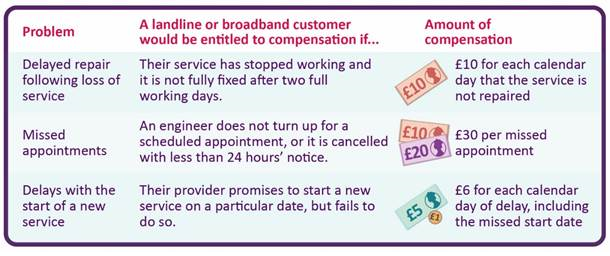
We estimate that our plans would mean up to 2.6 million additional customers could receive up to £185m in new compensation payments each year. Currently, there are 7.2m instances where landline or broadband customers suffer delayed repairs, missed appointments or delays to new installations. Financial compensation from companies, totalling around £16.3m, is currently paid out in 1.1m of these cases.

Around one-third of small and medium-sized enterprises choose residential landline and broadband services and would also benefit from our compensation proposals.

We are consulting until 5th June and plan to publish a statement at the end of the year”.

With best wishes

Helen

Reassurance to all EU citizens living and working in the Wokingham constituency

I have always said to those worried that I am sure all EU citizens living and working legally in Wokingham now will be free to stay if they wish after Brexit. The UK government has always indicated that is it wish, but pointed out we need the same assurance for our citizens living on the continent. At last Mr Juncker, the President of the Commission, seems to have said as much. He regards, he says, such a matter as one of “respecting human dignity”. He said “This is not about bargaining”. Exactly.


I will continue to press the EU to do the right thing, as I want all to be reassured that there will  be no forced evictions of people following Brexit. I know we all in Wokingham want those full reassurances. We seem to be much closer to them today.

The President of the Commission gets it right at last

Mr Juncker in his recent interview at last acknowledges that granting the right to stay and to work on the continent for all those UK citizens who currently do so is “about respecting human dignity.” He now says  “This is not about bargaining”.

I have been a sustained critic of the EU’s refusal to live up to decent values and reassure all UK citizens living in the EU that they are free to stay if they wish. I am therefore glad The Commission has now shifted its position. I have long been reassuring all EU citizens in the UK who ask that they will be welcome to stay and work here if they wish, as I assumed the EU would not in the end throw UK citizens out. It is just bizarre that it has taken them so long to say so, and strange that even now it is  not a formal statement by the rest of the EU as a whole.

If anyone in the UK remains worried about the EU’s intentions then they should write and lobby the Commission and their MEPs. The UK government has always been clear it does not intend to threaten EU citizens living in the UK.

What should be the age to receive your State pension?

We have received a couple of reports this week discussing the age at which people should be entitled to a State pension based on their NI contributions.

Current policy is to raise the age from 65 to 66 in 2020, and to 67 in 2028. As people live longer, so the cost of their pensions rises without a proportionate increase in their contributions over their working lives. Whilst the state retirement scheme is a pay as you go one, where each generation pays for its parents generation out of current NI payments, individual pension entitlement is still based on your past contribution record.

The Cridland report suggests raising the age to 69 between 2037 and 2039 and going higher thereafter. The Government Actuary suggests 69 by 2053-5, with another variant bringing in 69 as early as 2040.

The Report also raises the issue of whether after the end of this Parliament there should be some change to the triple lock. Currently the government is pledged to increase pensions each year by the highest of earnings, prices (CPI)  or 2.5%. Dropping one or two of these requirements could make progressive savings to the total cost. In recent years the 2.5% minimum has meant pensioner incomes rising faster than incomes in work.

I would be interested in your thoughts on all this. There does seem to be a good case to say that as longevity rises there should be a proportionate rise in the pension age to keep some balance between an individual’s contributions when working and their pension receipts. Allowing the triple lock has helped narrow the gap between pensioner incomes and working incomes. There is an issue in how much further people think that should go.

The events at Westminster yesterday

I send my condolences to the family members of those killed by the assailant yesterday and my best wishes for a speedy recovery to all those injured. The death of a policeman  is especially sad. It reminds us of the risks some state employees run in the course of duty, and strengthens public gratitude for their service.

It is right that Parliament resumes its work today. The Prime Minister spoke well on how we should respond.

The Brexit opportunity – a new fishing policy

It is time for us to consider how the UK should use its new won powers of self government once the notification has been sent that we are leaving.  The Repeal Bill should more properly be called the Great Continuity Bill, as it will simply confirm all current EU laws and policies as good UK laws and policies. As soon as it is through the UK Parliament can then get to work amending and improving the inherited law. The most obvious place to start is fishing.

The UK as a sovereign country again can establish its territorial waters out to 200 miles from our coast or to the media line with another country’s seaside. The UK can decide what regulations to impose on fishing in these waters. Out must go the idea of quotas with discards of dead fish. The first new rule should be that the fisherman lands all his catch, rather than waste dead fish by putting them back.  With modern technology the Regulator could see what is being caught and could if damage is being done to our fishing grounds require the fisherman to move on or amend his fishing practice. A local regulator should be able help fishermen choose the right net mesh and find the best locations to take more of the fish we want to catch and avoid more damage by catching too many of the wrong size and kind of fish.

The UK will of course need to discuss its new arrangements with neighbouring countries, including Iceland and Norway outside the EU, and France and  the Netherlands inside the EU. There is also the issue of current rights to quota held by Spanish and other fishing interests. Do you think there should be some kind of transitional arrangement for those who have bought businesses and quota? What rights will these fishing businesses have when we decide to change our approach and are no longer under the control of the Common Fishery policy?


The UK will be a full member again of the world bodies for fishing.

The extreme Centre

I see Mr Blair and others are out and about complaining that the centre is not strong enough. He thinks the centre ground needs reinforcing, as he dislikes the way it is assailed by Brexiteers of all persuasions, and by the Corbyn tendency in the Labour party. He still sees new Labour as ideal, as the perfect balance between “the extremes”. It is high time this piece of self serving nonsense was exposed to some criticism.

The problems with New Labour were their three main extremisms.

They took an extreme view about UK intervention in Middle Eastern wars, believing we could use military force to create liberal democracies in various Middle Eastern countries. The public disagreed, and the results of their military actions despite much bravery and heroic effort by our forces were disappointing. They did not understand or manage the politics of the MIddle Eastern countries well, relying too much on force.

They took an extreme view about the ability of the economy to withstand a huge build up in public and private debt and credit, before making an even more extreme judgement to bring some banks crashing down for no good reason. They told us they had abolished the boom-bust cycle, only to preside over the biggest boom-bust since the Great Depression of the 1930s.

They took an extreme view about EU integration and government. Whilst telling us each Treaty was a mild tidying up exercise with all the potency of the Beano, they signed the UK up to a comprehensive cradle of laws and controls making democratic government in the UK difficult. They always denied the public a referendum vote on their centralising tendencies, always denied their significance, and always claimed when challenged that EU laws were for the best regardless of what they said. Their EU actions led directly to the referendum which they helped lose.

Mr Blair needs to grasp that the world has moved on from New Labour. We now know their economic claims were false, as their era ended with major recession and banking crash. We know their EU policy was based on the lie that the EU was only of interest to Conservatives, and that nothing important was happening. We know their policy of favouring large corporations and encouraging cheap labour from the continent to take the low paid jobs they created was not popular with many voters.

UK inflation lags behind US and Spain and is close to Germany’s

The countries experiencing some reasonable recovery in demand are all experiencing an upturn in inflation of a similar magnitude. Slow growth economies have also experienced a rise thanks to oil and commodity prices, but less so than the faster growing ones.

Spain leads the pack with 3% inflation, followed by the US with 2.7%. The UK at 2.3% is close to Germany at 2.2%.

This is not some Brexit related phenomenon!

BBC and Brexit

I signed the letter about BBC coverage of Brexit which was published today. On Radio 4 there is a never ending repeat of the same tired old story that some people think Brexit will damage the economy sometime soon, whilst ignoring all the evidence that the economy has been quite unaffected by the Brexit vote so far. There are all too many pieces trying to whip up criticism of possible changes post Brexit, and practically nothing on what are all the opportunities for improvement once we take control of our own money and law making.

I look forward to a few months when they explore the upsides as thoroughly as they have explored the downsides. Is the BBC really happy with the way EU tariffs discriminate against the agricultural products from poorer countries outside the Customs Union? Do they think the Common Fishing Policy has been a commercial success and an environmental triumph? I would be happy to offer some balance to their coverage, if only they would let me make the case for the things we can change for the better once we are out.

Digital radios

There are a few cases  of newer technology that is not as good as older technology. I need to mention digital radio.

Like everyone I was made to go out and buy replacement digital radios when they changed the old broadcasting system. The fm service seemed to get fainter as they promoted digital.  They said they would be better.  I was supplied with a digital radio in my most recent car. They are worse than the ones they replaced, as well as being dearer. Nor was it environmentally friendly to have to ditch all the older radios which still worked fine all the time there was a signal for them to pick up.

There are places where my car radio now cuts out in the middle of busy areas because reception is poor. I used to get uninterrupted reception in these locations on the old system. The home radio needs to  be switched on two to three times before it will work. It does not give you instant reception with a simple turn on/off button as the old radio did.

There is one room in the house where I cannot get good reception, and can only get some signal  by balancing the radio high on a bookcase and adjusting the way it is pointing from time to time. When leaving the garage the car  radio repeats itself.

In another room reception varies depending on where a person is in relation to the radio.

Whilst most modern technology is so much better than last century, digital radio is temperamental, poor quality and frustrating to the listener.