The Consumer Council for Water (CCWater) is the statutory body for water consumers and they have a service for complaints about water supply and sewerage service. They have provided contact details should you need to make a complaint.
The Consumer Council for Water (CCWater) is the statutory body for water consumers and they have a service for complaints about water supply and sewerage service. They have provided contact details should you need to make a complaint.
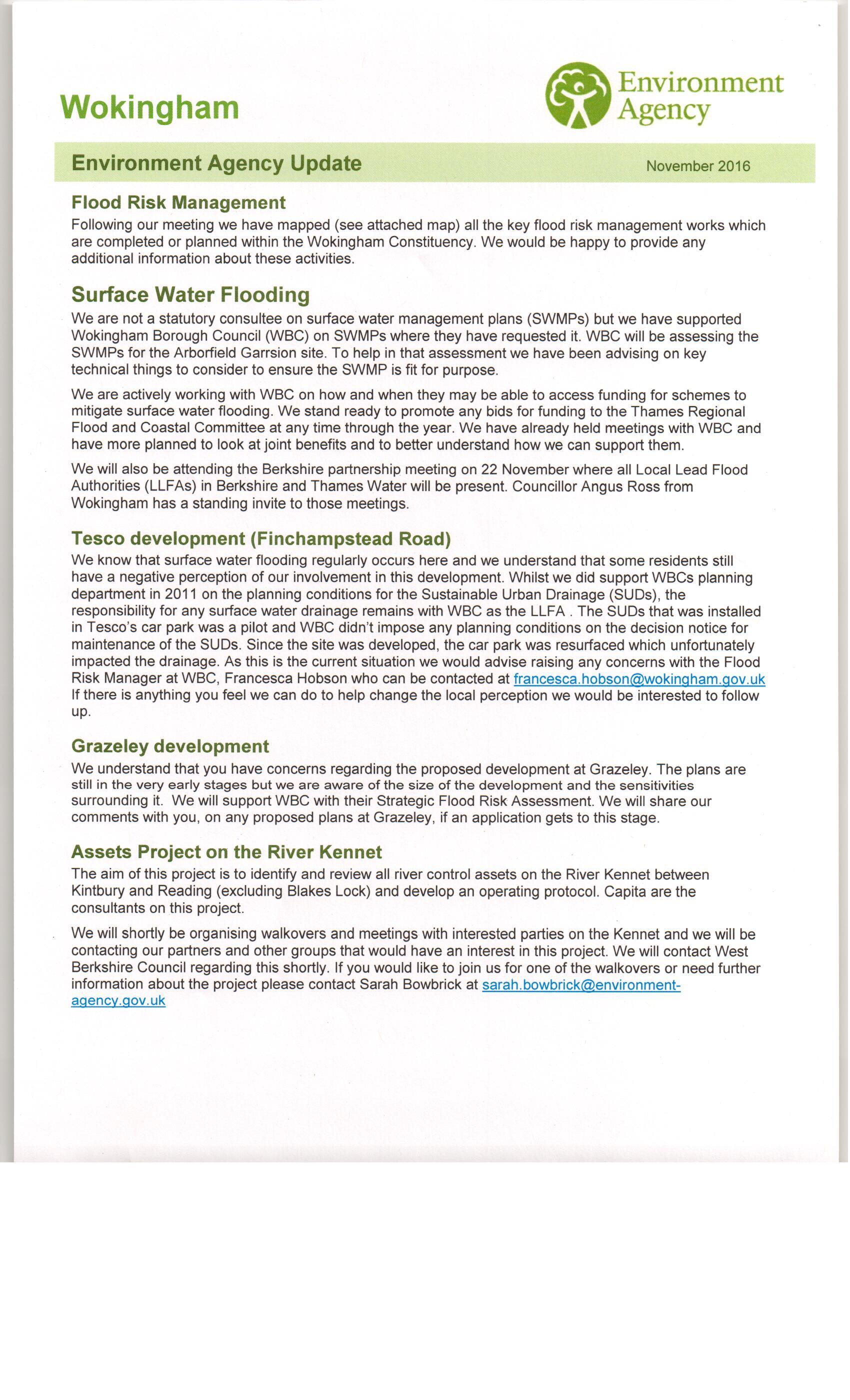
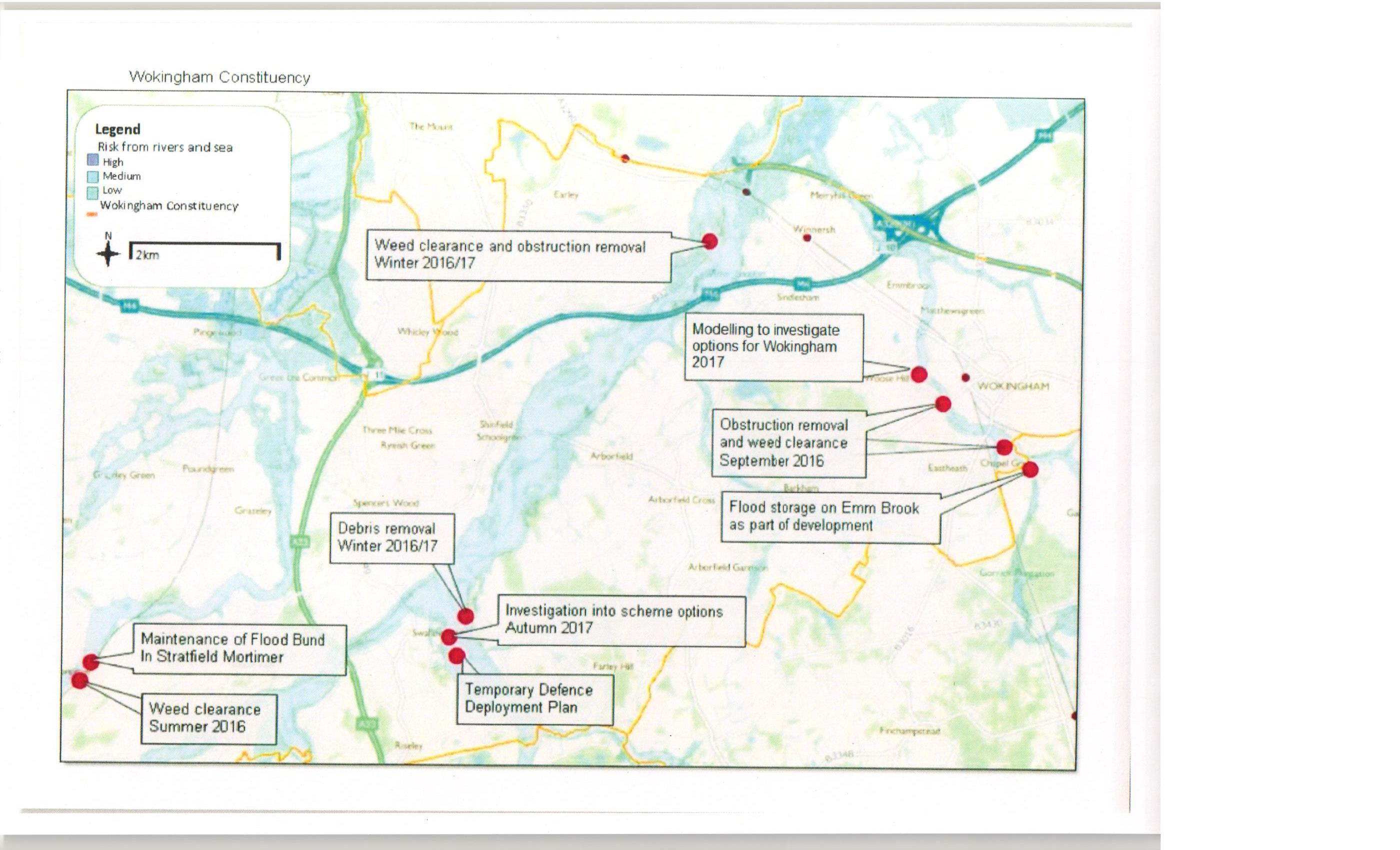
Further to my meeting with the Environment Agency, they have provided me with an update on flood risk management.
Yesterday showed unemployment falling to 4.8%, the lowest since 2005. Wages rose by 2.3%, well ahead of prices. Price inflation fell back despite the Bank’s continuous assurance of inflationary problems ahead, though it might rise next year. Property companies reported increases in rentals, and gloomy valuers only managed to shave a little off central London capital values, where they had been forecasting a big hit after the vote. The workforce participation rate rose to a healthy 74.5%, ahead of the USA and continental countries. Google announced a major new investment in the UK. A major housebuilder told us sales were 19.5% up.
The money supply is accelerating into a a double digit rate of growth, and bank credit is also growing well. All this points to the UK being the fastest growing of the advanced countries this year, and indicates next year too should see good growth. It is high time the gloomy forecasters admitted their mistakes and hiked their 2017 forecasts.
The OBR and the Treasury also need to lift their forecasts. It would be quite wrong in these conditions to feed the Chancellor low forecasts for growth for next year. These would tell him the deficit will be higher, thanks to lower revenues and higher welfare spending. Instead the truth is likely to be very different. I am sticking with 2.2% for next year’s UK growth rate. Given the latest figures it is difficult to see why it should be lower.
Today’s retail sales figures, showing a record rate of growth of 7.4%, confirm the trends.
I have reworked some remarks I made in Parliament recently. It is background to the current debate about whether Parliament should immediately get on and approve a short Bill to send the Article 50 letter, or whether the government should continue to seek to reverse the strange decision by the High Court of England, effectively in conflict with the High Court of Northern Ireland, over how to handle our exit from the EU. As someone who thinks exit does have to be passed by Parliament I am all in favour of pressing on, as I believe there is a clear majority for an Article 50 letter, which is why Labour has never tabled a motion to stop one as they could have done! I do not think these large constitutional issues are ones for the Courts, but are for Parliament and people to decide.
17.4 million people voted to leave the EU.
That’s more people than have ever voted for a new government in the UK.
We voted in good faith
We voted knowing exactly what we want our country to do
We voted in optimism, expecting a better future out of the EU
We voted knowing many experts thought it would do substantial short term economic damage
We thought them wrong, and so it has proved
We voted to leave.
We did not vote to stay in parts of the EU
We did not vote to carry on paying them money or accepting their laws
We voted to take back control
We voted to have our own borders policy
We voted to spend our own money
We voted to be able to make our own laws
We voted Leave because we want to live in a democracy again
To live in a country with its own sovereign Parliament
Serving a sovereign and free people
To live with the freedoms, rights and responsibilities our ancestors fought to give us
We voted to transform this puppet Parliament into a proper Parliament again
17.4 million voters understood our liberties had been pillaged
Our voting rights eroded
Our control of our laws had been stolen away
Some of our taxes had been taken to spend elsewhere
We have been lied to
We no longer believed the endless reassurances that we still had a UK democracy
That we still had a sovereign Parliament
Under pressure they told us we were still sovereign because we could leave the EU that took so many of our powers
So we took them up on that promise
The people have spoken
What part of Leave do some in the establishment not understand?
On May 24th I spoke in Parliament
I explained why it is a puppet Parliament
I reminded MPs of how impotent Parliament has become
Unable to change benefits, when government and opposition was united in wanting to
Unable to control our borders
Unable to abolish VAT on tampons and green products
Unable to make our own decisions about so many things from energy to the environment, from tax to trade
I asked if the people will do what Parliament feared to do
Would the people demand that we stop this charade of power
And take back control?
We now know the answer
So today the question is
Can this once might Parliament be mighty again?
Does this Parliament have it in it to take back control?
Does this Parliament accept that all its true power comes from the people?
And all its power has to be used in the interests of the people.
Today we must pledge to do as the people decided
The people are merely telling us to take back powers so needlessly tossed aside
So we can again do good for them
So we can again carry out their will
So we can restore to the Mother of Parliaments her full dignity
Or else perish at the next election
Are there enough MPs willing to sweep aside this puppet Parliament?
Enough peaceful Pyms and Hampdens wishing to empower us again?
There are still strange forces trying to impede the popular will
This Parliament needs to tell the courts we must send an Article 50 letter
We need to show an earnest urgency to do what the voters told us to do
It need not be difficult to take back control
It does not need Mrs Merkel’s consent
Or is this now a House of people who fear to take responsibility?
Are we but shadows of past glories
Still marionettes in the Brussels drama
Still too timid to step into the light of accountable power?
Of course not
If the people can be brave
Surely we can follow
If the voters get it
So must the establishment
The High Court of Parliament answers to no UK or English Court in matters of the constitution and high politics
Soon we will no longer bow to the courts of Brussels either.
Lets take back control
Send the letter
Leave the EU
Reunite voters with their Parliament
Dear President elect
Congratulations on your election. As one of the few UK and European politicians who did not seek to interfere in the US election or seek to regale a little interested world with my views on the candidates, I can now say I was impressed by your wish to see more rapid economic growth with more jobs, higher incomes and lower taxes. I understand the wish of many in the USA to see the US make more things for herself, to enjoy rising living standards, and to benefit from a modernising and expansion of US utilities and transport systems.
Your tax reforms should generate more corporate income onshore, and more jobs and individual income. There will be a laffer effect, as more activity generates more revenue despite the lower rates of tax. You will doubtless be told this will be small or insignificant. I trust you will have good advice to make a sensible case so foolish forecasts of ballooning deficits are not used to thwart reasonable reforms. In the short term the tax breaks may well lower individual and corporate income tax receipts, but repatriating substantial sums from abroad could offset these early effects.
The large infrastructure programme can be substantially financed in the private sector, where the US has a tradition of user charges and tolls. This too will help keep down the debt and deficit consequences which will otherwise concern fiscal Conservatives. The right investment can help boost productivity, the way to higher real wages. Supporting more locally produced energy will also help boost jobs and manufacturing. These proposals need to be the cornerstone of the early actions of the new Administration, to use the political advantage of the election result for something which should draw support from across the divide, and which takes time to bear fruits for electors to see.
I was also interested to hear and read of your scepticism concerning past military interventions in the Middle East, just as I have been worried that my country has joined in common actions that have not left behind or helped create new stable regimes or bring about peace. I am sure you share many western concerns about the intents and actions of Russia, but it may well be better to draw Russia into dialogue as Mr Obama was seeking to do in recent days given some common ground on Islamic terrorism. There is war weariness and concern amongst many of us in the west about past military actions which have not left societies at peace with functioning governments.
I wish you every success in choosing good people to run your Administration, and in pursuing the path to prosperity and peace.
Yours sincerely
John Redwood
Why did you let the banks expand credit far too much prior to 2007?
Why did you bring several banks down by refusing liquidity and not backing schemes for bank recovery,leaving others badly wounded in 2007-8?
Why have you gone for Quantitative easing and ultra low rates, which damages small savers and helps the super rich at the expense of everyone else?
Why didn’t you get on with the task of encouraging and enforcing recapitalisation of the banks so we can have a normal credit creating system again capable of financing recovery?
Why did you bring down a dictator in Libya without having a plan to rebuild a better government and society?
Why did you go to war in Iraq?
Whose side are you on in the Syrian civil war, and how is western military action helping?
Can you bomb people into accepting democracy?
Why did you back the Exchange Rate Mechanism, the Euro, the Remain campaign and the Clinton campaign, and what do you think of how they have done?
Why should people trust the economic and political judgements of the World Bank, the EU, the IMF, the Bank of England and the rest when they have got so many forecasts wrong?
There is one theme in common between the very different Brexit and Trump campaigns. Both drew strength from the growing hostility to global government, global treaties, neo con military interventions. Both challenged the arrogant assumption of superior wisdom and moral right adopted by a gilded elite flitting between the large corporations, quangos and governments of the advanced countries, claiming they know best and should be allowed to get on with it unchallenged.
In the case of the UK there was a strong feeling that a largely unaccountable use of power by the EU institutions was not what electors want. We accept that national governments make mistakes and may annoy us, but they are mistakes we can criticise and do something about . They are governments we can persuade to change or politicians we can remove from office if they stubbornly persist in doing the wrong things. We have little power or influence to change EU taxes , budgets and laws, and find that the rigid Treaty based legalistic approach makes normal democracy impossible. This is even more true for Euro members as Greece and its chosen government, Syriza discovered.
We remember the litany of disasters the so called experts and elites have visited upon us – their Exchange Rate Mechanism recession, their Banking crash slump, their Euro with running crises attached, their dear and intermittent energy which often produces more carbon dioxide overall, not less. On both sides of the Atlantic politicians struggle to explain why lower incomes remain depressed and why so many jobs have been exported abroad.
In the USA there was a feeling that their Washington elites – of both major parties – have embedded too much in global treaties too. They felt their trade and global warming treaties did not take into account the need for more and better paid jobs at home, and the important role cheaper energy plays in industrial renaissance. In both countries there was an anger about the elite idea that we in the west know best how Syria, Iraq, Afghanistan and other Middle Eastern states should be governed, and have a moral duty to bomb their cities and train rebel groups in those countries to effect violent change.
The gilded elite lacks awareness of its own moral insensitivity. Why did Mrs Clinton think it a good idea to spend valuable campaign and air time in the last week fraternising with rich celebrities, rather than making it her business to see what she could do for out of work steelworkers or middle income Americans facing huge health insurance premium hikes from Obamacare? Why did she think it right to organise a large fireworks celebration of her victory before she was secure in that aim? Why did she not see that the big money she raised from corporates for her campaign posed presentational problems and would not guarantee victory just because she had more cash to spend than her rival?
There are so many examples of the elite rewarding itself too generously from public funds, living on donations from companies whilst claiming they have bought no influence, and meeting in private gatherings where the corporate financiers of it all can rub shoulders with the political leaders. If the governments do not deliver what people want, voters get suspicious of these methods.
Mr Trump’s slogan “Drain the swamp of Washington” resonated. It will be interesting to see if he can do it. A good start would be tough limits on how much a candidate can spend in an election, just as we rightly have here for individual constituency campaigns.
When we leave the EU we will be able to change our procurement rules for the public sector. I would like to see a greater presumption that we buy things from local and UK suppliers where there are appropriate goods and services available with more than one competitor for the business.
We can under EU rules buy more from the UK in the area of defence. It us good that our new aircraft carriers, for example, are being built in the UK with UK steel.
Yet we are buying armed vehicles from Germany, and the steel for our subs is coming from France. The Defence department should work harder to make sure we have the capacity here to meet our needs. Surely an order for 800 armoured vehicles could provide sufficient workload to offer a worthwhile invetsment for a UK factory?
The UK is a huge importer of many things needed to build homes. We import large quantities of tile, bricks, kitchen and bathroom assemblies, central heating boilers, taps, valves, copper pipe, and many aluminium and steel items. As the government and Councils are large builders in their own right directly and through the Housing Associations why not demand a higher UK component in the new homes, or choose specs which UK businesses have a chance of delivering?
I am always struck in France at how much public procurement there buys French, even whilst operating the EU rules. Freed of the EU rules we should be able to do better than our neighbours in this crucial area.
Let’s have another go at explaining why many of us want to leave the so called single market, whilst having access to sell into the EU internal market.
As Single market Minister who “completed” the single market in 1992 according to EU false statements at the time, I remember an endless procession of businesses lobbying me to water down, delay or scupper law after law the EU thought necessary for more trading. Business did not see these laws as helpful on balance when they were being brought in. The one that would have made the London Stock Exchange’s trading system illegal was a good example of the kind of problem we encountered. Having a Eurosceptically inclined Minister was a reassurance to them that I would battle to avoid disaster for them.
As a past Chairman of two global manufacturing businesses I always found it easier to do business in the USA and Asia than on the continent, despite the alleged advantages of the single market. As a Company Chairman I did not use my position to intervene in the political debate about the EU and its market. I was very conscious that I had responsibility for many livelihoods, that I represented employees of all political views, and had to sell to customers with an equally wide range of views. I kept the companies I led neutral on politics, and did not seek to know an individual’s politics or discuss UK party politics with employees.
When trying to do business on the continent I sought to select executives keen on the EU project with the necessary language skills to speak to each target market in their home tongue. Where possible we recruited nationals of the country concerned, as we were well aware of the cultural and linguistic barriers to more EU commerce. Despite this it usually proved impossible to sell manufactured product into Germany, even where we had a technical or competitive advantage that was appreciated in many other places.
It is true some of the businesses I was involved with in the past had complex supply chains involving procurement from places on the continent. They also had procurement from India, China and the USA as part of the supply chain. There was no noticeable greater complication in using the non EU parts of the supply chain. All was judged on assessment of value for money, seeking high quality at affordable prices.
I did not find the so called single market helped us much and were I still in post I would not be too worried about departure from it. I did find the European Exchange Rate Mechanism did a lot of damage with the recession it caused, and always avoided business in countries like Greece, Portugal and Spain given the damage being done to their economies by the Euro.
All year I have been told that Brexit could not win, and Mrs Clinton was a shoe in. All the clever and well educated people were quite sure of these “facts”. They were critical of anyone who suggested UK voters might want to leave the EU, or who dared to venture there might be quite a lot of support for Mr Trump. They were confident because the pollsters told them their preferred outcome was going to happen. They were unsighted on the attractions of the alternative view, leading them to believe someone would have to be stupid to vote for it. They assumed their priorities including freedom of movement, tackling climate change, intervening in Middle Eastern conflicts and the rest were also the preoccupations of enough other voters.
I predicted the UK vote for Brexit correctly because I listened carefully to opinion outside London and Scotland. My only surprise was that the vote was not even higher to leave given the mood and opinions of the majority. Doubtless the tragic death of an MP towards the end of the campaign, and the relentlessness of Project Fear clipped some support from a popular cause. I did not call the vote for Mr Trump because I am not an American voter, and I did not visit the USA to hear for myself on the ground what people were thinking. I did however think it quite likely Mr Trump would win. I was always careful to write about his candidature as a serious one which might win.I afforded equal protection to Mrs Clinton and Mr Trump from bloggers who wanted to be disobliging about them.
I formed this view of Mr Trump’s campaign from reading his website and comparing it with Mrs Clinton’s. Both were professional. Both contained serious policy recommendations. His was more focused, and spoke to the main issues US voters were likely to worry about, hers was wider ranging, lacked focus, and did not seem to grasp the concerns people had about their jobs, their wages, and the security of their local communities.
Last week I asked UK observers of the election who generally thought Mrs Clinton would win to tell me what the slogans were of the two campaigns. Most could name “Making America great again” for Mr Trump. Most struggled to remember either “Stronger together” or ” I’m with her” for Mrs Clinton. That summed up the impact of the two campaigns. Mr Trump had a popular optimistic slogan which could mean what the voter wanted it to mean. Mrs Clinton had a self serving slogan about her which did not cut through. Mr Trump offered people no tax on income below $25,000 a year, and the promise of more jobs from putting America first. Mrs Clinton’s offers were more detailed and diverse.
If the media, the pollsters and the establishment commentators want to be taken seriously, they have to remember the fundamental principles of democracy. Any main candidate running for office might win and deserves a fair hearing. Whilst I am the last person to say commentators should not be partisan, a good commentator understands the other point of view and seeks to explain it as well as criticise it.
The worst feature of some reactions on both sides of the Atlantic is the one where people say “He is not my President” or refuse to accept the verdict on Brexit. I wonder if the next move of Mr Trump’s critics will be to claim the US election was just an advisory vote which does not entitle him to assume office as the wrong person won? Or will they go off to the courts to try to block the decision?
I was on the losing side in General elections in 1997, 2001 and 2005. I thought it was a fair cop, given the damage the Conservative government did with its fashionable establishment policy of belonging to the ERM. I accepted Labour’s right to govern and to implement their Manifesto. I with colleagues took up the task of opposing where we judged it wrong, or where we thought it could be improved. We never said the elections were wrong or Labour had no right to govern. I often agreed with what they were trying to – I became, for example, a fan of much of Mr Brown’s tax policy.