Who are the West’s enemies in the Middle East?

I have read enough to know how little I understand about the complex theological and political struggles within Islam, and about the large number of differing terrorist groups operating in the wider Middle East. I do not speak or read Arabic and have not read enough  of the literature or history of these  very different countries. I have read enough to be suspicious of simple solutions seeking to elevate just one group into a position of being the only or main problem. I wish in this blog to pose some questions to those who do know more, and to those who seek to frame our strategy towards the region.

Time was when the enemy of the West was the Taliban. Today they have been brought into Afghan society and  form part of the democratic dialogue. Then the enemy was Al Qaeda. They have not gone away and still exercise considerable influence in a range of countries. Now the evil one is ISIS.

Recently news came that 7 people were brutally beheaded in Afghanistan by Uzbek fighters. Al Qaeda in the Arabian Peninsula has taken territory in Yemen and has a presence in Aden. Do these  present a threat to us? What should be our response?

Meanwhile Jabhat al Nusra seek to extend their influence  in Syria and Al Qaeda in the Islamic Maghreb increase their activities and smuggling profits in Libya. Does this concern us, or do we wish to co-operate with them because they are against ISIS?

Are we on the side of the Sunni or the Shia factions fighting the Syrian civil war? Or do we believe it is possible to form a Syrian democracy that can hold the peace between these two and offer decent civil rights to all?

The UK government accepts that it will need a political strategy for Syria to run alongside any bombing attacks. It seems to be seeking a new government of the whole of Syria, based on the military elimination of ISIS and the voluntary surrender of power by Assad. Does it wish to help a coalition remove Assad after the removal of ISIS? Does it believe Assad will go voluntarily? Who are the moderates and where are their forces who will fight for a vision of a united Syria under democratic rule? Who in Syria has the belief in toleration towards Christians, Sunnis and Shias and has the force to establish such a society? Will the West end up accepting the Russian view that Assad is the least bad option in an all too violent society?

By encouraging the Kurds to take action in the north of Syria we are encouraging them to gain and hold territory that they think should be part of a Kurdish state. What do we say and do if they want to extend that into Turkey against our wishes and against our Turkish ally in NATO? Who could establish a government for all of Syria who would have the Kurds confidence and persuade them to give up territorial gains they have made?

Is the West clear that it can help establish a united Syria at peace, or does the West think now there has to be partition between a Kurdish Syria, and a Sunni and a Shia one? Or does the West now accept that the days have gone when great Western powers could draw lines on a map of the Middle East to conjure states out of the rival tribes and the desert?

Either way, knowing who  our enemies are is crucial, and knowing who we might inadvertently help if we intervene on one side or another is important.
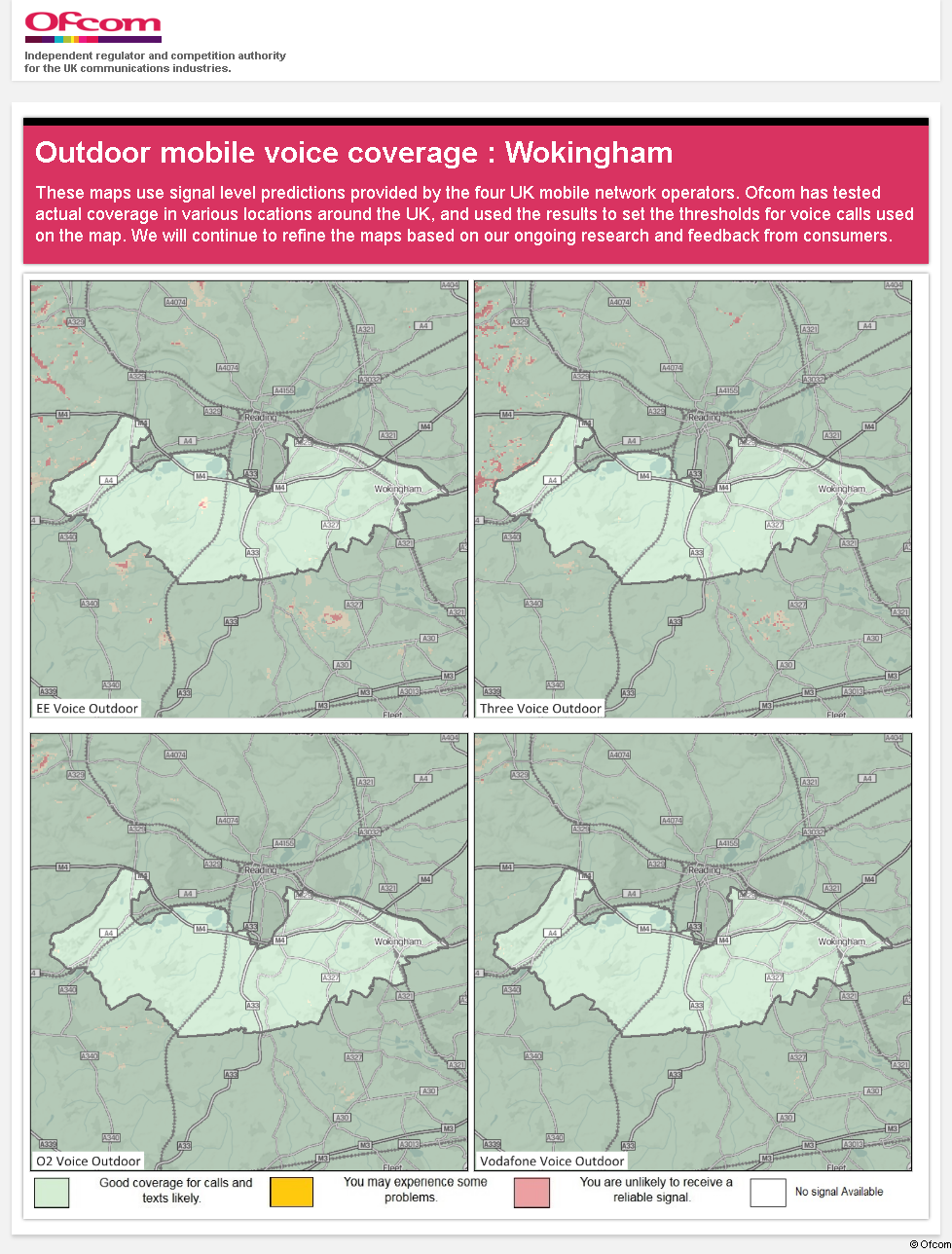
 

Mobile phone coverage in Wokingham

I have received the enclosed letter from Ofcom about mobile phone coverage in Wokingham:

Dear John,

In August we launched our online Mobile Coverage Checker to help consumers check the coverage they could expect anywhere in the UK. Using data from the four UK mobile phone network providers, our interactive map shows the predicted level of coverage both in doors and outside. It shows coverage for voice calls, 3G and 4G data connections.

It has proved to be a very popular tool for businesses and consumers: with over 286,710 people using our maps since their launch and around 1,500 people still using the checker each day.

I thought you might find it useful to see what the predicted mobile coverage is for voice calls in your constituency.

Outdoor mobile voice coverage

We also thought you might be interested in highlighting the checker to your constituents, who can use it to give us feedback for the local area. The feedback we get from the public is really important in helping us improve the maps, as people can tell us whether their experience matches what our database tells them – more than 4,000 people have done this so far. Please feel free to tweet or post on Facebook about the online tool. If you want to highlight the tool locally you might want to tweet or post something like:

“Want to know what mobile coverage you can expect in Wokingham? Have you tried the @ofcom mobile coverage checker? http://t.co/gYVvMG4Lj2

“Want to know what mobile coverage you can expect in Wokingham (even inside your house)? Try the @ofcom mobile coverage checker and let them know what you think! http://t.co/gYVvMG4Lj2

Because of this feedback we are able to update these maps monthly and do testing of our own to validate the coverage data from mobile phone networks. And we have plans to develop this tool further and will be rolling out improvements in the New Year.

Later this year, we will also be launching a mobile ‘app’ for smartphones and tablets, which will allow people to test their Wi-Fi connection. We estimate that consumers’ home broadband experience may not be working as well as it could in around a fifth of UK homes. The new app will help identify if someone’s broadband isn’t performing as it should be, and suggest simple trouble-shooting tips to help address it.

So please let me know if you would like more information on Ofcom’s work on promoting better mobile coverage and how we are helping consumers get the best out of their contracts.

Yours sincerely,

Sharon White
Chief Executive

Meeting with Minister on aircraft noise

Yesterday I chaired a meeting with the Aviation Minister, Mr Goodwill in my room at Westminster. Also present were Philip Lee, MP for Bracknell, and John Howell, MP for Henley, and two officials from the Transport department.

I explained the background to the change of air routes over the 3 constituencies represented at the meeting. I asked the Minister to require NATs and Heathrow to go back to the position before the trials of new routes. In particular I asked that he requires planes to fly considerably higher over our part of the world, and to disperse both take off and landing approach routes as used to happen. All agreed that slowing planes on their way in to the UK to cut the number of planes stacked over built up areas would be a win win, saving fuel and reducing noise and risk. It is possible to remove the need for stacking any planes over built up areas. All agreed flying higher would help cut noise.


I will follow up with the Minister when he has time to consider our submissions.

Defending the UK

The Defence Review answers some of the criticisms  bloggers on this site have made in recent years. The order for new fast stealth fighter jets has been increased, meaning the new aircraft carriers will have planes to fly from them. The maritime reconnaissance role will be served by  new planes, after a gap in UK capability. 8 new frigates will be ordered. The new carriers are well advanced in build. When they come into operation they will have frigate, destroyer and submarine protection.

The army will receive more new armoured vehicles, with a larger mobile force available to intervene, or support allies. Up to 10,000 troops will also be trained and available to reinforce the police at home should there be dangerous terrorist attacks requiring a forceful response.

I raised with the Prime Minister the issue of control of our borders. I welcome the  additional cash and personnel to strengthen our intelligence gathering. We can only keep safe if the authorities stay ahead of the threats to our way of life, and use the intelligence they have gained to good effect. I suggested that our borders be strengthened with specific links from the Intelligence services to the  border management, so that if for example terrorists are displaced from the Middle East by military action there they cannot gain entry to the UK, whatever their legal status, if their aim is harm or they are trained in terrorist ways. He accepted that more should be done to tighten border controls.

I also raised with Defence Ministers after the statement the need to continue to press for better value for money within the defence budget. In particular more can be done to release MOD land in places where it has substantial development value, and to provide new and better facilities elsewhere for our service personnel. I also relaunched my proposal for better assistance to service personnel in buying their own home. Everyone in the military should have a home base. They should be helped to buy a home of their own near the base in the normal way. Alternatively if they are using married quarters or other  service housing on a base they should be able to buy an interest in  it from the MOD for the duration of their time in the services, only to sell it back at a profit based on an agreed index of comparable freehold property prices when leaving the service. They would then have a deposit for a home of their own.


Airport noise

Last week I held a meeting with an experienced airline pilot captain who has flown many times into and out of Heathrow.


He confirmed what many of us have worked out. NATs changes have meant there are more flights that are concentrated along the same route. The old dispersal pattern has been ended. There are also many more flights that are lower over the Wokingham area.

There are several simple ways this problem can be remedied, if only the airlines, Heathrow and NATs will seek to do so.

  1. Planes taking off should use fuller power for a bit longer to get higher sooner. This does not mean burning more fuel overall, as fuel use decreases sooner when the plane is higher. Getting planes higher sooner will spare many more homes beneath.
  2. Planes coming in to land during easterly operations should stay higher for longer. They should also avoid lowering their undercarriages prematurely as many do today, to  both save fuel and cut noise.
  3. NATs should revert to asking planes to take diverging pathways out so no one line of route is subject to continuous noise all day and evening.
  4. Heathrow and NATS should plan arrivals better to avoid large stacks of planes flying and turning corners at relatively low altitudes over built up areas.

I am going to put these and related points again to Ministers, Heathrow and NATs.

Brexit would be such sweet change

The EU is something which happens to us daily. It means laws we do not want, bills we do not want to pay.

Those who urge us to stay in are usually the rich few older men who gave done well out of the EU themselves. A narrow elite of believers has been given the well paid jobs in government and multinational business. They push out the mindless and threatening propoganda to try to keep us in thrall to their bureaucracies, and to retain us paying their bills.

Those of us who want fewer laws and lower taxes have no part in the EU world. We are not wanted. Socialists are similarly ignored, as their views do not fit in with the austerity the EU wishes to visit on member states so it can carry on spending on itself and demanding tax revenues for its own purposes. The elite always knows best. It bullies the rest of us into submission or cold shoulders those of us who will not be bullied. It is not our EU, it is their EU. We are just made to pay for it. They offer us votes in European Parliament elections, but ignore the results in any country which votes against their views. Most people don’t bother to vote, showing they don’t feel part of it.

When the Germans ask me what do I want from the negotiations I say I just want one thing- the restoration of UK democracy. The easiest way of doing that is just to leave.

Every time the EU adopts a disastrous policy, it seeks more power and control for getting it wrong. When they made so many poor with the Exchange Rate Mechanism, instead of learning from it they decided to make even more people poor for longer by adopting the Euro.

Today they destroy industry and close plants in the UK from their energy and climate change policies. Their answer to the problems is to do more of the same to make us even more dependent on EU wide scarce and dear energy.

They make the EU vulnerable through their open borders policy. Now the damage that does us clear they seek more EU wide powers over security and intelligence.

Every EU created crisis leads them to demand more EU. It is high time the UK declined and regained its freedom.


The noise abatement message on the M4

I have put the case to Minsters for more noise abatement on the M4, and am doing so again in conjunction with Wokingham Borough representations to the Planning Inspector. I am asking for noise barriers as well as lower noise surfaces on all sections of the M4 running past affected residential areas in my constituency, including Earley, Winnersh and Sindlesham. I have put in new anti noise submissions to the Planning Inspector, following past representations, and am also putting them again to Highways England.

Councillor Norman Jorgensen urges more noise abatement on M4

News on the Highways England proposal for the M4 Junctions 3 to 12 Smart Motorway

I attended and spoke on noise abatement and local traffic at the Planning Inspectorate Open Floor Hearing in Reading on 16 November. It was good that several other Earley residents also spoke.

Highways England has already agreed to use lower noise tar on all lanes which will help reduce our noise. Councillors, residents and our MP John Redwood are pressing them to do more in noise hot spots throughout Wokingham Borough. I believe the Planning Inspectors have taken on board our pleas for more noise abatement to be built into the scheme where houses are close to the motorway and some form of barrier is appropriate. I also felt they had grasped the large number of people affected when I met the Inspectors on the Site Visit at Maltby Way, Earley on 10 November.

I also spoke at the Issue Specific Hearing on Environment on 17 and 18 November. This Hearing covered noise, traffic forecasting, air quality, visual impact and flooding. At this meeting the Planning Inspectors asked Highways England to include in their thinking enhancements (ie things above and beyond the minimum they must do). During the meeting Highways England indicated they will shortly publish an enhanced noise mitigation strategy and confirmed that consideration of noise barriers on the stretch of motorway passing Earley will be a priority. This is not yet a commitment to do anything further but significant progress I hope.

Following the Environment Hearing there was an Issue Specific Hearing on Road Safety which I also attended. The main concern raised during that Hearing was what would happen in the event that a vehicle broke down on a running lane at a quiet time. At peak times the detectors in the road would pick up the traffic queuing behind the broken down vehicle and alert operators to switch on warning signs. At quieter times how would other drivers be alerted and move out of that lane? It seemed the system currently proposed would sort that out after several minutes but there was increased danger in the minutes following breakdown. More work to do on that issue I think.

I was asked by the Planning Inspector to identify the location of houses in Wokingham Borough that are most adversely affected by noise and will do so by the 26 November submission deadline.

I look forward to reviewing the Highways England enhanced noise mitigation strategy once submitted in December or January.


Dr Norman Jorgensen

Member for Hillside Ward in Earley

22 November 2015

Does Syria need more bombs?

I am no pacifist. If a terrorist is about to  fire on us or about to blow us up, I am all in favour of our uniformed services shooting him. If a foreign power is about to invade us I support us having formidable fire power by air and sea to prevent or deter  the invasion. I accept that  the knowledge that we will retaliate is important to deterrence, so we need to keep open the likelihood of  retaliation against violence. The nuclear deterrent of course rests on understanding that in extreme circumstances a UK PM would retaliate. It works for us every day it is not used.

I also believe that violence can beget violence. I believe that politics and diplomacy is a better way forward in most cases than fighting. If you choose to  fight a war you also need to plan ahead for the peace. You need not only to see how you can win the war militarily, but also see ahead to how victory can lead to a better political settlement afterwards. Why enter a war you cannot win, or force a peace which is no better or worse than what it replaces? If you are retaliating you need to know who is causing you the trouble in the first place, so that the retaliation goes to the right place. Only a war of national self defence should alter observance of  these simple rules.

Some seem to be arguing that we have to respond to the terrorist attacks on France. They argue these attacks were outrageous – I agree – and that therefore we must do something. I also agree we need to respond to the current terrorist threat, and could do more to improve our resilience and reaction to it.

They then move to saying the thing we have to do is to bomb ISIS in Syria. This is a curious response to the French attacks. The terrorists in Paris came from France and Belgium. Those keen to bomb presumably wish to do so both to kill potential future bombers, and to retaliate for Paris. Fortunately they do not recommend bombing the suburbs of Brussels and Paris from whence the bombers came –  I would regard that as inhumane and counterproductive as I assume they do. But why then do they want to bomb the suburbs of Raqqa, when the terrorists did not come from there in this recent case? Are lives there of different value to lives in Europe? How can bombing ISIS embedded in a community help without ground troops to deal with them house by house, flat by flat?

The UK authorities also need to answer the question what magic could UK bombs do that US and French bombs have not already done? Why has bombing ISIS for months on both sides of the Iraq/Syria border not killed enough of them yet? It does not seem to me that Syria is short of bombs and bombers. It is very short of decent political leadership and good government.It is also still well short of a reliable army on the ground that could regain control over all of Syria with a  view to creating better government for the whole country.

I have no problems with  killing known terrorist organisers in the Middle East who have been responsible for organising mass murders there and abroad. Co-operation with the governing powers where they have authority is important when doing this. I do have worries about more generalised bombing campaigns seeking to kill imperfectly understood groups of terrorists embedded in civilian communities in Syria without the permission of the Syrian authorities and without clear intelligence on the ground from having enough people there observing targets. I do not wish my country to be involved in seeking change in Syria by force without having sufficient control or knowledge of local conditions. I dislike ISIS as much as the next person, but I do not think ISIS is the only or uniquely unpleasant extremist organisation we face.  If we intervene we need to back forces on the ground strong enough to take over in  Syria.Then they with our assistance  need to be able to put in place a government for the whole of Syria or for constituent parts of Syria that could command the support of the people it is governing and could govern peacefully.

Carry on spending! How will the Chancellor spend the extra £69bn a year by the end of this Parliament?

Next week’s Autumn Statement is about how to divide up the planned overall increases in public spending. Just to remind readers, the Chancellor plans to lift total public spending from £735 bn last year to £804 bn by the end of this Parliament.  That’s a total rise of £69 bn in cash terms. Inflation is currently zero. To ensure this increase gives us a good real increase in spending it is of course important to keep public sector costs down, just as the private sector is having to do in very competitive world markets.

Public spending rose again in cash and real terms last month, and for the year as a whole. When will all the austerity mongers accept that total public spending is rising, and has been rising modestly since 2010?

This time the increase is led by capital spending, but also includes rises in pensions, health, schools, overseas aid and European contributions. Over the Parliament as a whole a number of high spending priority areas will be given extra cash, so the Chancellor needs to find savings elsewhere to stay within the agreed increased totals.

As a result borrowing rose compared with the same month last year, and is leaving the government with a difficult task to keep borrowing down to the limits set in the last budget. As always, the strategy of cutting the deficit rests largely on rising tax revenues. This time corporation tax was not as buoyant as hoped. This is not surprising, given the collapse of revenues in the commodity and energy  areas, the continuing reductions in types of banking activity as the regulators squeeze banks more, and the very competitive conditions in areas like retail.

All this provides the  backdrop for the Spending Review to be announced next week. I am looking for some abatement of the proposed reductions in tax credits, as the cuts in these benefits for the lower paid need to follow wage growth and tax cuts, so people are not worse off as the changes come in. There is considerable comment about how the elderly are better protected with the reforms to the State retirement pension offering a better deal with rising real pensions and all the universal benefits guaranteed by Manifesto promises, compared to younger people in work. Maybe the Chancellor should carry his reform of public sector pensions further, to limit future rights to accrue more entitlements under favourable past provisions. Maybe he needs to look again at the state  retirement age, as on average people are living longer and staying healthier for longer, meaning an unexpected increase in total pension payments as well as great news for us all that on average we will live longer.

There are parts of the public sector which I have highlighted here which could do more for less. The two that spring most readily to mind are Housing Associations, and Network Rail. I trust there will be new proposals on their financing, to provide better  value for taxpayers money.

The reporting of the Spending Review will doubtless follow the usual Labour line of highlighting apparently large cuts in the unprotected programmes, taking a five year percentage decline in real terms or against previous budget. Few commentators will point out the modest  cash and real increase for the period as a whole for total spending , or remember the rises in some of the protected programmes. Most years I have been in Parliament the stories about public spending have been about the “cuts” yet every year total spending has gone up. Industry cuts its costs every year, doing more or the same with less. The possible gains in the public sector from applying modern technology could be substantial.