I’m taking the day off. Feel free to write in if you wish.
Author: johnredwood
Christmas Eve
Will Santa come for me?
May you all feel the excitement of Christmas.
( Here’s one I prepared earlier)
WILL SANTA COME TONIGHT?
“Will Santa come? Will Santa come tonight?” “He might. He might.
If you are good, he might.”
“Can I stay up and see?”
“No. He will not come for you or me If we do not sleep . He’s too busy to meet us all.”
“And will he come for us? If you go to sleep – he does not like fuss.”
Tonight, by the lights of the tree There is, at last, some grown up time for me.
The cake is iced. The wine is spiced .The carrots diced.
The pudding’s steamed. The brandy butter creamed.
The turkey prepared awaits. And yes, I did clean the plates.
The tree is up, the table laid, the cards are out , though the credit card’s unpaid!
So shall I soon with gifts a plenty mount the stairs to deliver twenty?
Do I dare to tread the stair?
And will it creak? And will it creak? When can I take a peek?
I need to know if they slumber before I arrive with my lumber.
If they are still awake what dreams will go? What heart might break?
Or do they know? And is their belief just all for show?
So tonight by the magic tree there is need of more time just for me.
I will wait – and struggle to keep open my eyes
And wrestle with the morality of eating Santa’s mince pies.
My adult mind is full of Christmas chores
The cooking times, and the cards through neighbours’ doors
The parties with do not drink and drive in my ears
So the night does not end in tears
Drinks that might have been – but not that cheap red
Which would give me a headache as soon as I got to bed
I was once a child too excited to sleep with a torrent of thoughts about what I might be given
Hoping that it was a toy beneath the wrapping – should I peep? –
Not more socks or hankies, preferably something to be driven
So could Santa still come for me? Drowsily I dream as if I were eight Hoping that Santa would not be late
Like every little boy there is of course a much wanted toy
So will Santa come tonight? He might, He might. If you sleep well and if you believe
Only if you believe. And only if in your family Love fills the hours you will be spending.
It could be the true Santa on the stair
Or it could be someone from an empty chair.
So will Santa come? He will. He will.
More money for social care
The government is now consulting on its draft local authority finance settlement for 2020-21.
An important part of this is £1bn of additional social care grant, and up to an extra £500m of social care money from increased Council tax.
Both Wokingham and West Berkshire have received poor social care grant settlements in recent years, so I look forward to some of this proposed increase coming our way.
The Government’s Response to the Independent Loan Charge Review
The Government has now published it response to the Loan Charge Review.
It is changing its treatment of pre-December 2010 loans and pre-2016 where full disclosure was made and no HMRC Enquiry launched. The position remains complex and each person involved still needs to sort their affairs out with the Revenue on a case by case basis. I suggest constituents affected should read the detailed Review and response and if necessary take professional advice on it. The Government also clarifies its position on terms and timings of payments, to seek to avoid anyone’s home being at risk.
The link to the Government’s full response is below:
Our Union
I would like the Union of the United Kingdom to stay together. I only want volunteers in our Union.
I thought it right for the UK Parliament to grant Scotland an Independence referendum given the strength of feeling for independence in Scotland in 2014 and the successful political campaigning of the SNP. Before the vote I pledged that I would respect the result whichever way it went, and would in good faith have worked with my colleagues to secure as smooth an exit as possible for Scotland from the UK if they wanted to leave. The SNP for their part said they too would accept the verdict. All bought into the phrase the vote would be a once in a generation opportunity to decide Scotland’s future. We also all agreed only Scottish voters would vote.
Today the SNP are trying to renege on all those promises. They now say they want an early second referendum on the same subject. They see no need to accept the last verdict as they claim there has been a material change of circumstance.
Their immediate argument is that as they won a majority of seats from Scotland in the UK Parliament on a ticket for independence it means opinion has shifted in Scotland so they should be able to try again.
Yet in the last General election the SNP, the one party proposing independence, got 45% of the vote. This is exactly the same percentage as voted to leave the UK in the referendum. This is scarcely evidence of a major shift in Scottish opinion.
Their other argument is Scotland voted to remain in the EU, so it should be allowed a vote to leave the UK to try and rejoin the EU. This is a curious argument, as Scotland voted to stay in the UK and part of staying in the UK was the acceptance that a decision like membership of the EU was clearly a decision for the whole UK, not a decision for parts of the UK to make differently.
It is also difficult to understand how they think it would work. The EU under Spanish influence would not be keen to foster independence movements within member states by offering Scotland, Catalonia, Padania and others easy entry into the EU as they left the UK, Spain, Italy and others. Presumably it would entail joining the Euro which the SNP have always been reluctant to propose.
The SNP are not believers in full independence. In the referendum they wished to stay in the UK currency union and remain with the Queen. The muddle at the heart of their campaign remains. Are they really just wanting devo max or do they eventually want to be properly independent? How does that square with being a small member of the EU if the EU would have them?
If I were a Scottish or English campaigner for independence I would want my country to have its own currency and not to be locked into the EU and Euro. That after all was what the UK referendum was all about, where I did campaign for my country, the UK, to be properly independent.
Disguised remuneration – Independent loan charge review
The government’s website now publishes the Loan Charge Review and sets out the government reply through Jesse Norman’s response. The government is changing its treatment of pre December 2010 loans and pre 2016 where full disclosure was made and no HMRC Enquiry launched. The position remains complex and each person involved still needs to sort their affairs out with the Revenue on a case by case basis. I suggest constituents affected should read the detailed Review and response and if necessary take professional advice on it. The government also clarifies its position on terms and timings of payments, to seek to avoid anyone’s home being at risk.
How independent is a Central Bank?
In an autocracy the Central Bank is the instrument of the state and takes instruction from the government or Leader. In some democracies like Turkey and India the politicians clearly change personnel in the Bank to get the answer they want.
In an advanced sophisticated democracy the relative powers of the government and the Bank are more subtle. It is still fashionable to claim that the Fed, the Bank of Japan and the Bank of England are independent . The answer is, only up to a point.
It is true it is now common for Central Banks to have Committees or Boards of actual or supposed experts to review the domestic economy regularly and to set interest rates at the short end. This process is said to be independent. In practise it is heavily influenced by the appointments made to the committee which are under government control, and or to the views of the Bank Governor who is also appointed by the government.
Mr Trump took a strong interest in the appointment of Chairman of the Fed when the vacancy occurred and made clear his wish to have a Chairman who backed his expansionary growth oriented policies. When he did not do so sufficiently the President and the markets complained until he changed policy.
In the UK it was commonly reported that the former Chancellor was keen to appoint Mr Carney as Governor and got his way during the appointment process. Mr Carney had a negative view of Leave, a crucial and contentious issue. His view coincided with the Chancellor’s. The Bank did not rate the obvious upsides from ending the payments to the EU, having our own trade, fishing and farming policies and the other gains. The Bank joined the Treasury in making a series of short term forecasts about the immediate aftermath of a Leave vote which were predictably far too pessimistic.
The famous pioneer of so called independent Central banking was the German Central Bank set up after the War and continuing into the Euro era. It was true that for many years the German Central Bank made decisions on rates and money that were unchallenged by politicians. The truth was the politicians were happy with what the Bank was doing and there was no need to challenge. The first major disagreement between Bank and government came with the decision of the government to press on rapidly with amalgamating the Ostmark into the DM on the merger of the two Germanies. The Bank gave good advice on the rate of transfer and the timing which the government overrode, reminding the Bank of their supremacy. The Bank was right on the economics but overridden by the politics.
Further humiliation came for the once proud Central Bank when the German government decided to abolish the DM, the currency the Central Bank had to control and guide, and to go into the Euro. The Central Bank had to accept its sidelining with the abolition of the very currency it had proudly championed for years.
In the UK Chancellor Darling rightly overrode the Bank of England on interest rate changes during the banking crisis. It was dressed up as Bank decision by the Bank agreeing to hold an out of diary special meeting to cut rates to co-ordinate with other countries following Ministerial agreement. Gordon Brown changed the inflation remit of the Bank when he wanted to influence policy more directly.
The USA gets it right. The Fed has twin objectives of inflation and growth, and has to work closely with the Administration’s economic policy. The President was right to demand money loosening at the end of 2018 and the Fed came to accept his judgement for themselves.
Flood warning
The Environment Agency has issued a flood warning for the Swallowfield area. Fortunately their latest posting says they do not expect property flooding. Their site has details of who to contact if residents become concerned about water levels.
Their floodline is 0345 988 1188
www.flood-warning-information-service.gov.uk
Central Banks have plenty of options
The Bank of England has uniquely amongst the larger Central Banks of the world set its policy against promoting growth. The rest of the world’s leading Central Banks have been loosening policy this year to prevent the global slowdown becoming a recession. How are they doing this? What are the Bank of England’s options?
Some have simply been cutting interest rates. Some have lowered reserve asset ratio requirements, which is a way of allowing commercial banks to lend more for the same amount of capital they hold. Some have made available cheap facilities for commercial banks to borrow if they will lend more to the real economy they serve. Some have undertaken full Quantitative easing, creating money to buy bonds and ETFs to drive asset prices up and keep interest rates low. Some have injected more money in through the money markets.
I am not proposing a resumption of Quantitative easing in the UK. Nor does the Bank have to cut interest rates, though taking 25 basis points off the 0.75% interest rate would send a signal. Better would be to relaunch Funding for lending, a scheme to provide more money for commercial banks to support investment and larger consumer purchases in the economy. The Bank should also cancel or defer its recently announced doubling of the counter cyclical capital buffer.
There will be those who object that the Bank is independent , so the rest of us should not discuss these matters. How wrong they are. In a democracy the Central Bank, owned by taxpayers, has to be answerable to Parliament and people. The government has just appointed a new Governor, so presumably they have discussed with their preferred candidate how they see the task ahead. The Labour government legislated to make big changes to the functioning of the Bank, taking away substantial powers it needed to regulate and guide commercial banks and money markets. The Coalition government legislated to put those powers back. Government and Parliament settle the aims of Bank policy and can change those if they wish. There has to be continuous dialogue between Central Bank and Treasury as they are both having influence over the same economy. It helps if they are both trying to achieve the same purpose.
The Governor is accountable to Parliament and comes to give evidence of progress. The Bank works closely with the Treasury, particularly at budget time. The two institutions do not usually diverge much in their forecasts. The new Governor has to understand there has been a big change of economic policy with the change of government. The target of reducing state debt as the main aim of policy has gone. The promotion of growth now lies at the heart of the new fiscal framework. It must also inform the Bank’s work. The Bank of course has to keep to the inflation remit but needs to understand the shift of its parallel aim of helping promote growth and good levels of employment. Currently there is no inflation threat in the advanced world and no inflation problem in the UK.
Let’s hoper others join in the call for a change of approach at the Bank of England. They have fought inflation successfully. They now need to join the mainstream of world Central Banks and fight against slowdown.
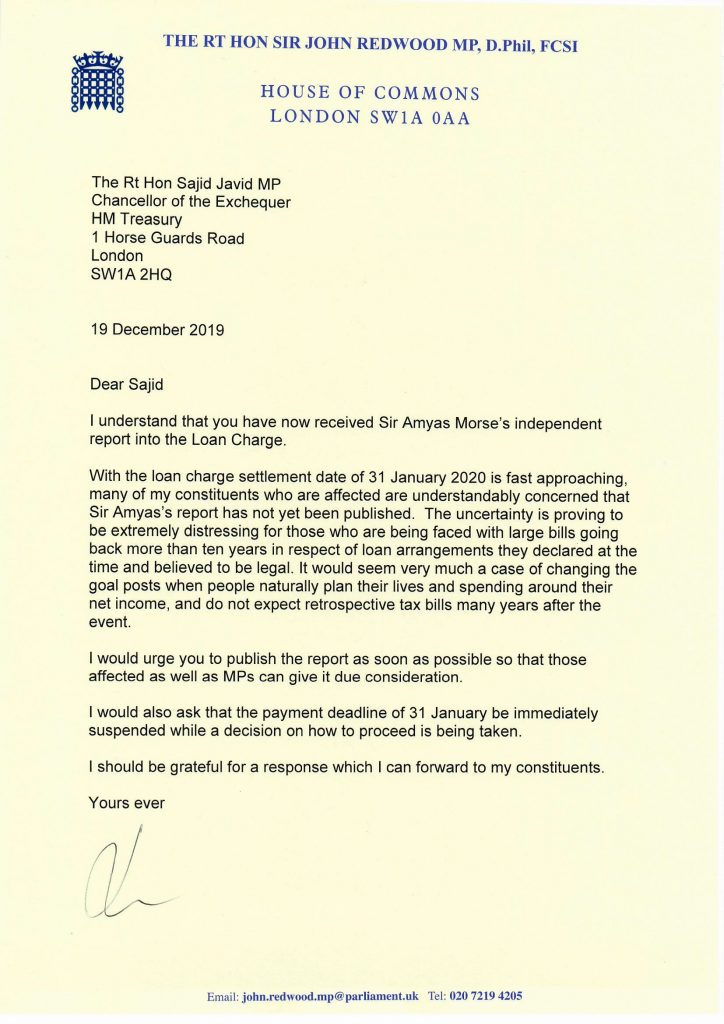
Letter to the Chancellor on the Loan Charge
I have written to the Chancellor urging him to publish Sir Amyas Morse’s independent report on the Loan Charge as soon as possible and to suspend the payment deadline of 31 January until a decision on how to proceed is taken.