The Conservative leadership election.

As I expected there was Boris and the rest.  I voted for Boris as I agreed with his clear statements that we have to leave by October 31st, and that failure to quit would be deeply damaging to our democracy and to the Conservative party. Next week will be about deciding who should go forward to challenge Boris, who commanded enough votes in the first round to secure one of the last two places, assuming all his voters stick with him which is likely.

It is difficult to see Rory Stewart, Matt Hancock or Sajid Javid staying in  contention. Dom Raab’s votes are likely to drift away to Boris as the Get out candidate who can win. I expect Jeremy Hunt will extend his lead over Michael Gove and stay in second place. Michael Gove is trying to sell himself as another Leave candidate, but he was one of the most insistent advocates of the Withdrawal Treaty which was the opposite of leaving, and now says if necessary we should delay our exit beyond October 31. None of the candidates who rule out No deal Brexit have explained why the EU should negotiate a revised Withdrawal treaty, nor how they could negotiate anything without the leverage of just going if necessary.


The BBC takes free tv licences away from older pensioners

The BBC pocketed the higher licence fee but has now gone back of the idea that they should finance the free tv licences for the over 75s.

Should the government now decriminalise payment of the licence fee? Should it review BBC funding and spending to see why the BBC cannot afford to meet its obligations to pensioners?

Parliament makes a sensible decision at last on Brexit

Yesterday the combined forces of the Opposition parties united to try to hijack the business of the House in the future to delay or prevent our exit and to ban a so called No deal exit. By 309 votes to 298 votes this proposal was defeated. They wanted time to legislate to stop Brexit or to prevent the government counting the clock down to our exit on 31 October without allowing the Parliament yet another say on the Brexit options.

It is traditional for governments to control the business of the House. If a majority builds up in the House against what they are doing then the opposition forces have the right to table and vote on  a motion of No confidence. If the Opposition wins that motion it  ends the government’s tenure. The Opposition is not afforded the right  to have Parliamentary time to have its own alternative programme of new legislation or its own alternative foreign policy . As it does not enjoy a majority there would be  no point in allowing this. It enjoys plenty of time to question, criticise, debate and comment on the government’s approach which is its role. The Opposition is free to table  any amendments it likes to government legislation, and free to try to persuade government MPs to join them in amending or opposing it.

The last time the Opposition tried a hijack to secure legislation it was to ask the government to seek a delay to our exit. As it happened Mrs May wanted to seek a  delay anyway, so when the vote was won by just one  vote it did not change anything as the government wanted to ask for a later exit date. As they found when trying to legislate then, all Parliament could try to do was to bind the hand of the UK government. They could not legislate to require a delay because that also required to consent of the EU.

It is good news that this time Parliament recoiled from allowing those MPs most hostile to our exit from the EU to take control of the Order paper. If they did so they would undermine the UK’s negotiating position further, humiliate our country again internationally, and thwart the clear wishes of the British people by refusing to implement the Brexit we voted for.


Thanks to the IEA for a good event last night

The IEA had 100 acceptances for a full house last night to discuss my book  “We don’t believe you”. (The book is  available on Amazon) The questions went on for almost two hours . We discussed everything from the collapse of traditional political parties to Brexit, from the Trump phenomenon to austerity economics, from  the middle Eastern wars to the distrust in the media. I will draw on parts of the discussion in blogs to come.

Don’t forget the middle

Labour claims to stands up for the poor, the dispossessed, the unemployed and the unfortunate. The Conservatives seek to show that many Labour policies would in practice damage them, as they would damage the economy as they memorably did in 1975-9, and in 2007-9. Fewer jobs, less growth and more unemployment as they produced do not cut poverty. Conservatives have sought to show that they too want to help those most in need, promoting work whilst supporting welfare. In government Conservatives have pursued higher minimum wages, less tax on those on lowest incomes and a range of other measures. In the leadership election there are furious bids by various candidates to set out what more can be done for the poorest in our community.

Amidst all this politics someone needs to stand up for the many who are not on higher incomes but who earn enough to get little or no benefit help and who have to pay substantial tax bills. Mrs May seemed to understand this in her early comments as PM about the “just managing”, though there was a danger this language was a bit patronising and downbeat. What we need is a vision of how the many who work to provide for themselves and their families can aspire to higher incomes and better lifestyles feeling the government is on their side rather than seeing them as an audience to tax and regulate in pursuit of wider social goals.

I want the next government to take the taxes off aspiration. Why do we face such high taxes on buying a better home or on moving to a different location? Why do we have to pay such large taxes if we want to buy a new or better car? Why does the government charge VAT on various home improvements? Why does the government want to reduce the number of people working for themselves by claiming they are not truly self employed for tax reasons?

There are limited ways out of low income and no assets. To do it people usually have to buy a home of their own and spend time and money on improvement. The range of tv programmes about moving and home improvement point to the interest in this opportunity. People do need to keep a decent proportion of their work income, to reach the point where they can afford to save. Building your own business is one route to a better lifestyle with assets in your business. It should be feasible for the average person, not needing super human skills to run the gauntlet of regulatory compliance and tax challenge.

I would like the next government to make it easier for people with aspirations to achieve their aims, and for more of the freedoms and lifestyles of the better off to be available for the many. Instead of government seeking to regulate our conduct more and tax success wherever it finds it as if it were a problem, I want a government that rewards those who want to do more for themselves and their families, and who given the chance will do the right thing.

Wokingham Post Office

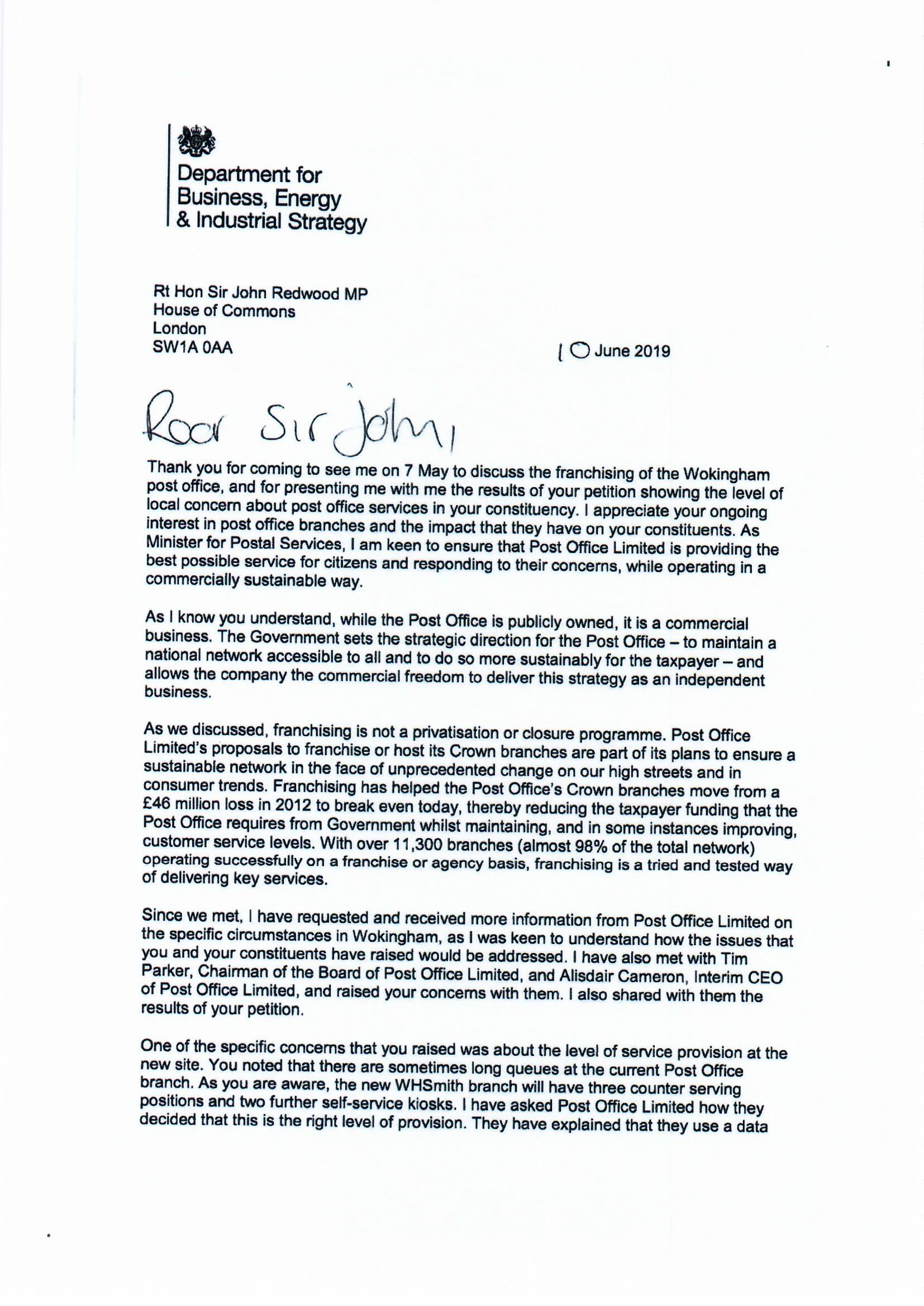
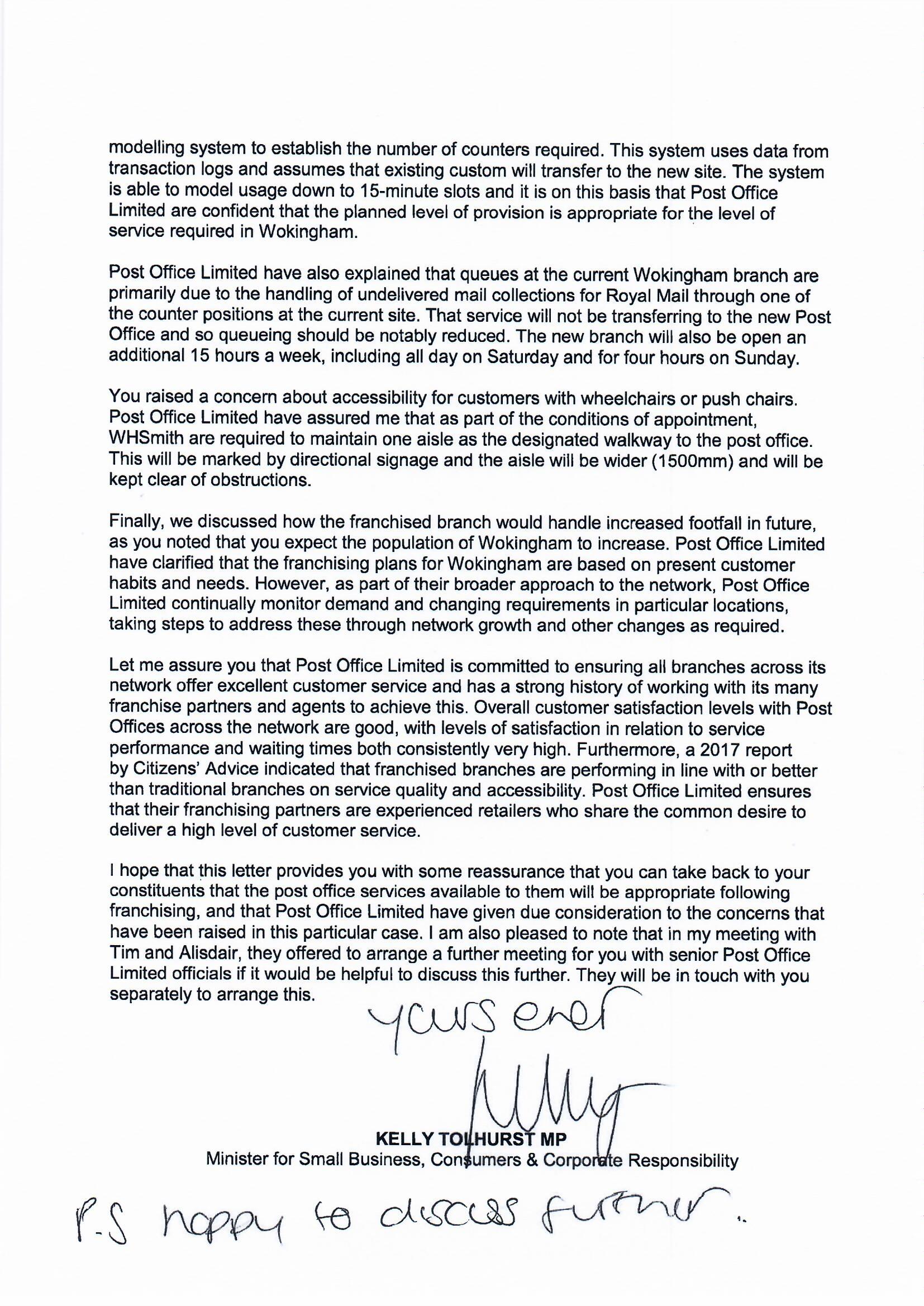
I have received this letter from the Minister regarding the move of Wokingham Post Office. I will be taking up her offer of a further meeting.

Mrs May’s non EU policies

Mrs May set out a strong  vision of a fairer and more prosperous UK in her initial statement of beliefs as she became Prime Minister. It hangs on the wall in 10 Downing Street as a reminder to visitors of what she intended. Unfortunately in office she was unable to make progress with it.

One of her mistakes was to appoint as Chancellor someone who did not buy into her vision, and who had no wish to use more public money to achieve some of the objectives she wished to set where state intervention was seen as part of the answer. The Chancellor did not conceal his wish to dilute and delay Brexit. He used Brexit as an excuse to withhold cash from public services or tax cuts on the grounds he wanted a “war chest” against a possible exit from the EU which he always wrongly thought of as damaging.  The PM wanted more money for schools to help raise standards and give people a better start in life. She wanted more money for the NHS, which was eventually extracted after a long battle. She probably wanted or needed more money for social care, though that remains a series of problems in search of a policy.

She saw social care as a major issue. I remember being sounded out by the Downing Street Policy Unit on possible reform prior to the 2017 election. I advised a careful approach and suggested that first the government should issue a general document describing current policy and outlining the problems as they saw them, to invite responses and to trigger a national debate before trying to formulate answers. They said they were interested in how Margaret Thatcher had run things, and I reminded them I had helped Margaret approach welfare reform in this way with a big public conversation and enquiry before offering change. I was very aware from my work as a constituency MP that some  people with no direct family experience of care homes did not know that the elderly person’s home had to be sold to pay the bills in many cases, and this needed to be more widely understood to have a conversation on care.

Unfortunately advisers decided they could invent and land a major reform of social care using a General election as a brief period to sell their ideas to the voters. Mrs May accepted a scheme for the 2017 election Manifesto that sounded like the old death tax that Conservatives had rejected under Labour. It turned out to be  a predictable disaster which the PM had to reject during the election campaign itself, as criticism of the social care policy drowned out other matters and came from many potential Conservative voters.

She was keen to encourage more housebuilding and put in place various schemes and directions to do so. There was progress in increasing the build rate as she hoped. She saw the need for improved standards in schools, building on the reform work of the previous government. It was not a smooth path given the antipathy of teachers to the Gove reforms, and the shortage of cash for the lower funded schools around the country. She continued to develop and promote her agenda to curb modern slavery and to tackle discrimination.

The bold aim to narrow the  north-south divide, one shared with many previous governments, made some progress with welcome acceleration of investment and modernisation in some of the great northern and Midlands cities.  

The aim to develop a modern industrial strategy made little progress. The industrial strategy was damaged by the ever dearer energy which made it difficult to keep or expand energy using industries in the UK. The car industry strategy was damaged by the Chancellor’s higher taxes on cars and the general government assault on modern diesel vehicles. The Business Secetrary, like the Chancellor, was downbeat throughout about the opportunities and prospects after Brexit. The various car factory closures in the UK and rest of the EU and currant state of the uk steel industry shows the failure of their so called industrial strategy.

Nomination day

Today we will learn which of the many possible  candidates have eight MP supporters and the will to contest the leadership. We have seen a long phoney war. There will be fewer candidates than the commonly touted 11.

Esther McVey has come up with the clearest and strongest position on the EU. She has stated we must leave by October 31 with no further delays. She is a good presenter of Conservative views, using language that cuts through well and standing up to the abuse and attacks that come with the job. Like all the candidates so far she voted for the unacceptable Withdrawal Treaty on the third vote.

Several candidates have been diverted by stories of their past drug taking. As someone who did not take drugs because it was a criminal offence, I can say these revelations are not helpful to them, but have not proved to be a bar to high office. Mr Gove should not be supported for his long and futile support of the Withdrawal Treaty, his willingness to delay exit longer and his ill thought through views on VAT and sales taxes.

Boris has  said the Withdrawal Treaty is dead and any negotiation with the EU would have to encompass both withdrawal and future relationship matters. This is reasserting the position in the Conservative Manifesto of 2017. Given the attitude of the EU it should mean we just leave with or without free trade talks and a mutual agreement to avoid tariffs and new barriers during the talks. He has rightly stressed we must leave the EU with no further delays by 31 October.

Mrs May as a political leader

Mrs May inherited a working majority from her predecessor. She chose to hold an early General election which lost her the majority. Her last series of local elections saw major Conservative losses with the Conservative vote down to just 28%. Her dreadful decision to delay Brexit and hold European elections saw the Conservative party slump to an all time low of 9.1% in a national election. This is a  very poor record and explains in itself why the party wanted her to go.

There were few silver linings. It is true she managed to get the Conservative vote back up to 42% in the 2017 election, reuniting Eurosceptics from UKIP with Conservatives under a banner of delivering our exit from the EU in a timely and positive way. That was her high point. She asked the whips to consult the Parliamentary party over whether to hold the 2017 election or  not. She had always ruled it out when asked. I was one of those who advised against, but I assume she must have got many saying they wanted to do it. I wanted us to c0mplete Brexit before going to the country, then setting out a post Brexit agenda.

She found it difficult understanding the cross currents of groups and voting blocs within the Parliamentary party. She always seem to exaggerate the numbers and strength of the Remain forces  and in her last months  in office seemed to delight in opposing the Leave majority on the backbenches, ignoring our advice and offers of support.

The most difficult thing to understand is why she ever thought the Withdrawal Treaty would pass, and why she persevered with the strategy of attrition trying to get more and more MPs to give in to vote for it. As I pointed out to her, even if in the  very unlikely event that  all Conservative MPs gave in the DUP were never going to accept the provisions on Northern Ireland so the legislation could not pass. Worse still insistence on the legislation threatened her whole government, which needed DUP votes to validate it and keep it in office.

The sorry procession of Ministers leaving office over the same issue would have alerted most politicians to the need to trim. The PM who was always willing to trim for the EU was never willing to trim for the Leave voting majority in the country or for the MPs who sought to represent them. It made her downfall inevitable. It means her successor has to rescue the country from Brexit delayed, and rescue the Conservative party from its historic 9.1% low in an election. Fortunately both tasks require the same positive action to get us out of the EU and to use the freedoms that brings for a better UK.


Dear energy fuels de industrialisation in the UK

Much of industry needs plentiful supplies of low cost energy. Industry is about transforming basic materials taken from the earth into materials, and then cutting, shaping and assembling these into manufactured goods. Transformation of silica into glass or iron ore into steel or oil into plastic requires very large amounts of heat energy. Creating components and final products from materials requires substantial energy to cut, shape, bend, bolt, glue and assemble.

The UK following EU rules and guidance has decided on a dear energy policy. Unsurprisingly this has triggered de industrialisation. The government says it has an industrial strategy, but its energy policy makes it more and more likely that industry will gravitate to  cheap energy USA or lower cost China than stay at home. In the name of decarbonising our industry we will end up importing more industrial products from countries that burn as much or more carbon per unit of output but at cheaper prices. We have already lost most of our aluminium industry from this problem, and seen a  big reduction in  our steel industry and petrochemical capacity.

Let’s take the current case of the steel industry.


British Steel made a profit of £92m to March 2017, and a loss of £29m to March 2018. Losses have probably  got worse since March 2018. Turnover rose in the year 2017-18. The main problems were


  1. The crippling costs of the EU carbon permits scheme. BSC had to find more than 10% of turnover for this item alone, leading to a UK government loan to cover the £120 m carbon tax.
  2. Dear energy costs, with UK electricity  substantially dearer than  US electricity thanks to the EU/UK energy policy
  3. Intense competition lowering steel prices in Europe, as countries like China diverted steel away from the US market following tariff impositions there. Prices fell around 15%.
  4. High cost of debt finance introduced by rescue company Greybull who took the company  over for £1 in 2016


The business is being offered for sale in whole or parts by the Receiver with bids closing 12 June.


Possible solutions

The business needs cheaper energy one way or another. It needs assistance to counter the high costs of the carbon tax, if we are to use energy here to make steel instead of import it. There will be some kind of refinancing with a probable reduction in debt service costs as a result of the Administration. It can work at more sales of specialist steels with higher value added, as they seek to do, and can ask for more sensible help in gaining UK domestic orders for the their rail and construction steel products. Many of the solutions needed to help them require permissions within EU rules over contracts, competition, and subsidies, or are simply illegal.


The single biggest cause of the financial collapse of this business is the huge energy bill from dear energy combined with carbon permits. I have always urged the EU and UK government to understand dear energy means de industrialisation, but they refuse to listen.


The company owns some crucial plants – 4 blast furnaces, a Basic Oxygen facility, 4 casters and 3 mills.

I used to be responsible for Darlington Simpson rolling mills (not a BSC facility)) to make long and flat product so I have past working knowledge of part of the industry.