Fiscal squeeze continues in UK

Tax revenues were up by  a massive 9.7% in January, creating a record surplus in a month where the government usually collects more money than it spends. Public borrowing is running 46% lower than last year and is on target to hit the Chancellor’s wish to cut it sharply.

Stamp Duty revenues are down for the year so far and down in January, reflecting the continuing  impact of higher rates. The government should cut the rates to help the market and would then collect more cash from this source.

Income tax revenue was  particularly strong.

The government is squeezing the economy too much and could do with some  cuts in tax rates  to promote growth. The right tax cuts would also boost revenue. Property taxes including business rates are particularly damaging at a time when we need to see more redevelopment and change of use as the digital revolution sweeps through our High Streets and industrial parks.

State debt as a percentage of GDP is falling, and now stands at 62% after deducting the debt the Bank of England has bought up

The Independent Group and anti semitism

Yesterday we had a moving and important debate in the House about the rise of anti Semitism in the UK. Most of us agreed that it is a nasty racism which no-one in a decent democracy should have to confront. James Brokenshire made a powerful speech for the government setting out how we must all take action to prevent it. The Labour spokesman Barry Gardiner apologised to the Jewish community on behalf of the Labour party and confessed that there has been a strand of virulent anti Semitism within Labour that they need to control. He spoke with passion and feeling.

The new Independent grouping of Labour MPs were well represented. They gave good support to Luciana Berger who catalogued the abuse she has faced from Labour party members and social media for her Jewish ancestry. Another group of active Labour MPs sitting on the two back benches behind their Shadow Spokesman also delivered powerful asides and interventions, demanding that their party did more than just offer an apology but tackled the backlog of cases that have been referred to the National Executive alleging anti Semitism. They showed considerable sympathy for their former colleagues and expressed similar feelings. They were keen to see the expulsion of Derek Hatton, recently admitted to the Labour party again.

Into this emotional rift came the resignations of three Conservative MPs from the Conservative party. They too wish to be seen as independent, though it is not clear they are the same kind of independent as the Labour group. Their reasons seemed somewhat different to the Labour explanations given the day before. They have yet to articulate exactly what they want to stand for, or why they have moved away from the 2017 Conservative Manifesto with its clear pledge to leave the EU and its customs union and single market in order to  fulfil the mandate of the EU referendum. They say in general terms they object to the very Brexit which helped get the Conservatives elected, and that they think the modernising agenda has been overthrown. They also dislike austerity, which ironically came from the modernisers David Cameron and George Osborne that they professed to like.

The Labour independents have said they are not forming a new party and will not be contesting elections. The polling assuming they would shows them capturing just 14% of the vote, mainly at the expense of Labour who go down to 28%, and squeezing the Liberal Democrats down to 7%.  The sense from yesterday is the main reason they have split from Labour is one of attitude and tone from the leadership. They dislike Mr Corbyn and dislike the intolerance they find in the party. Others might follow them judging by the reactions of some other Labour MPs during the debate.

The Conservative party will come together again as soon as we are out of the EU. It has been the delay in our exit for 2 years 9 months that has allowed the argument about how and when  we leave to fester. The Labour party has deeper seated disagreements within it which pose a problem for the leadership. At Prime Minister’s Question time neither leader wanted to mention the difficult topic of defections.

Development in the Wokingham Council area

The Council is in the early stages of considering the next local Plan and where development might go. I have suggested that we make a case for a slower pace of new housing development in the next plan period given the large amount of housing and its impact on our area currently underway.

The issue of Grazeley and a possible large settlement there is under discussion. I have said that this should only be considered if it was instead of development elsewhere in the Borough, as we would not wish to commit to a large new settlement and have substantial sites elsewhere as well. I have also said there must be an up front considerable investment in infrastructure not just for any new development but also to tackle the knock on effects on transport, health and schools in the wider area affected. I am not myself committed to any given location for development for the new plan.

I would be interested to hear your views.

Honda loses out in Europe and worries about the change to electric cars

Honda’s market share has fallen a long way in recent years in Europe. From selling 311,000 cars at the peak in 2007, last year it sold just 136,000.  The Swindon plant is only running one of the two lines, and at under 150,000 cars a year it is a small plant by world standards. Honda Europe is one of the casualties of the top down electrification policy pursued by the EU and UK governments. As Honda explained :

“This is not a Brexit related issue for us. This decision has been made on the basis of global issues. We have to move very swiftly to electrification of vehicles, because of demand of our customers and legislation”.

Honda wishes to concentrate its investments in large plants making modern vehicles that meet changing legislation in the places where they sell most cars. That is Asia and the USA, not Europe, where their market share is now small. This is one example of the massive change being forced on the industry by governments with their requirement to sell many more electric vehicles. It is interesting that Honda mentioned legislation as an important factor, underlining that this abrupt change in the profile of cars to be sold results from a top down instruction from legislators as well as from some customers having a genuine preference for electric vehicles.

It follows hard on the heels of Nissan’s decision to make one of its diesel cars only in Japan without adding  a UK line , given the big drop off in demand following adverse legislation and threats of more to come from government. Nissan does have decent overall  volumes in the UK and is committed to further investment in its UK business.

I forecast particular difficulties for the UK car industry in 2017 when the  Bank of England adopted a tough stance on car loans, and the government  launched a tax attack on new vehicles whilst  pursuing an anti diesel policy. This was particularly damaging to the UK based car industry which had built centres of excellence for clean diesel engine technology here in the UK with government encouragement. Investment in car production is a long term business. The big switch in UK government attitudes to diesels will have a price that goes beyond its obvious impact on the large section of our car industry that makes diesel cars. Companies  want consistent support for the industry and a predictable legislative and tax background, whether they are making diesel or petrol vehicles.

I trust the government will explore alternative uses for the Honda factory and work for the workforce. It could get a contractor that supplies vehicles to the state and or does deep maintenance on  public sector vehicles to undertake it there, for example.
Honda VP Europe confirms “This is not a Brexit related issue”

I am deleting contributions  to the site  that wrongly ascribe the planned closure of Honda Swindon to Brexit given the very clear statements made by Honda that is about other matters. I will comment in more detail tomorrow.

The workforce at Swindon is skilled and capable, and I wish to see the government and Council offer all the help they can to ensure that in the run up to closure good jobs are found to replace the lost Honda jobs.

An Independent group

Seven Labour MPs resigned from their party in protest over its anti Semitism and general attitudes. Several of them might not have been re selected as Labour candidates, such is the gap between their thinking and that of their former party’s leadership. None of them intend to put their new attitudes and affiliations to the test of the electorate in a by election. So far they are not saying they are forming a new party, and there are no current plans to put up Council candidates in May or put up a candidate to  fight a Parliamentary by election when there is vacancy.

Their policy platform is also so far unclear. They come from the Blairite pro EU wing of the Labour party, but did not wish to play up support for a second referendum. Perhaps they grasped that that is not a very popular idea, and does not look very democratic. They were wishing to annex the idea of democracy to themselves, but would have some problem in explaining why they reject the biggest vote in our history when the people answered  the question Leave or Remain on promise of Parliament implementing the decision.  They said they did not wish to join the Liberal Democrats who showed that having as your main distinctive policy  overturning  the referendum on the EU commanded only 10% support in the last general Election.

UK politics has been substantially changed by the Brexit vote. It led to the two main parties defying the trend in the UK from 2010, and the trend on the continent, of  declining vote shares for the two traditional left of centre and right of centre parties. Labour and Conservative together leapt up to 82% of the vote at a time when on the continent the two traditional parties in most countries is  now well below 50% together and in some cases as in France down to under 20%. Labour gained votes by moving leftwards whilst saying they would implement Brexit, Conservatives gained votes by pledging we will leave the EU. The election did not show a large demand for a new party pro the EU along Lib Dem or Blairite lines.

UK politics this year will be about Brexit. Both main parties have to assist it or suffer electorally if they do not. Both promised voters they would implement the referendum, and both said they wanted an independent trade policy for the UK which means leaving the customs union. The Independent Group wisely avoided making Brexit the main point of their break from Labour, as they would be putting themselves in a difficult and unpopular position if that is their main grudge. They were after all  willing to stand for election on a pro Brexit ticket in 2017. They also need differences that will last longer than the time to our departing the EU. So far they struggle to define them, but doubtless will do more to set them out in the weeks ahead. The biggest point of difference they highlighted is one of tone and approach to people, with their plea for a kinder more inclusive type of politics than they find in the modern Labour party.


Proposed move of Wokingham Post Office

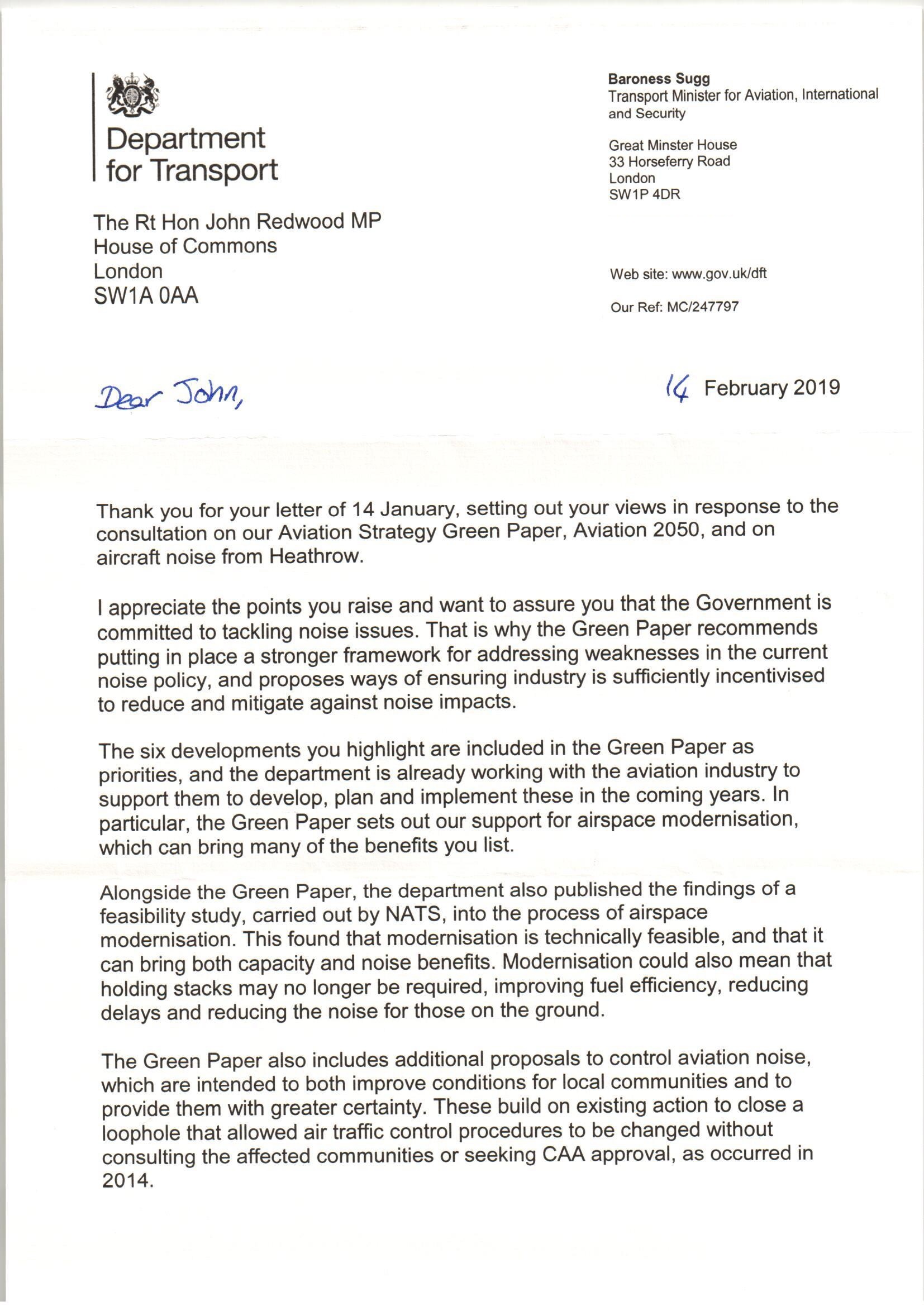
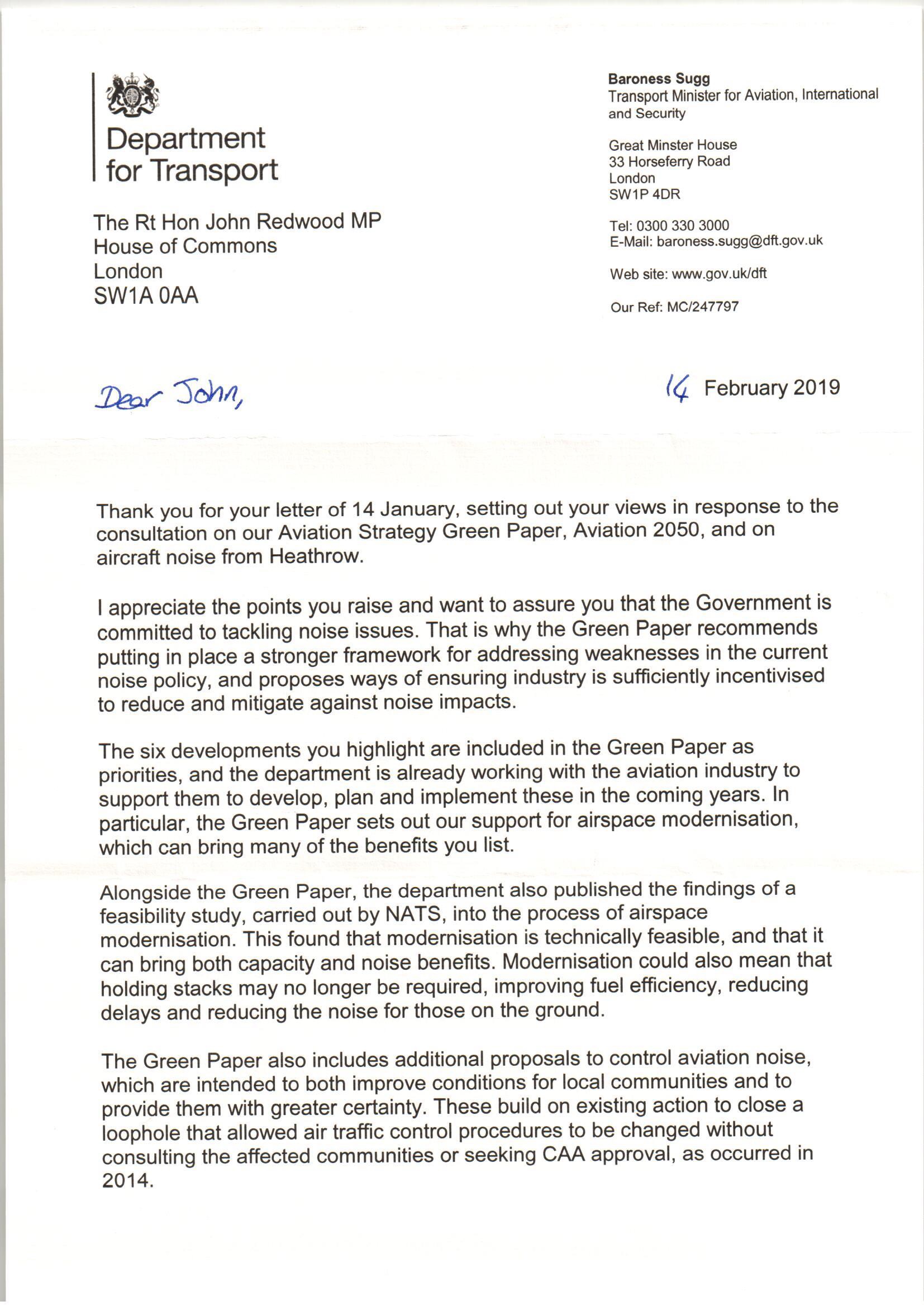
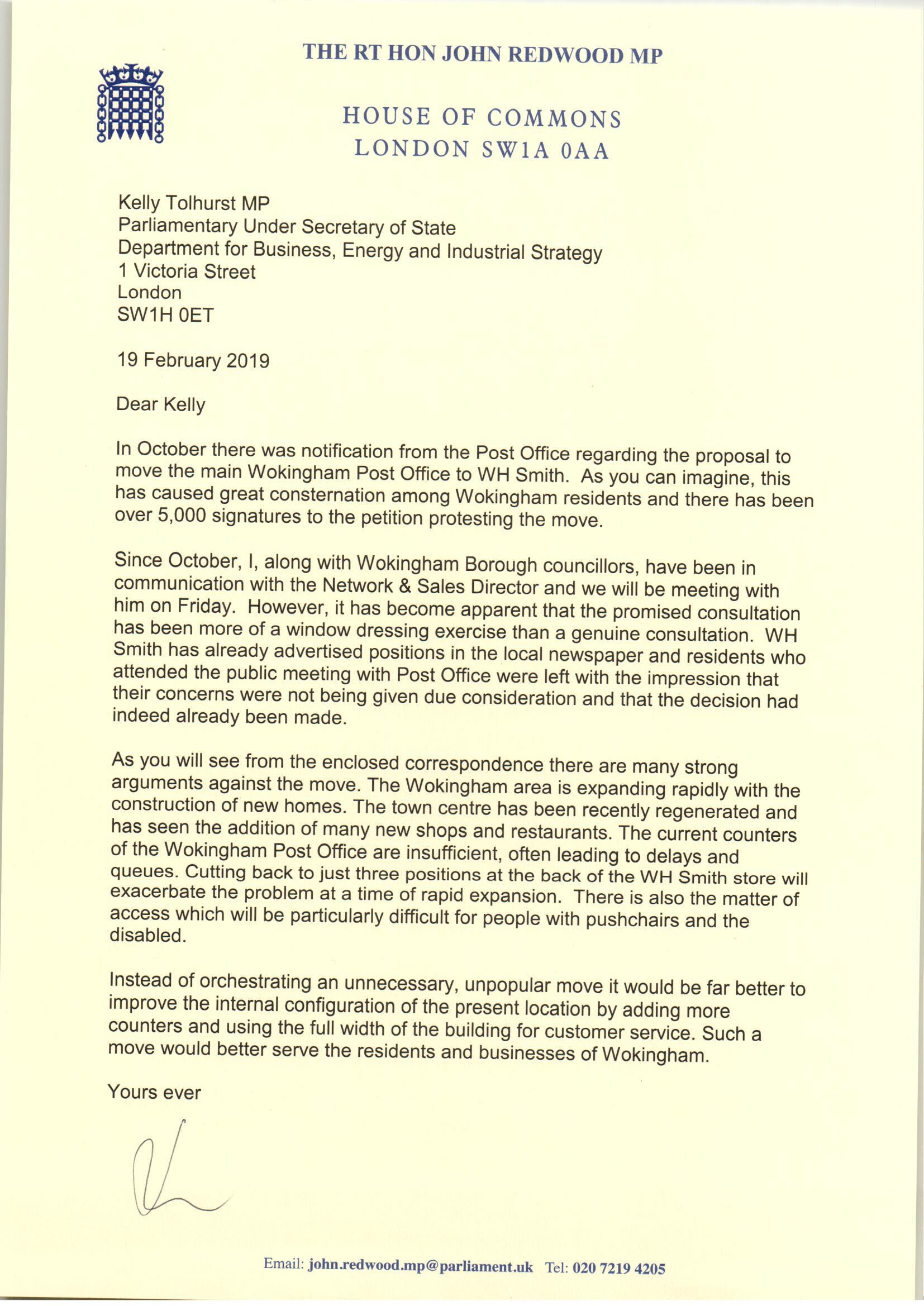
Last week I was made aware that WHSmith was advertising for jobs for the proposed move of Wokingham Post Office to their premises.  This was despite the fact that the consultation is still underway and that I, along with three Wokingham Borough councillors are meeting with the Post Office Network and Sale Director on 22 February to discuss our concerns.  I immediately raised this with the Post Office and I have received the reply below.

Thank you for drawing this to our attention.

It is normal practice for WHSmith and other potential new operators of Post Offices to advertise for possible new roles in potential replacement Post Offices, and it is not the case that this pre-empts any final decisions about moving a branch.

Once a branch goes into consultation, both Post Office and the potential new operator begin all the detailed planning for the move. Any recruitment is conditional upon the proposal being approved. The reason this detail planning is done at an early stage, ahead of a final decision, is that we know, should the decision to move the branch be made, it is much better for our staff and the community that the transfer proceeds without any unnecessary delays.

We can see that only one of the three adverts for roles at the potential new Wokingham Post Office makes this clear. We have contacted WHSmith and asked them to correct this ASAP.

Kind regards,

Ken

External Affairs Manager
20 Finsbury Street,
London
EC2Y 9AQ

The shackles of the single market and customs union

Being the UK’s Single Market Minister during an intense period of EU legislating when they said they were “completing”the single market turned me from a mild sceptic to a strong critic of the undemocratic approach of the EU. It was quite clear watching and listening to the EU officials during that period that their aim was to take more and more powers of self determination away from member states in the name of the single market. All you needed for a sigle market was the rule that a product of merchandisable quality in one country could be offered for sale in another with suitable labels.

They had a doctrine of the occupied field. Everytime they put forward a regulation or Directive in a new area it meant they established competence or power over that area. Quite often the first piece of legislation did little and was unexceptional. The reason was they merely wanted to capture the jurisdiction without at first using the power in ways that alarmed or upset. That came later, once competence was established.

My job was offen a negative one. The UK government wanted the single market, but also often wanted to resist bad or needless legislation in its name. It was also the case that often the draft regulation was based on a Franco German way of conducting business, and not on a UK way where that was different. I then had to argue for a change of draft to stop UK businesses being made to change their model or being declared illegal.

All this should worry the present government about the Withdrawal agreement. If the UK signed that as currently drafted there would be no UK vote, voice or veto on any law the EU wanted to pass in all the areas of its competence. That means that every business sector and company in the UK would face a prolonged period when the EU might deliberately or inadvertently legislate in ways that damaged their business models with us being unable to stop them.

Why don’t the UK business bodies raise this issue? Why don’t they raise the problems for our car industry created by the attack on diesels, car loans and the costs of purchase? UK industry has suffered from past EU regulations and taxes, and could be made to suffer more.