Questions for Remain

I am bored to tears with much of the conventional media, which simply recycle endless old Project Fear stories as if they were true, parades so called experts who always back Remain, and fail to ask any of these people the questions pro Leave would ask. The media interrupts and cross examines Leave supporters aggressively but rarely asks a difficult question of a Remain “expert” or supporter. So here’s the sort of questions they should be asked, in the interests of balance.


  1. Why do you want to give £39bn away to rich countries on the continent in return for 21 more months of talks with the EU?
  2. Why do you think the EU will give us a good deal on a future relationship in 21 months of talks after March, when they have failed to offer anything in the 2 years 9 months before March?
  3. Why will it be easier to get a good deal once we have given away the money than it is before we do so?
  4. Why did Remain tell us that leaving the EU meant leaving the single market and customs union if you now say we could negotiate our way back in?
  5. If you want to stay in either the single market or customs union what do you expect the EU to demand on freedom of movement, budget contributions and adherence to EU laws?
  6. Why should there be any delays at UK ports where we import food and drugs, when the UK will be controlling the borders there and when Customs and Excise have already said they can ensure a smooth incoming border?
  7. Why didn’t the UK economy collapse into recession and massive job losses as Remain and the government predicted for the first year after a Leave vote?
  8. How would you afford the tax cuts and spending increases which Brexiteers plan from the big savings on the EU budget? Do you accept a Brexit bonus budget will boost the economy?
  9. Would you like to see lower tariffs or no tariffs on tropical produce from emerging market poorer countries, as the UK can do that once out? Wouldn’t removing all tariffs on imported comp0nents for manufacture be a great idea as well?
  10. Wouldn’t another 21 to 45 months of talks prolong the very  business uncertainty you dislike and worry about?
  11. What would you have said if Leave had refused to accept the 1975 referendum result and demanded a second referendum on the basis that Remain then lied by saying there would be  no loss of sovereignty by joining the EEC/EU?
  12. Why do you have such a low view of our country that you think we cannot govern ourselves?
  13. Is there anything the EU has done that you think is wrong or damaging? If so  why didnt you oppose or try to change it?


Let me give a cheer for the Bank of England

Regular readers will know I have been critical of the Bank for its tough squeeze on car loans and mortgages since March 2017. Some of you have written in to support  the Bank, claiming with them that the build up of consumer debt and mortgages  is worrying and they are right to rein it in.

So I was pleased to read the recent speech of the Deputy Governor Broadbent who has offered a more considered position by the Bank of England. They now acknowledge that there has been no worrying increase in consumer debt as reflected in credit card, overdraft and other borrowing. The main increase in consumer borrowing has occurred through an increase in student loans as more people graduate from universities under the loan system. As the Bank recognises, much of this debt will never be repaid, and it is more a state debt than a personal one as repayments are only made above certain income levels. It is more of a graduate tax on success. There has been a more modest rise in car loans, but as the Bank now accepts most of this is a kind of hire contract. There is no risk for the individual who would simply surrender the car. The individual does not own it. The Bank also accepts that the ratios and spread of these car loan hire contracts is sufficiently broad for there to be no great risk to the financing houses responsible.

I hope this more thorough analysis by the Bank will lead to a relaxation of policy on car hire contracts. I hasten to add I have  no personal interest as I do not want one myself. There are however many people who would like to renew their car and buy a more fuel efficient and clean vehicle, currently restrained by the squeeze.

The Bank also points out that mortgage affordability is considerably above the levels that prevailed in the years before the banking crash. Whilst house prices are on average well up and a higher multiple of earnings than in the 1990s, the much lower interest rates means that mortgage outgoings are not up as a proportion of income on normal levels at the end of the last century. Again the Bank rightly confirms my view that there is no excessive mortgage debt problem out there.

Both our housing and our car market have been damaged by high and increased transaction taxes, by changes to other tax arrangements and by a credit squeeze. It is time to relax it a bit. I am glad I can now agree with the Bank’s analysis, which seems thorough and convincing over this issue of debt.

Parliament and the Executive

For the Tuesday debate in accordance with the EU Withdrawal Act the government has tabled a neutral motion on our exit from the EU. The motion simply says Parliament has considered the matter of our withdrawal.  Parliament after all has debated little else for the entire last two and a half years. It has also legislated twice to leave the EU on 29 March 2019. As I made clear to the Commons when we passed the EU Withdrawal Notification Act, that was the decision point. Parliament’s wish to send the Article 50 letter should have been the end to the debate on the principle of leaving.

Some in Parliament have now decided they would like to move amendments to the government motion to undermine  the legislation Parliament has put through to allow us to leave. It is true that passing a motion next week cannot of itself change the law, so unless the law is amended we will still leave. Some hope that if Parliament expresses a strong view that it has changed its mind it might get the government to think again. That would  be unwise given the solemn promise made by Parliament and government that we would implement the decision of the referendum.

Some opponents of Brexit have therefore decided they wish to rewrite Parliamentary rules to try to legislate to stop Brexit against the wishes of the government. It has long been the practice agreed by all  parties in government that government has three advantages over any other group in the House in order to allow it to govern. The first is that government leads over the choice of business in the Commons to allow it to get its legislative programme through. It still of course needs  a majority for each proposal and may have to allow extensive debate and disagreement, often resulting in compromises. It would not be easy or orderly for any group of MPs to propose a Bill and then to try to get it through against other groups competing for time and support. All governments have readily made time available for private members bills and for Opposition debates as part of the deal over cross party working.

The second is anything that requires taxes to be raised and public money to be spent should need Parliamentary consent based on a resolution put to the House by a Minister. The government has to take responsibility for the whole budget and needs to keep control of spending as best it can.

The third is where a power to be exercised is a so called prerogative or Crown power the PM and the government act for the Crown or seek the Crown’s assent. Other groups of MPs  cannot claim to act in the name of the Crown nor exercise any such powers. Government Ministers negotiate with foreign governments on behalf of the UK.

The wish of some to legislate to delay or prevent our exit from the EU comes up against all of these issues. The Cooper and Grieve amendments wish to alter the idea of government business motions, asserting that their proposed bills would take precedence over anything the government might wish to do, with guaranteed Parliamentary time. They argue wrongly that their bills do not have any financial implications so they do not need a Money resolution. They ignore the involvement of prerogative powers in negotiating and signing international treaties.

The government’s strongest case in pushing back on these revolutionary constitutional proposals is that clearly any decision to extend our membership of the EU has substantial financial implications. Under the EU Withdrawal Act our payments to the EU cease on March 29 2019. The government has no power to authorise payments for contributions and programmes after that date. The so called £39bn of the Withdrawal Agreement would need  new legislation to authorise it. All payments up to 29 March are legal under the European Communities Act, but this Act ceases to be on our Statute book after March 29th. Staying in for longer would doubtless be expensive and should need a government motion to approve the spending, with  Treasury consent that it is affordable within the revised budget.

The government would also be right to warn that moving over to a new system of choosing how to spend Parliamentary time could make government very difficult. If a government cannot be sure of enough time to try to get its programme through it cannot govern effectively. Any government with a small majority will be especially at a disadvantage. Were this to be established as a new precedent then the next government with a decent majority would presumably legislate to stop Parliament having such extensive rights, and might make things less flexible and friendly to backbenchers and opposition than they are today under a settlement that has lasted for many years.

The government can also point out the EU has not offered us a few months delay on Article 50 and that would require negotiation with the EU over the terms. The EU would wish to negotiate with the government, not with a temporary alliance of MPs.

Thanks to the CAB in Wokingham for helping people

Today I visited the CAB. I thought I was just dropping by their stall in the Marketplace to hear how well they were doing encouraging people to save money on their energy bills. CAB were telling people about how to switch tariffs or supplier to get a better deal. They were also explaining how to improve insulation and efficiency of boilers and machines at home to cut demand. I am all in favour of green policies which save us money, letting us stay warm and clean whilst using less power. Thats  a win win for  us all. Getting on the cheapest tariff can also help with the family  budget.

Whilst at the stall I was invited to visit their offices and meet more of the staff and volunteers.  I was pleased to learn they are recruiting more people who would like to help others in the community, and are training them so they can be confident in the advice they provide.  I like to keep in touch with the CAB and hear  of any problems affecting a number of people, especially where government might be able to help or  to do something better or differently to cut down on the numbers.


I said a big thank you to all  involved. The CAB are always interested in recruiting  more volunteer advisers. It can be very worthwhile and interesting work.

The Treaty of Aachen and the European army

This week President Macron and Chancellor Merkel signed a Franco German Treaty at Aachen. It sets up a governing committee for a common European army, to  be based on establishing a common culture in the German and French forces and engaging them in more joint operations. There will  be common weapons procurement and an integrated supply industry.

The same Treaty also wishes to erode the distinctions of government and culture in the border areas between the two countries. There will be an overall joint governing structure, encouragement of bilingualism, and joint government programmes.  The Treaty in addition  sets up an economic council of experts to advise on bringing together economic policies. The two countries pledge themselves to even closer governmental working and more convergence of law and action.  France promises to take the common EU line on the Security Council of the UN, and to seek a permanent seat for Germany on that body as well.

They presumably chose Aachen as the resting place of Charlemagne, a great figure in European unification. The Rathaus at Aachen where they met was the setting for the coronation of 31 Holy Roman Emperors, and it houses replicas of the crown jewels of the Emperors. The two leaders wishes to reaffirm their enthusiasm for a political unified Europe.

The Rathaus has also seen other events that remind us of the trials of European history. There was the period of occupation by the French Napoleonic forces, when France tried to unite a large part of Europe by force of arms. There was the 1923 sacking by Rhineland nationalists, and the bombing of the building by the allies seeking to reverse German militarism in the 1940s.

True to form, signing this Treaty to try to unify more, the political forces in France and Germany have included strong criticism from their  oppositions. The German populists are concerned that Germany will be dragged into spending more German money on French economic developments. The French opposition is very concerned about giving Germany a role in the government of French border areas. These are all matters for French and German debate, not for UK opinions.

I highlight this event because during the referendum Leave was told by Remain there was no question of a European army, yet the language of this Treaty develops the idea a long way. It is clear again that the main drivers of European integration do wish to have a joint military capability distinct from NATO. This in turn requires a much higher degree of political integration and joint decision taking.

The pound rises against the Euro and dollar

Good silence from the anti Brexit commentators over recent rises in the pound as we get closer to the date to leave the EU.

They are none too noisy about the latest IMF forecast either where the IMF  think the UK will grow faster than Germany this year.

That’s the magic of Brexit!

Project Fear takes another hit – employment and wages carry on rising

The latest employment figures are good. Unemployment has fallen to 4%, with strong jobs growth continuing. Vacancies are also at good levels, implying no immediate fall off in employment in prospect. Average earnings hit £27,500 a year as we go into 2019, with real wages now growing at  around a 1% annual rate.


This means over the two and a half years since we voted to leave,  the economy has continued to generate a lot of extra jobs, bringing unemployment down. Most of these jobs are full time, and many are well paid, boosting average earnings. That is the opposite of the recession allied to big job losses we were told by the Treasury and Remain experts to expect after the referendum decision.


Many in Parliament wish to increase the uncertainties and carry on portraying a gloomy outlook from their own pessimistic imaginations. Many of them now are desperately searching for a delay to Brexit so they can prolong the uncertainty and spend many more months rowing over what kind of Brexit they want or will allow, regardless of the views of the voters and regardless of what the EU might agree to. It is particularly cheering that employment has grown so well recently, when the national conversation has been dominated by gloomy Remain MPs telling us the future is dreadful, and when the chances of us just leaving without signing the Withdrawal Agreement have risen thanks to the huge defeat of the Agreement in the Commons.

It also shows that the authorities attempts to slow and damage the economy with a series of tax attacks on homes and cars, and with the slowing of credit, have not been sufficient to stop overall jobs and wage growth, though they have of course done damage to the targeted sectors.

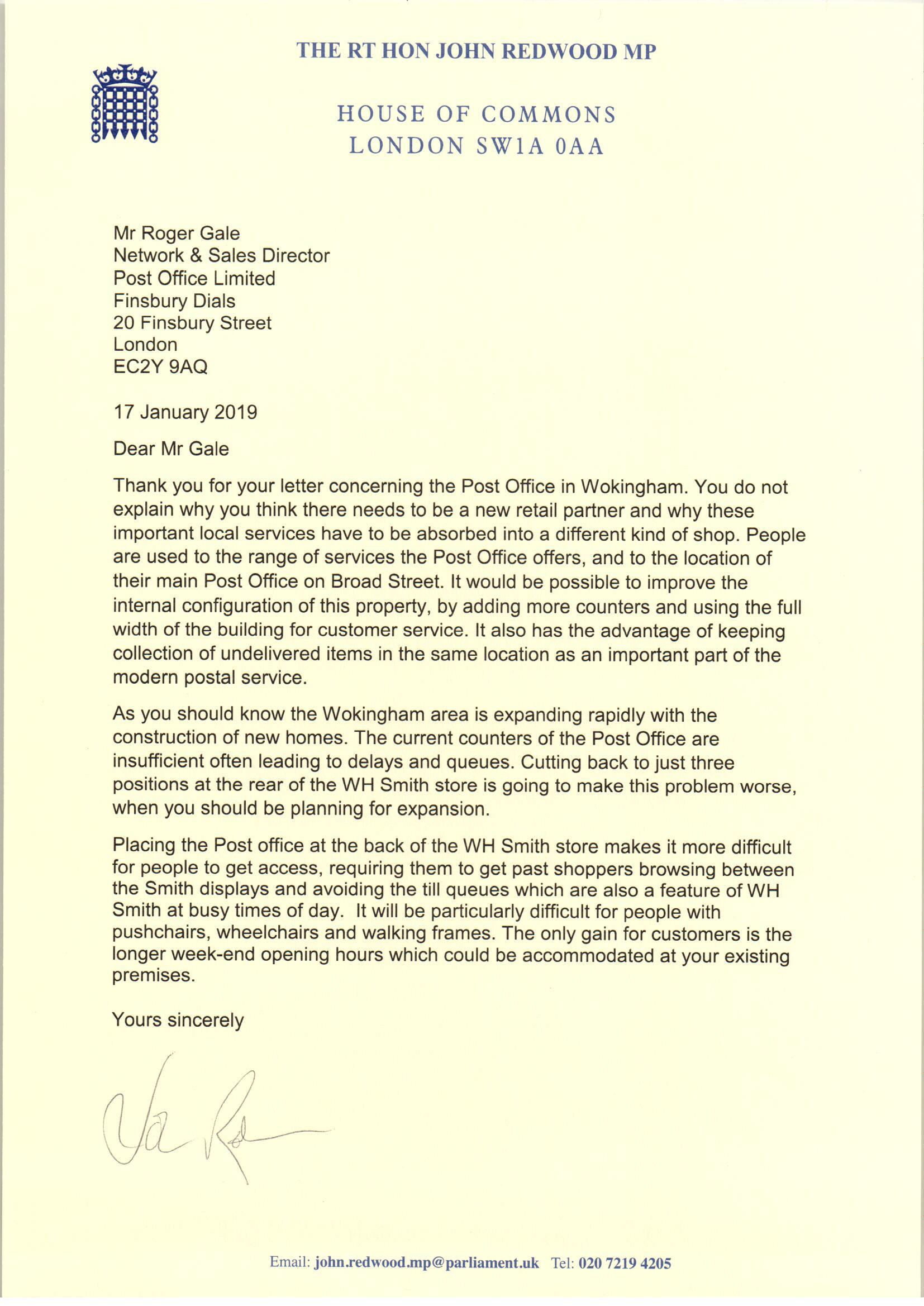
My letter to the Post Office Ltd regarding their proposal to move the Wokingham Post Office to commercial premises

I have written to the Post Office regarding their proposal to move the Wokingham Post Office to commercial premises citing my reservations about the move.  They are currently running a consultation and I would encourage residents to contribute to the consultation to make their views known.  You can find the consultation at: https://www.postofficeviews.co.uk/national-consultation-team/wokingham-rg40-1aa-008939/.

I, along with Wokingham Councillors, will be meeting with Mr Gale next month.

The revolt of the motorists

The French gilets jaune movement has in part been a protest against the attempts of the elite to limit people’s uses of cars and vans. The movement began with demands to cut the taxes on petrol and diesel, and to resist more moves to make motoring ever dearer. Some of the protesters then went on to damage or obscure the cameras checking car speeds on French highways, rapidly taking a majority of them out of use. This followed an unpopular reduction in the speed limit .

The car to many is not merely an important symbol of personal freedom, but a vital means of getting to work, going to the shops, taking children to school and enjoying leisure time away from home. Many people want to learn to drive and acquire a car as soon as they are able, recognising how much more scope they will have to do as they wish in their lives if they have their own transport. The establishments of Europe see the car instead as an enemy of their vision of the future. They impose high taxes to reduce use of vehicles and to price people on lower incomes off the road altogether. They impose tougher regulations to limit the use of certain vehicles in certain places and at certain times. They are now threatening the whole car park of diesel and petrol cars, wanting to push people into owning an electric vehicle or giving up on personal transport altogether. They seem to think people can and should take the bus or train even when they live in rural areas with little or no access to such services.

Of course governments need to impose some rules on car drivers to ensure safer roads. It is sensible to have a testing regime for drivers and vehicles, and sensible to have road markings and road rules to avoid collisions. No-one disagrees with good measures to keep us safe. The problem comes when the rules and requirements multiply to the point where they can be a distraction or a problem for the safe driver, and where the whole exercise is one large attempt to take more money off the motorist with tax placed on tax to drive, own, buy and operate a vehicle.

The intervention in the market by the EU and member state governments to get more people to buy diesel cars worked well, only for the EU then to change its mind and tell us we had been wrong to follow their advice. Now they wish us to believe that if we take on an electric car we will in future be subsidised or taxed a lot less. People are very sceptical, fearing that if electric cars become popular then the subsidies will end and new taxes will be imposed as governments will want to replace the huge lost revenue from taxes on diesel and petrol. They also worry lest some unseen environmental problem with batteries emerges as emission issues arose late in the day with diesels.

In this vexed area of policy the car and van using public see hypocrisy from those who govern them. They seem to have plenty of access to prestigious cars without a thought for the cost as they are provided by the state. If cars are good enough for Mr Macron to get around in, aren’t they also necessary for French men and women as they go about their work?

67 days to Independence Day

Let’s countdown to Independence and get ready to celebrate our exit.

There are only 36 days left when Parliament is in session and able to try to mess up or delay our passage to Independence.

Write to your MP today if they are showing signs of wanting to stop Brexit and remind them of their Manifesto promises and the result of the referendum and General Election.

The government should be discussing how we commemorate one of the great days of UK history, the day we restore an independent self governing democracy to these islands.

The government should also be publishing our tariff schedule, getting its Brexit bonus budget ready for March, taking back control of our fishing grounds and setting out a food and farming policy that is good for the UK.

When we joined the EEC there were commemorative stamps and coins. There were more coins for the 25th anniversary of our membership. What should we do for March 29 2019?