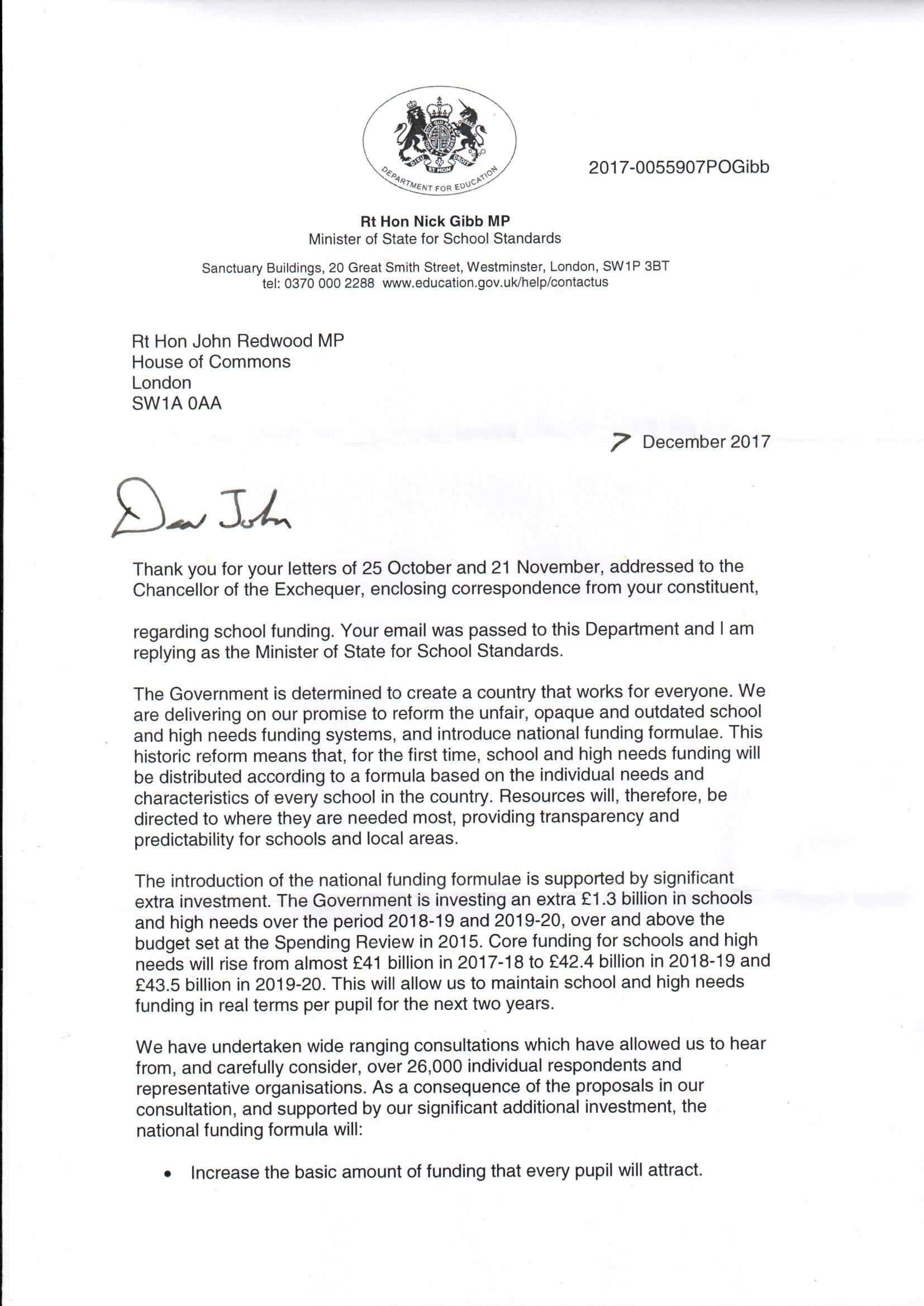
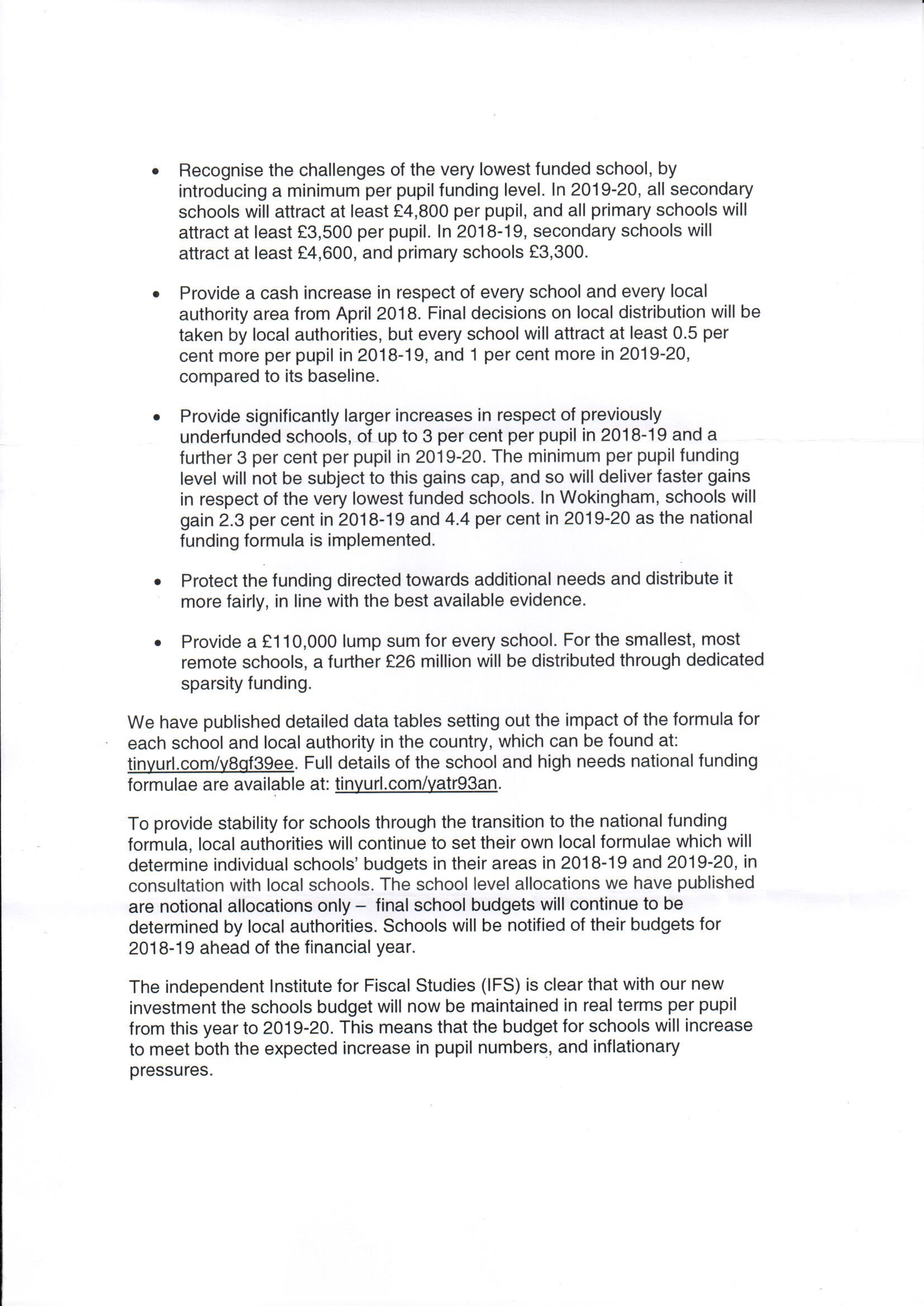
I recently met with a number of constituents to discuss school funding. Following the meeting, I took the points raised up on behalf of those attending. I have now received the enclosed reply from the School’s Minister:
Author: johnredwood
What kind of defence policy do we want?
Under Labour and the Coalition the UK made frequent use of its defence capabilities in the Middle East, alongside Presidents Bush and Obama. In the last couple of years the UK has been rightly more cautious about using military force in tense and difficult civil wars, as has the USA.
There has been a general shift in western thinking away from sending in troops to police war torn territory on the ground. Instead smart western weaponry has been used in support of other local and regional forces attempting to influence the outcome of these conflicts. The West has used a variety of manned aircraft, smart bombs, missiles and drones to kill people on the ground and damage property in support of ground forces provided by others.
This development of western policy towards the Middle East is leading to new thoughts about what kind of forces the West will need in future, as the weapons designers and manufacturers are placing more emphasis on unmanned systems, remote control and robotics. I wish to explore how the UK can respond to these changes.
The first question to answer is what should be the UK’s policy aims.
First and foremost must be home defence. By a combination of our diplomacy, foreign policy and military deterrence we wish to keep our islands from military threat. We also need to make sure we have the force needed to defend ourselves in the unlikely event of a threat materialising.
Second comes our contribution to NATO. NATO remains the West’s prime mutual defence alliance. The UK wishes to contribute properly to this, and to benefit from the protection the offer of mutual support gives us.
Third, the capability to go to the aid of territories and countries within the UK family, as we had to for the Falklands in the 1980s.
Fourth should be the ability to join international coalitions of the willing in pursuit of UN aims. There will be times when the UK should join forces to resist an invader or to counter the illegal use of force somewhere in the world. As a member of the Security Council the UK has to be willing to contribute to missions where we have the resources and interest to do so.
What is money?
There is active discussion of what is money with the advent of crypto currencies. There are also those who see gold and silver as money, given the ability to convert these metals into coins and to trade them.
Money has three main characteristics. It is a means of exchange. It is a unit of account. It is a store of value. Most of our money today takes the form of an entry in an electronic ledger at a bank. We accept transfer of electronic money to our account as payment for our work or pension. We pay for many items by offering an electronic transfer from our bank account to the account of someone selling us the good or service.
Most of us rely on the monopoly fiat currency of the country where we live. We know that we can draw money out of our bank account in the form of bank notes, which are accepted as payment universally in our domestic economy. A bank note or a bank account credit possess the three characteristics of money. We can pay for anything with them. We can keep the notes or ledger entry as a store of value for future purchases. We use the value of the money we own to assess the prices and values of goods and assets we might buy or own. Assets, goods and services are all priced in the local money.
Money depends on trust. We trust UK banks to hold our money because they are large businesses with substantial reserves. We know that the Bank of England regulates them and stands behind them. The Bank of England has the power to create additional money if the system needs more liquidity. Our deposits in commercial banks are backed not just by the bank we use, but by the Bank of England standing behind that bank, and by the UK state and taxpayers who stand behind the financial system. There is a deposit insurance scheme for deposits up to the stated limit.
In some overseas countries trust has been badly damaged in their local money thanks to gross mismanagement. A country which manages its economy and banking system badly can end up with a run on its currency, lowering the external value of it too much. This in turn can lead people to want to be paid in foreign currencies, and even to trade in dollars instead of their local money to create some stability of values. A hyperinflation coupled with a collapse in the external value of money in a country is a destructive process.
Those who distrust all fiat currencies look for some other store of value. Gold has often been their choice. This precious metal has had a volatile past, with periods of large gains in value against paper currencies interspersed with periods of decline. Holding gold entails costs of storage and insurance. To use gold as a payment system normally requires selling the gold and using the proceeds in a paper currency to complete a purchase. Like paper currencies, the efficacy of gold rests on confidence and its popularity with users. It is not widely accepted as direct payment and is not normally used as a unit of account for valuing items.
Better animal welfare
THE GOVERNMENT HAS PUBLISHED A DRAFT BILL TO STRENGTHEN ANIMAL WELFARE
The Government has published a draft bill which would increase the maximum prison sentence for animal cruelty tenfold, from six months to five years, in England and Wales. The draft bill also sets out that the government “must have regard to the welfare needs of animals as sentient beings in formulating and implementing government policy”. Subject to consultation on the draft bill, the government will legislate to deliver both aims.
The plans underline the government’s commitment to raising animal welfare standards, ensuring there will be enhanced protections for animals as we leave the EU.
Many constituents will be pleased that we will strengthen protections for animals.
What might a UK/EU Agreement look like?
Early next year we should begin talks about trade and the future relationship with the EU. Until we do so the language developed over money and the Irish border is parked. Both sides confirmed “Nothing is agreed until all is agreed”.
There may be continuing misunderstandings on the EU side about what the UK has in mind once the proper talks begin. The UK offers a full free trade agreement covering goods and services, with zero tariffs and no new barriers to trade. The EU sometimes seems to be suggesting they want the UK to sign a leaving agreement and implement it prior to 29 March 2019, to leave, and then engage in more detailed talks on trade. The first thing to clear up is the phasing of the talks. The UK needs to stress the urgency of getting on with the free trade talks. It is accepted we only sign a free trade agreement with them after we have left, but we need to know the details of such an agreement before we leave to judge the rest of the Agreement and the phasing of implementation.
The second thing to sort out is the possible Transitional arrangement. The PM always stressed this would be an Implementation Agreement. It would be as short as needed. We would only need one if there is an Agreement on our future trade and partnership to implement. The idea should not be to create a further two years in the EU under the guise of a Transitional Agreement, in order to have another two years of uncertainty and more talks about trade. Business and consumers need to know where they stand. They want to know as soon as possible if we are en route to a free trade agreement, or if we will be trading under most favoured nation WTO terms.
The third necessity is that once we have left in March 2019 with or without an Implementation Agreement, the UK will be free to sign trade deals with other countries and to pursue its own overseas trade agenda. There are various misunderstandings about regulatory alignment and convergence. Of course when you trade with another country or trading bloc you need to meet their requirements and product rules to sell to them. The UK accepts US law and rules when selling into the US, and will accept EU rules and laws when selling into the EU. What you do not do as an independent country is also accept all the rules and laws to govern all the rest of your trade. You have your own national rules based on an understanding of world standards instead. Alignment or equivalence means you have regulations with the same purpose but they may be different in the areas where this matters. The US sells services into the EU based on acceptance of equivalence for its regulations compared to EU regulations. It does not have to enforce EU rules on its domestic businesses or foreign trade outside the EU.
Visit to CEMAS
On Friday I accepted the invitation of CEMAS to visit their company and the meet their staff.
Cemas is a privately owned business based in south Wokingham. It employs 72 people and specialises in preparing test data for the agro chemical and pharmaceutical industries. It can monitor trace substances in air, water and animal tissue, identify active ingredients in products and their concentrations, and prepare large independent dossiers of tests of product approvals and monitoring. This work is vital to ensure product safety, to limit damage to the environment and to help companies produce innovative new products and treatments.
The company has strong links with our local University at Reading. Some of the younger staff are also working on degree courses at the university, and some of the more senior people are Reading graduates and postgraduates who have specialised in relevant subjects.
The company works for a wide range of global businesses. It seeks to maintain high levels of accuracy and independence, as it needs to do to satisfy its own standards and its Regulator. It has grown steadily over the last three decades from its Wokingham home base. I wish the staff and the owners every success with their venture.
Talks about trade
I have in the past said trade talks between the UK and the EU could be relatively short and straight forward. I have never said they would be. I have always acknowledged that if the EU wants to make them long and complex they can do so.
The first question the UK must ask when the talks begin is the simple one. Does the EU want a comprehensive free trade Agreement with us or not?
If the answer is yes, we can get on with translating our current tariff free arrangements on goods into a WTO registerable Free Trade Agreement, along with the access methods for service covered by current EU arrangements. This is largely a scissors and paste job, ensuring continuity of trade. As I understand it the UK is happy to offer this.
If the answer is No, then the UK needs to ask the second question. What new tariffs and barriers does the EU wish to impose on our exports to them, given that we will likely impose identical barriers on their exports to us?
If we take goods, the EU could if it wishes impose the same tariffs on our goods and food exports as they do to other non EU countries under WTO rules which govern us both. This would mean they would face high tariffs on their large farm exports to us, where they run a £20 bn surplus. We have a year to source alternative cheaper food from around the world and for our farms to gear up to produce more at home behind the tariff wall. If the EU for example wants a high tariff on meat there are plenty of other suppliers who would like to sell us more.
There is then the question of what impediments they would want to place on services. They have never completed a proper single market in services. There are still many national regulatory, language and qualification barriers around. The UK allows considerable access to its markets that helps continental business.
If the EU wanted zero tariffs on goods but more restrictions on services the UK could say it sees a trade off between the two.
Loddon carols and Christmas music concert
Christmas always gets a big boost at the Loddon concert. The primary school choirs from the Borough excelled themselves, singing with great enthusiasm a number of much loved carols and Christmas songs. They belted out the Philippine carol with particular force and verve.
The Berkshire Maestros provided excellent musical accompaniment. They delivered their performances of Leroy Anderson’s Sleigh Ride and his Christmas Festival medley with skill, in a most entertaining way. Grazeley, Crazies Hill and Shinfield schools added a performance on recorders and hand chimes.
I thank all the teachers who trained the choirs, the conductor James Baker who brought it altogether, the performers, and the parents who supported their children. It was a great evening, much enjoyed by a packed hall.
Buying your own home
On Friday I met a number of young professionals in the constituency who wanted to talk to me about opportunities to buy a home of their own.
They all reported difficulty with current house prices in the Wokingham area, and wanted to know what more could be done to make homes more affordable. One had recently succeeded in buying a property but was still concerned about this issue.
I explained that the government has produced two schemes to help directly with raising the money to buy. The Help to Buy Isa provides a £3000 top up to savings of £12000 in an Isa to speed up saving for purchase. The Help to buy equity loan offers up to 20% of the price a first home to pay the deposit, where the buyer has the other 5% of the house price as savings to complete the 25% deposit requirement. The price of a home is limited to £600,000 in England for this scheme, which is well above the price of the typical first home.
The government has now removed Stamp duty on most first time buyer properties, and is working with Councils and the development industry to see that a suitable number of lower priced properties form part of the mix of new homes being built.
I am keen to find other ways that Councils and the government can assist in making more affordable housing available for first time buyers. As my meeting confirmed there is substantial pent up demand, as the wish to own remains strong in the younger generation as with their parents. Those with access to the well funded banks of Mum and Dad usually do get on with house purchase in their twenties. The government wants those without this advantage to be able to do the same.
The Joint Report on the negotiations so far
The Report opens by stressing that both sides are pledged to the view that nothing is agreed until everything is agreed. The Report acknowledges that the detailed draft agreement on citizens rights and on a financial settlement are without prejudice to an agreement on a future relationship. The Prime Minister has stated that the payment of any money other than our contributions up to leaving date are contingent on a wider Agreement.
The UK has won some of the important arguments over citizens rights. It is important that EU citizens living in the UK are under UK law, just as UK citizens living in the rest of the EU will clearly remain under EU law. The UK has sought to avoid a situation where EU citizens living in the UK enjoy a special status which is governed by EU law and the European Court of Justice. There will be further debate about whether an eight year right for UK courts to seek guidance on EU law in this field dilutes the UK jurisdiction too much. The UK side stresses that individual cases over citizens rights in the UK will be governed by UK law and adjudicated by UK courts.
The complex clauses on the financial settlement do not set out detailed numbers or precise programmes. The main extra cost appears to be accepting the Union budget for 2019 and 2020 after we have left. Presumably this is envisaged as a transition period which still has to be defined and negotiated in subsequent exchanges. People will want to know what such UK generosity achieves in terms of the future relationship. The Prime Minister has previously made clear that there only need be a transition period if there is a good Agreement to transit to. The UK has made some general statements on so called RAL or financial items after 2020, and on contingent liabilities. It will need greater clarity of what these are and why the UK might make some ex gratia contribution, as there seems to be no legal liability for these sums.
The wording on Northern Ireland and the border with the Republic is general and about principles. It will fall to later talks to work out how the “detailed arrangements” will work. This, as the UK has often pointed out, needs decisions on the general arrangements for UK trade with the EU before anyone can finalise the border arrangements. There will be considerable debate about the meaning of this statement “In the absence of agreed solutions the UK will maintain full alignment with the rules of the internal market and customs union which now or in the future support North-south co-operation, the all island economy and the protection of the 1998 Agreement”