Wokingham social care

I was pleased to hear in the budget that my representations along with other MPs for more money for social care had been accepted. I had made it one of the principal features of my pre budget oral and written submissions to the Chancellor

I was less happy when I heard of Wokingham’s small share of the total. I am now taking this up with Ministers to see why Wokingham has not got more of the increase.

Movement in EU thinking on Brexit and “populism”

There are signs that more governments on the continent are beginning to realise that the UK is not seeking continued membership of the single market or customs union, and accepts it will have a relationship based on friendship, collaboration, joint working and trade in a wide range of areas and activities.

Germany now grasps that they need continuing access to the large London financial markets which do so much to help finance continental business as well as to our lucrative car market. French, Dutch, Danish and other farming businesses on the continent do not want to see the quite high tariffs allowed under the otherwise low tariff WTO regime placed against their voluminous exports to us. The more realistic continental politicians see they cannot undertake the type of negotiation they expected. They thought the UK would be begging to stay in the single market, so they could impose requirements over financial contributions and freedom of movement. It is not going to be like that.

A good negotiation for the UK needs to be friendly, straight forward, and with limited requests of the others. Indeed, it is difficult to see that the UK wants anything from the negotiation that the rest of the EU does  not want and need more. They need tariff free more than us. They need good access to financial services and  banking. They want their many citizens resident in the UK to be able to stay here. They want the UK to continue to make the largest contribution to the European part of the NATO defence activity and budget.  The great news is they can have all that if they simply reassure our UK citizens resident on the continent about their status – which they will – and opt for tariff free trade which they would be wise to do in their own interests.

Many are breathing a sigh of relief in the Chancellories of Europe that the Dutch did  not give a larger vote to Mr Wilders, and made Mr Rutte the leader of the largest party. However, they would be wise  not to be complacent. Mr Rutte lost 8 seats and Mr Wilders gained 5  seats. Mr Rutte had to disrupt the EU’s relationship with Turkey to sound more like Mr Wilders in a bid which did swing some voters back according to the polls. In line with the progressive collapse of the Conservative and Labour look alike parties in Euroland owing to their inability to influence main economic policies, the Dutch Labour party had a disastrous election.

The EU without the UK  does have to find more tax revenue from the remaining members or cut back its spending. It is curious to see how all those pro EU forces who told us our net contribution was tiny before the referendum are now saying it will leave a nasty hole in EU finances when we are gone. Fortunately they need to agree a new longer term budget around the time we leave, so they can decide as a more homogenous group of countries, mainly in the Euro, how much collective spending and taxing they need for the new circumstances. As they build their more integrated Europe they would probably be wise to ensure it is properly funded, with sufficient cash to send to the poorer regions and countries. Other single currency areas send much more money around their unions as grants than the Euro area does.  That, however, is a matter for them,  not for us. They will benefit from not having the UK in the room trying to stop any budget increase when they turn to these important matters for their future.


MPs employing family members

IPSA have decided to introduce a new rule that in future MPs will not be able to employ family members in their offices on the public payroll. Existing family members with contracts will not be affected.

I do not employ any family member anyway.

Time to see the UK’s strengths – steady pound since 2012

Amidst all the hyperbole over short term movements in sterling it is worthwhile looking at the longer trend. Today sterling is around the same level against the Euro as it was at the beginning of 2012. It is almost a fifth higher against the yen, and around one fifth down against the dollar. Over this time period the dollar has been strong against all major currencies, running with higher interest rates and expectations of higher rates than elsewhere in the advanced world. The yen has been particularly weak thanks to negative rates and the creation so many extra yen by the authorities.

One of the odd features of the protracted and often repetitious UK debate about Brexit is the wish of so many to look for weaknesses and problems on the UK side, and to fail to analyse the weaknesses and difficulties on the EU side in the forthcoming talks. On Tuesday I pointed out to the PM during the exchanges on her statement about the EU summit that the questions to be asked need to be asked of the 27.

I began by asking how can a group of civilised democracies that are meant to believe in decent values not reassure British citizens living on the continent legally that they can stay there after exit?  I do not for one moment think the Spaniards will want to evict UK pensioners living in their own villas on the Costa Brava, for example. Nor do I see how they could do so legally. However, why is it asking too much of the EU and the Spanish government not to confirm that of course they are welcome to stay. After all, the UK government has been very clear that we would like all EU citizens legally in the UK to stay as long as they wish, but do need similar confirmation for our citizens on the continent.

I also asked for confirmation that it is clearly in the interests of business and governments on the continent to carry on trading tariff free, with no more barriers than they currently face, once the UK has left. The UK will willingly offer continental countries tariff free access to our market as long as we have the same to theirs. The choice rests with them, as the UK would recommend tariff free but can live with WTO most favoured nation terms.

Whilst we are about it, we should ask the rest of the EU how they intend to implement their Treaty obligation to have good relations with neighbouring states and to promote trade with them. As the EU is always keen to ensure we follow the letter as well as the spirit of the Treaty I assume the same applies on this important issue.

The UK voted to take back control of our laws, our money and our borders. We are doing so based on the referendum of the UK voters, and now also on the back of a Commons vote with a majority of 372 to leave. Under the Treaty we do not owe them any money apart from our regular contributions.

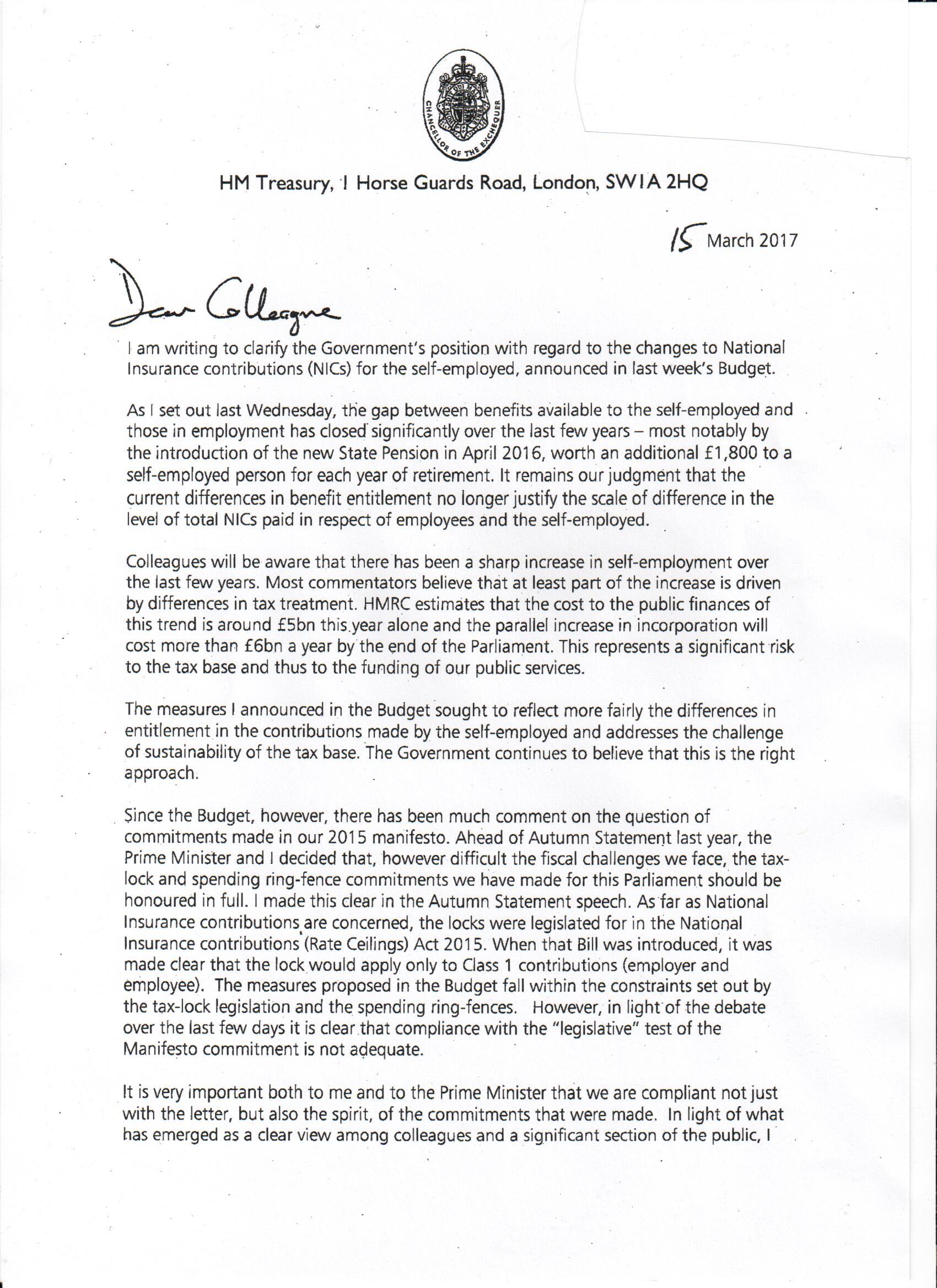
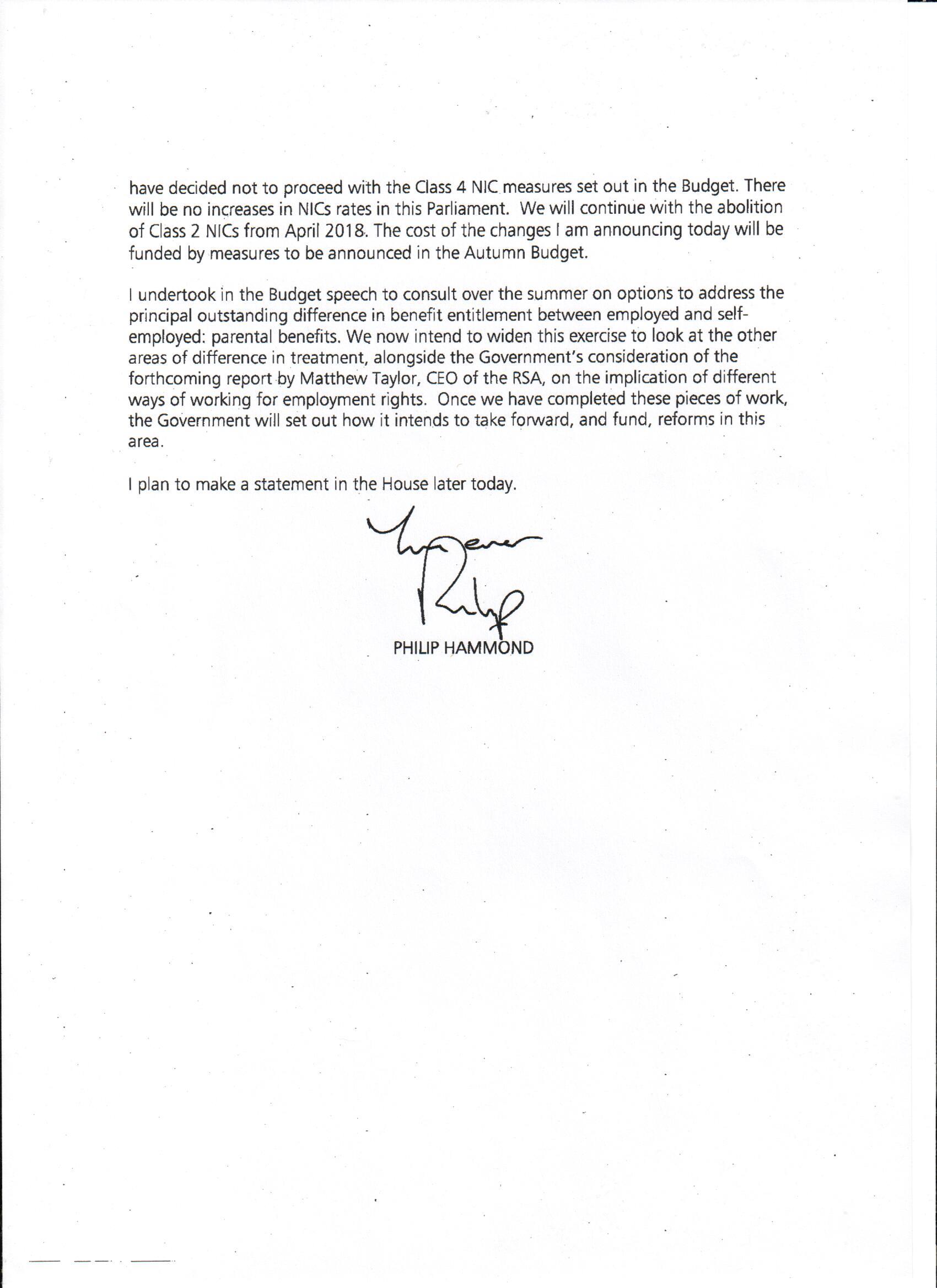
No rise in National Insurance for the self employed

I am pleased the Chancellor has changed his mind on National Insurance. It is true the previous Chancellor defined the Manifesto promise as relating to NI for just  the employed when he legislated to implement the promise, but there was no such limitation in the Manifesto or in the election speeches and broadcasts to warn the self employed they were not covered. It is always a good idea to keep the spirit and the letter of promises made.

I did speak in favour of not taxing the self employed and small business more, and put in representations from constituents against the Budget proposal. Removing this tax increase removes £325 m extra tax from 2018-19, and around £600 m in each of the next two years. I see no need to replace this “lost” revenue, as I expect the economy to grow a little faster than the official forecasts, which will generate more extra revenue than this policy change. Fortunately the sums involved are  small against a total revenue of around £800 bn annually  in the relevant years, so this item is under 0.1% of the total.


Airspace Consultation

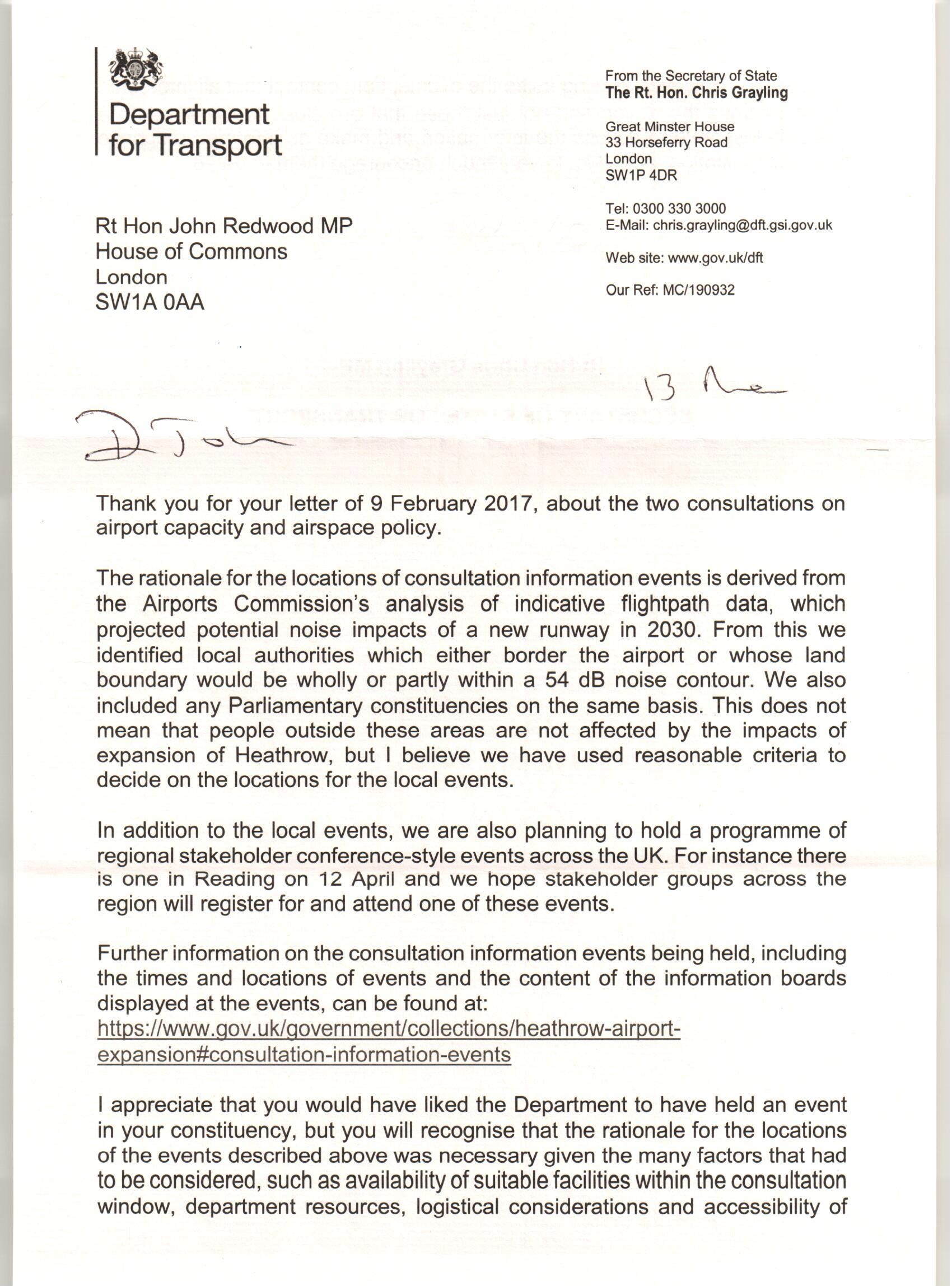
I recently wrote to the Transport Secretary to request a consultation event on airspace changes should be held in Wokingham. I have now received the enclosed reply from the Secretary of State.

The future of Scotland

I was pleased Mr Cameron gave the Scots a referendum on the future of Scotland in the UK. I sought assurances in the Commons that the SNP would accept the result, just as I and others who supported the Union agreed willingly to accept the result. The SNP made clear they thought it was a once in a generation opportunity. They said of course they would accept the verdict of the people.  It is therefore disappointing that their Leader now thinks they need a second referendum in less than five years from the first one which they lost.

Her argument is that leaving the EU represents a major change in circumstances. Apparently leaving the EU single market would be bad news, yet leaving the UK single market which is four times bigger for Scotland’s trade  would be good news. She wants a referendum before the UK has left the EU, based on a guess as to the final terms of any Agreement on our future relationship. It is difficult to see why this makes any sense. Surely if the departure from the EU is important, the SNP would wish to see it completed and see how the new Agreement works out before asking Scottish voters again to express their wishes on membership of the UK.

I trust the PM will explain that the Union Parliament will not grant a referendum all the time we are seeking to implement the results of the last on  the EU. Polls indicate there is little demand in Scotland for a second referendum. There is more demand for the SNP to use the substantial powers they already have to govern Scotland better. A referendum on the future of Scotland in the Union is a matter for the Westminster Parliament. I would think it would be wise to review the matter after the next Scottish election. If the SNP have done well in that standing on a ticket of wanting a second referendum then the UK will have to consider the request carefully.

I only want volunteers in our Union, and am glad we settle these things by referendum votes. I also think we need reasonable periods of constitutional stability between major referenda, so governments can use the powers they have got for the purpose intended-  the improvement of public services and the pursuit of a more prosperous and decent society. The UK is a serious democratic country. Occasional referenda on big issues are part of that. Constant repeats of referenda would turn us into a debating society with government constantly diverted from the day job of governing well.

The Netherlands government picks a diplomatic fight with Turkey

It looks as if the strong polling of Mr Wilders and the PVV in the Netherlands has worried the government led by the VVD. They have recently denied access for Turkish Ministers to their country on the grounds that their visits would be inflammatory.  The Foreign Minister was stopped from coming and the Family Minister was ushered out of the country. Turkey is of course a NATO ally and has recently agreed a comprehensive and close Association Agreement with the EU. This Agreement includes the free movement of people from Turkey to EU Schengen countries which include the Netherlands.

It will be interesting to see tomorrow if the idea of acting in this manner serves to reassure those otherwise thinking of voting for Mr Wilders and the PVV, or whether it simply highlights Mr Wilders agenda in a way which helps him. Turkey is angry about the actions of Mr Rutte and his VVD party, and have asked the Netherlands Ambassador to remain out of Turkey. Meanwhile protests about this in the Netherlands have led to the use of water cannon and ugly street scenes.

None of this is good news for the EU/Turkey relationship, and brings the whole issue of the EU/Turkey Association Agreement back into contention. Many voters in the Netherlands have been worried about these Association Agreements, but so far the Dutch government of Mr Rutte has gone along with them at EU level, so they do apply to whole EU Schengen area including the Netherlands. This row may serve to remind unhappy voters about these developments.

It does not look as if Mr Wilders can win enough seats to be part of a future Dutch government, but if he wins more seats than any other party it will add to the stresses and strains on the ruling coalition which emerges from the election.

Voting for the Brexit Bill

Today I will be voting to ensure the Brexit Bill at last passes the Commons again unamended , so the government can send the Article 50 letter. I do so because I campaigned to give UK voters a referendum, and made clear before and during the referendum campaign that the people’s decision would be implemented by the government.

I am pleased the Bill has passed with a large majority in the Commons, and trust the two Lords amendments will be removed by the Commons who rejected these views before.

As I stressed in my speech on the Bill, the letter itself marks the end of the UK’s membership. The one thing I agree with Lord Pannick about, the lawyer who led the Gina Miller case in the Supreme Court, is that the notification of leaving is irreversible. Under the Treaty you can only leave legally by notification. Once you have notified you have up to two years remaining in the EU to seek an agreement about the future relationship, but are out  without such an agreement at the two year stage, or sooner with an agreement. That provision was put into Article 50 deliberately to ensure the EU cannot delay unduly the exit of a country in order to get more money out of them in the form of their regular contributions as members. The rest of the EU should not be able to delay exit unduly when a country has decided it wants to leave. The EU, after all, is meant to be an association of democratic freedom loving states, so their freedom must include the freedom to cease to belong.

I  am surprised to see the rest of the EU is still using the misleading analogy that this is a divorce. It is not. It is a country leaving an international treaty arrangement which no longer suits it, because that Treaty based organisation has changed so markedly compared to one the UK agreed to join in 1972.  There are no provisions in the Treaty to make additional payments to leave or to carry on making payments after leaving.

The main question to be settled about our future relationship is whether we trade under WTO Most favoured nation status in future with the EU as we do successfully at the moment with the rest of the world, or whether we carry on tariff free. The UK would be happy to carry on tariff free despite being in large deficit on this basis, so it is a simple choice for the rest of the EU. It is high time UK media started putting this basic question to the other member states and Commission, instead of trying to find holes in the UK stance.

At the same time they could ask the rest of the EU why they have not yet reassured all UK citizens living on the continent they can continue to do so after Brexit, as we wish to do for all  continental EU citizens currently settled in the UK. The UK government is not a threat to either tariff free trade or civilised treatment of EU citizens living in a different country to their home one. I find it odd that the EU might be a threat to these straightforward common decencies. Why is the people who most like the EU that have a such a low opinion of its likely conduct?