Fair funding for Wokingham and West Berkshire schools

Following lobbying by a group of MPs including myself, the government has issued a Consultation document (https://consult.education.gov.uk/) on a new fairer funding system for schools. The document draws attention to the way a school can receive 50% more than a school with a similar mix of pupils elsewhere in the country under current formulae. It states it intends to move to a system where ” we must fund pupils with the same characteristics and the same costs at the same rate, no matter where they live”.

The new system will continue to give more money to pupils from disadvantaged backgrounds. It will also take account of school and local area costs. There will be transitional arrangements, so the full national funding formula will apply from 2019-20. Progress will be made in the intervening years to get closer to fair funding.

This should mean improvements in the amount of money paid for each pupil at Wokingham and West Berkshire schools, which currently receive a low level of support. I encourage Councillors, teachers and parents interested to respond positively to the Consultation and to stress the need for a formula which does live up to billing and gives Wokingham and West Berkshire schools the same funding as other comparable schools.

How much trade do we do with the EU? Under 40% of our exports.

People who want to stay in the EU wrongly think our trade is at risk. They then compound their error by telling people half our trade is with the EU.

They clearly have not read the balance of payments figures. Less than half our goods exports are to the rest of the EU, and well under half our service exports are to the rest of the EU. The total of our published export trade with the rest of the EU is 43.6% (latest figures available, Q3 2015).

You cannot get to half our trade even if you add in imports as well as exports. What the Remainians never point out is that we import so much more than we export to the rest of the EU, so the percentage of our imports from the EU is a lot higher than the percentage of our exports.

In Q3 2015 54% of our goods imports came from the rest of the EU, but the total imports were still below half when you add in services.

All these figures also have to be adjusted for the Rotterdam/Amsterdam effects. Quite a lot of our exports go first to a large continental port, and then are shipped onwards to a third country outside the EU. This is counted as trade with the EU. Taking this off means less than 40% of our exports are to the rest of the EU. The ONS assumes around half the published trade with the Netherlands is in practice trade with the rest of the world.

The chugger state

Most MPs concentrate on representing people who need the state for support and often see the state as an ally. I too represent my constituents when they need welfare, state help with housing, school places and care from the NHS. By definition most of an MP’s job is going to be helping those who need state assistance, and supervising or seeking improvement in the large free at the point of use state services.

I also seek to represent my many other constituents who do not see the state as helper, and have to spend their time complying with state dictats and paying all the bills. Parliament has been much less good at representing taxpayers and all the people who set up, manage and work in the private sector companies that supply much of our goods and services and provide most of the jobs and incomes.

It has also not been kind to many savers seeking to live on their past prudence. To many people who get up and go to work to pay the family bills and to keep our country civilised with plentiful supplies of what we need the state can come across as hostile and unhelpful. At times the state is the worst kind of chugger, extracting money in so many ways. The state as chugger of course is more worrying than a too persistent fund raiser elsewhere, as you have to comply with every demand the state makes.

One of the worst features of the modern state is the great complexity. They have so many ways of demanding your money that you have to devote considersable time to compliance. The state expects you to know when you have to pay and to get it right according to their process.

You park your car in a municipal car park and then have to be sure you get back within the stated ticket tine. It puts pressure on your meetings or shopping as you seek to conform. It means fewer impulse buys or leisurely cups of coffee at the weekend as you are time limited. You often are not allowed to buy as much time as you might need.

You drive to your next engagement. You need to be ever vigilant for the hours of operation of bus lanes, endless changes of speed limit, box junctions, cycle ways on the carriageway, left and right turn rules and the rest. One mistake that does no harm to anyone and you may well face a penalty fine.

You have to remember to pay the Council tax bill to be allowed to carry on living in your own home, whilst some Councils have now made it difficult to pay unless you are prepared to put in a direct debit.

Every payment that you receive needs to be recorded so you can explain if it was not income or pay tax on it if it was income.

If you save you may find the rules of those savings change after you have committed your money, as many have discovered with pensions savings over the years. The government can change the tax they levy on it even though you are locked in to a contract based on different tax rules.

Every time you have to deal with the state there are requirements to produce documents and reference numbers. Despite all the money spent on government computers there us still no single simple access and one ID per person to make your reporting to the state easy.

Whilst I agree we need rules and need to raise revenue, we could do so much better by making it easier for people to comply. The complexity means quite a lot of people do not bother to take on something extra or grow their business, for fear of the blizzard of state demands extra effort by them will bring forth.

Given the way that the state gets reports on people’s savings income and on employment income from companies that handle our savings and employs them, why can’t the state send a tax return request with the details they know already filled in? Why are people who wish to defer NI on other income because they are paying their full amount through their main employment made to fill in the same details each year on a new form?

I wish the next budget would be friendlier to taxpayers, would try to make their lives a bit easier, and would understand you raise more revenue if you set sensible taxes and allow people to profit sufficiently from their extra effort, investment and hard work.

Wokingham Healthwatch

On Friday I visited Healthwatch in Denmark Street Wokingham at their request.
I thanked the volunteers for their interest in the services provided by the NHS and answered their questions on a range of issues.

There were individual cases over access to social care. I explained that these were matters run by the Council. Their first opportunity to sort out difficulties lies in a conversation with the Council officer handling their case. They have a right to involve their Councillor, who is elected to supervise Council policy and administration and to help residents sort out complaints and difficulties. There is also an independent appeal system where things go wrong, and a Local government Ombudsman if all else fails.

There were general concerns about our need for more GP service as the population of Wokingham grows. I explained that money follows the patients, so there will be more money for GP practises taking on additional patients. There is also capital money available from the NHS and local and national government for new premises to back new practices or practice extensions. A Councillor present reminded us that Wokingham had negotiated some money for additional health facilities in their deals with developers over new homes.

I am willing to pursue with Ministers and NHS England issues that they can influence. The immediate need is for our local CCG (local NHS management board) and the relevant section of Wokingham Borough Council to finalise their views on where GP practices can and should be expanded or added to provide services for the new housing areas being built. I will also make enquiries of them about this.

Output and transfers between the regions of the UK

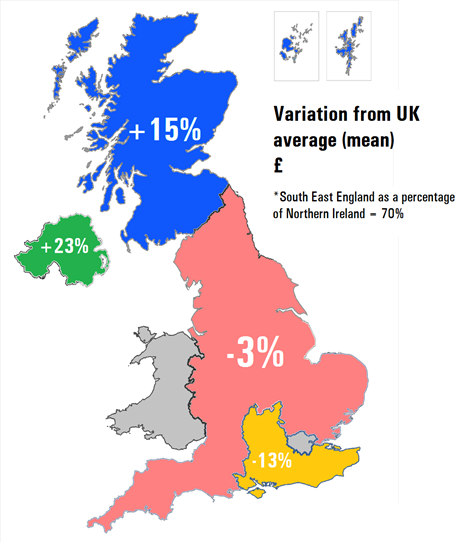
In the light of the Scottish financial settlement I am offering these important maps taken from National Statistics. (ONS publications) The first  shows just how much more public spending per head Scotland and Northern Ireland receive compared to England, especially south east England. It  illustrates the extent of the regional transfers of money around the UK.

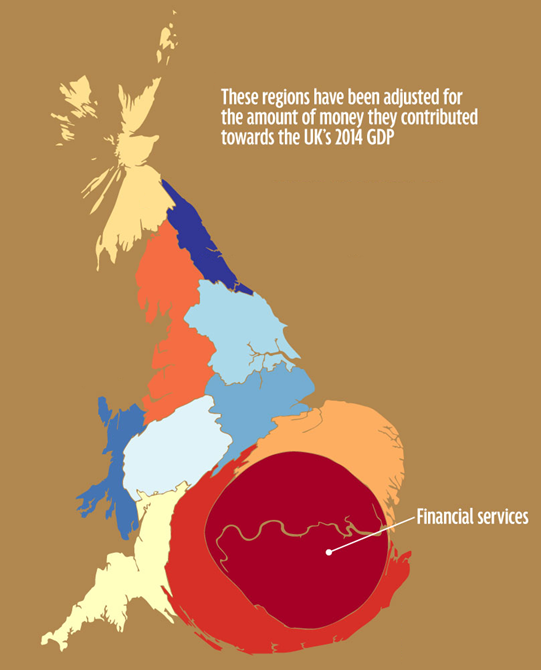
The second map shows just how much bigger London, the south east and East Anglia have become as a result of more rapid economic and population growth than the rest of the country. These three parts of the UK now represent almost one half of our economic output. This is displayed graphically by the redrawing of the map in line with economic output. As a result we see a very large London, and a large south east and East Anglia.

It appears that the latest financial settlement for Scotland gives the SNP all they asked for. The grant to Scotland has to be adjusted for the extra responsibilities the Scottish Parliament now has, and for the extra revenues they now control. The formula allows adjustments to be made for the likely slower growth of population in Scotland than the rest of the UK, the main thing the SNP insisted on.

Variation from UK average map.02.03.16

GDP Map

How many EU migrants have come to the UK?

Conservative MPs are concerned about the big difference between the number of NI numbers issued to EU migrants in recent years and the official figures for EU migrant numbers. I was pleased to see this morning that this concern is shared by John Wjhittingdale, in the Cabinet. New National Insurance numbers for EU citizens have been issued at a rate more than twice the number of EU migrants recognised in the official in the last five years. An additional 1.25 million people are involved. Last year alone the figures for new NI numbers at 630,000 were 145% higher than the 257,000 EU migrants officially recognised.

We need to know the answer for proper planning of public services and housebuilding rates, and to inform the debate on whether we now need to regain control of our own borders through Brexit.

Burghfield Lakes development

Yesterday I visited the Burghfield Sailing Club to see the latest exhibition on the Burghfield Lakes development, to respond to their consultation.
They have reduced the numbers of homes since the original scheme. They are putting in water handling to reduce flooding in the area when we get excessive rains, in addition to needing extra water handling to cater for the homes they wish to build. The development includes lakeside homes which float if water levels on the lake rise too much, and affordable homes.
If constituents do have concerns or are interested they should look at the latest plans at the Sailing Club exhibition and be aware that the company will soon be submitting an outline planning application.
I asked a number of questions about access, flood prevention and the nature of the properties. The lakeside homes do I am told meet requirements for home insurance and mortgages.

My contribute to the debate on End of Life Care, 2 March

John Redwood (Wokingham) (Con): I will draw on conversations that I have had with people around the country who have experienced a relative dying relatively recently, as well as on my own observations. I will not mention a particular case, because if I did have a difficult case, I would take it up privately in the usual way.

The first conclusion that I have formed, which I think the Secretary of State has wisely come to, is that a patient undergoing the last stages of their life and their family need a named doctor who is in charge. The family and the patient, when the patient has capacity, need to have access at reasonable times to that doctor to find out where they have got to and what the next stage is likely to be.

I believe that Ministers have put in place a requirement for there to be a named general practitioner for every patient when they are at home or in a care home. That is very welcome and let us hope that it works, so that there is someone people can turn to, whom they trust and know. However, when, as so often happens, people enter hospital and may not come out again, because of the way in which rosters and rotas work, it means that every day or every other day, there is a different group of doctors and nurses in charge of them.

That can mean one of two things. Sometimes, the family and/or the patient are constantly retold very bad news because the new team feels that they have a duty to tell them. It may not be helpful for people to keep getting the same bad news. Alternatively, the family or the patient with capacity may want information at a particular time, but no one is up to speed because they have only recently taken over and have not had time to read the notes. Indeed, reading the notes is not necessarily as good as being continuously in charge of the patient and talking to them over the days or weeks in which the treatment is undertaken or as their last days draw near. I therefore urge Ministers to get behind the idea that it is best if there is a named senior doctor—perhaps a consultant or registrar.

Often, people in their last few weeks or months of life have complex and multiple medical conditions, so a series of different consultants are involved, but no one consultant feels as if they are ultimately in charge. I am told that in some hospitals, patients are moved from ward to ward at very short notice, with different specialties in mind. The family then turn up and do not even know where the patient is, because they think that they will be where they last saw them. That can be very disruptive for the family. More care and attention is needed in some cases to deal with that issue.

The second issue, which has been mentioned by other colleagues, is the interface between social care and hospitals. All of us who visit hospitals as Members of Parliament and sometimes as family members will have observed that a very large number of patients in a lot of our wards are extremely elderly and very frail, with lots of complex medical conditions. Some of them may not be easy to treat. Others might be better off in a care home or at home, but there has been a failure to put together the set of services that they need.

I do not really believe that that is a money issue, because in many cases one could buy an awful lot of social care for the cost of the hospital bed that the person is occupying. Social care might even be cheaper.

I am not recommending that we take people out of hospital because somewhere else is cheaper, but if they would be better off somewhere else, if they want to be somewhere else and if there are no longer any medical interventions that the hospital can make, it is sensible to take advantage of social care if it is also cheaper.

Kelvin Hopkins (Luton North) (Lab): I hear what the right hon. Gentleman says, but when local authorities know that they have to pay for care when somebody comes out of hospital, they will try to persuade them to stay in hospital for as long as possible. Different budgets put different pressures on different institutions.

John Redwood: The hon. Gentleman is right. Throughout the time he and I have been in the House, under Governments of different persuasions, we have all known about the problem, we have all said that we need to solve it and still we have not managed to do that. I hope that our current talented Ministers can do something that no previous groups of Ministers have been able to achieve. There is an experiment because, with the devolution models that Ministers are considering, if the health and social care budgets are put together under the same authority, the excuse that there is a budget row goes. One would hope that the best interests of the patient were dominant and that authorities would realise that, in some cases, the best interests of the patient also enabled them to save money through switching from an expensive hospital bed to a decent care package. That could be helpful, and I hope that Ministers will do that.

For the families of those who die, the need for care does not end at the moment of death. That is generally understood by the public sector, but there are serious problems with delivering the support and administrative back-up that families need when a loved one dies. Several people who have been through this recently told me that the first thing that happens is a delay in getting a death certificate. Without a death certificate, nothing can be done to settle things. People cannot even hold a funeral because they cannot instruct a funeral director until they have a death certificate.

Not only is there a delay in getting the death certificate from the medical staff at the hospital, but people cannot register the death because of the insistence on a face-to-face meeting with the registrar, which can mean a further delay of many days before a slot becomes available. Quite a lot of families therefore end up with one, two, three and four weeks of delay before they get the death certificate, which is necessary to trigger the funeral and any financial changes consequent on a person’s death.

The Government have introduced a sensible “Tell Us Once” system so that when a person dies, the family can fill in quite a complicated electronic form, which is meant to tell all Departments with which the dead person may have been involved what the Government need to know. There are two problems with that. First, families often do not have all the knowledge that they need. Unless they have that knowledge, the Government seem unable to cross-refer and discover that, for example, the person had a benefit as well as a pension. It would be helpful if Government computers talked to each other more adequately so that the Government could do more of the work and families just had to notify them of the death and did not have to know every detail of the dead person’s financial affairs.

Secondly, because the delays with the death certificate and registrar appointments often mean that registration of the death is delayed, the Government make payments to the deceased person, and the families, having used “Tell Us Once”, get a set of not terribly friendly letters—I appreciate that they have been dressed up a bit—saying, “Your dead relative owes us this much money”. The families cannot necessarily get their hands on that money, but they are none the less obliged to pay the Government back, at an unsettling time when they are mourning and grieving and were not expecting a tax or benefit bill.

In the interests of handling the families better, the Government should speed up their side of the administration so that the death can be registered promptly, the Government do not make wrong payments and the families are not faced with letters demanding money back when they have other things on their mind and are trying to deal with the hurt. It does not make it better when the Government say, “We’re very sorry you’ve had a loss” if they go on to say, “but you owe us this much money. The usual rules apply. See you in prison if you don’t pay”.

We need to improve greatly on dealing with the first few weeks for the poor grieving families, who do not necessarily know the process, are very lost because they have lost their loved one, and are not helped by delays and sometimes the incompetence of the regulatory authorities.
The new EU deal does not safeguard the City

One of the most important parts of the UK/EU negotiation was the attempt by the UK to gain guarantees that the UK as   part of the EU will not be drawn into Euro related regulation of the finance sector nor into the financial consequences of the Euro.


The UK began by asking for the Union to be described as a “multi currency Union”. The final text allowed instead “not all member states have the euro as their currency”. It  also drew attention to the fact that all but two countries (UK/Denmark) do have to adopt the Euro in due course.


The UK sought a repetition of past assurances that the UK will not be responsible for any bail outs of Euro members. The text states “ Emergency and crisis measures designed to safeguard the financial stability of the Euro area will not entail budgetary responsibility for Member States whose currency is not the euro, or as the case may be, for those not participating in the banking union.” The EU is allowed to bill the administrative costs to the EU general budget, but other costs from any emergency will be reimbursed, implying that the UK may  have to make an initial contribution,as it did with the Greek loan in the summer of 2015.


The UK sought to keep its own rule book and ability to supervise its own banks and financial institutions, given the drive to common regulation and control in the Euro area.  This produced the following balanced text:


“The implementation of measures, including the supervision or resolution of financial institutions and markets, and macro-prudential responsibilities, ………(for non Euro countries)…is subject to the requirements of group and consolidated supervision and resolution, a matter for their own  authorities and own budgetary responsibility, unless such member states wish to join common mechanisms…

This is without prejudice to the development of a single rule book and to Union mechanisms of macro-prudential oversight for the prevention and mitigation of systemic financial risks in the Union and to the existing powers of the Union…”


In  practice the UK will come under an increasing volume of EU financial regulation, both as new Directives and regulations are passed, and as the ECJ and the European Central Bank augment their powers as need arises and individual cases dictate. There are no new mechanisms to prevent Euro area member states using their power to form new EU regulations and outvote the UK.


The UK also gave new ground to the Euro area by accepting the following limitations on its future actions:


“In order to fulfil the Treaties’ objective to establish an economic and monetary union whose currency is the euro, further deepening is needed……It is acknowledged that Member States not participating in the further deepening of the economic and monetary union will not create obstacles to but facilitate

such further deepening….”


The intention to create a single currency area with full monetary, capital markets and banking union is clear, and the UK has agreed to not to impede it. As a result there will likely be an increasing number of issues over the common rule book and EU wide regulation of the finance sector. In recent years there have been several important disputes between the UK and the EU over these matters. The UK had to dig in to secure protection against possible  loss on its share of the loan to Greece in 2015. The government withdrew its court case against EU rules limiting bonuses in the financial sector, on the grounds that the case was “unlikely to succeed”. The UK has been worried about the Alternative Investment Fund Managers Directive with its capacity to drive hedge funds away from the EU altogether, but unable to stop it. The UK was also unable to block the restrictions on short sales introduced by ESMA.

The UK has so far impeded the Financial Transaction Tax which some EU member states wish to impose. This could return to pose difficult issues over where and whether  the tax could be charged  on a trade were the continental countries to reach an agreement to press ahead without UK consent. Would London have to levy the charge on a German-French transaction handled through London? What if a UK person or corporate were one of the parties?


Living alongside the Euro area as it moves to complete its full banking and capital markets union will pose problems as the EU intends to use the legal authority of the whole Union, not just the Euro area,  for many of the measures it thinks it needs. The Union as a whole has a defined legal personality and well established decision making institutions which are not matched by the Eurozone. Much of the Eurozone’s business has to be cleared through the EU.  The general  EU budget also could become an issue.Whilst the UK has the promise that this will not  be used for emergencies and bail outs, the Euro itself may require larger regional programmes, administrative expenditure and other items where the general Union budget will be used.