Carbon dioxide reductions – the Chancellor is right and the BBC wrong

I awoke to the sound of a Radio 4 interview concerning CO2 reduction. A poor interview produced no figures, but left listeners with the opinion that China, the USA and others are doing more to cut their CO2 emissions than the UK. The Chancellor was wrong by implication to warn us that the UK is in danger of  doing more CO2 reduction (by higher energy prices)than competitors which could just result in  more of our industry going elsewhere. The UK was urged to do more.

I have found UN figures which tell us the story of the 20 year period from 1990-2010, the first 20 years of the Kyoto targets and the CO2 campaign. Over that time period US CO2 emissions rose by 20%, China’s by 165%, and the UK cut by 7.6%. Other comparable countries like Australia saw a 42% increase, Japan a 14% increase and France a 0.8% increase. Only Germany of the majors did  more than the UK to cut its CO2 output.

In the last 3 years the US had developed a lot of cheaper shale gas which has helped cut its CO2 output. Doing it that way helps competitiveness, as it cuts energy costs. The UK is doing it the dear way, through renewables, which does the opposite. It puts prices up and means fewer industrial jobs in the UK.

I think the Chancellor was right to say the UK should not follow policies which simply divert good business from the UK to other centres. Policies which develop new cheaper sources of energy which also cut CO2 would be a good idea.

Making a stronger Parliament

The UK Parliament is continuously evolving. The battle to have power and to use it wisely is a daily one. Constitutional theory may still say Parliament is sovereign, but that is only true if Parliament retains the political will to assert itself.

Parliament gained its supremacy by limiting the power of Kings and then taking over power from the monarch. It retained it by making the institutions of the country bend to its will, reshaping the aristocracy through taxes and changes to the Lords, fashioning regulation and tax for business and the professions, and undertaking a large redistribution of income through the public sector.

In more recent years Parliament has had to rein in the large government it created and sponsored. Even though most government Ministers are also MPs, the Commons has had to use its voices, votes and abilities to prevent the executive using power to excess or taking Parliament for granted under a majoritarian system.

By far and away the largest and as yet unbridled challenge to Parliament’s power has come from the EU. It is true that all the powers the EU possesses were powers that Parliament has granted. A single Act of Parliament could still take back this jurisdiction. However, the longer Parliament leaves a new settlement of powers with the EU the more danger that these powers will eventually be beyond the political power of Parliament to wrestle back. Treaty law is in conflict with Acts of Parliament.

Meanwhile, Parliament has had some successes in recent months and years reminding the executive of its role and supremacy. Ministers’ careers can be broken as well as made in Parliament. The Select Committee system provides a further check on departmental actions and decisions. This Parliament has played a major part in issues like the Syrian war. When no single party has a majority government has to work harder to ensure it has the votes for any measure it wishes to introduce.

Mr Redwood’s contribution to the debate on the Water Industry, 5 November

Mr John Redwood (Wokingham) (Con): It is a pleasure to see you taking up your new duties, Madam Deputy Speaker (Mrs Eleanor Laing).

Monopoly is the evil that we are here to debate. It is monopoly that stifles innovation. It is monopoly that drives prices higher. It is monopoly that takes away choice and consumer power, and it is monopoly that leads to rationing. We saw all those features in the water industry when it was nationalised. I am amazed that the Labour party still has people who think it would be a good idea to go back to the nationalised water monopoly, which regularly ran out of water in the summer. Woe betide the man or woman who had bedding plants in a hot summer in Britain—because before global warming we used to get hot summers, and then the water would run out. It was a tragedy, because it was a direct result of the nationalised industry.

The privatised industry, I am pleased to say, has done one thing better than the nationalised industry—it has got access to more capital. It has mended a lot of pipes, put in new pipes, and put in some investment into dealing with dirty water as well, so we have fewer interruptions to supply under the privatised industry than before. However, we did not go far enough with the privatisation. We transferred the ownership but, as some of my hon. Friends have wisely pointed out, we kept in place much of the regional structure.

We bought the idiotic idea that the industry sold to Ministers and advisers that because rivers run to the sea in separate geographical areas called river basins, it was terribly important to have local monopolies around a river basin. Woe betide anyone who wanted to move water from one river basin area to another, and woe betide anyone who wanted to use borehole water. Apparently, it all had to be organised around river valleys. Sometimes it is difficult to create boundaries between them, because tributaries and streams have a habit of not being as neat as administrative lines on maps, but it was decided that we had to have this “natural monopoly”.

There is no natural monopoly in the supply of water. As was pointed out by the right hon. Member for Holborn and St Pancras (Frank Dobson) who has recently departed the Chamber, rain falls across the whole of the United Kingdom, not always all at the same time, not always in the same quantities, but this island is not cursed with a shortage of rain for most of the time, and we collect very little of it. It is also not true to say that water is some precious resource that has to be husbanded because it will run out. Water is the ultimate renewable resource. It falls as rain; it mainly runs out to the sea; it is picked up by the winds and goes back into the clouds; and it comes back again as rain. Nature or God, depending on one’s beliefs, does most of the job for us, producing an endless supply of water to this country. All that we have to do is provide business people who can raise the capital to make sure that we capture enough of that water in a form that we can then put into pipes, and that we clean it up to an appropriate standard for the use.

We did not introduce competition into the industry when we privatised it, so many of the evils of monopoly are still with us. We have less rationing, but we can still have rationing. We have quite dear prices, although perhaps they do not go up quite as quickly as they did when they were part of a Treasury exercise. We certainly get more capital into the industry, but at the expense of quite substantial gearing, as some hon. Gentlemen have mentioned. However, many of the bad features of the nationalised industry are perpetuated and it is very difficult being a challenger to the industry, so I pay tribute to the former Minister, my hon. Friend the Member for Newbury (Richard Benyon), who produced a White Paper which is becoming a piece of legislation, which will try to open up the market a bit more.

I pay tribute to the modest steps taken in Scotland, where it was discovered that far from the taps running dry or the water prices going through the roof if the authorities dared to have more than one provider of business water, the opposite has happened: the prices went down—a little bit, because there was not a great deal of competition coming in—and above all the quality of service rose. I have talked to some of the Scottish businesses that have to deal with the water industry. They say that the great breakthrough in Scotland as a result of competition was the fact that they could get a much better service. They could get the water supply when they wanted it and where they wanted it, and pipes and so on mended and repaired.

Businesses in Scotland can also negotiate with their water industry about what sort of water they want. At present, under a nationalised monopoly or a privatised monopoly, only one type of water is available. It is cleaned to a certain standard and it then has additives put in it. An industry wanting to make drinks may need to take the additives out before it can make its drinks, so there is a double cost and a nuisance, because it cannot get the type of water it wants. A firm that wants to carry out a fairly rudimentary washing business does not need water of a quality that we can drink, but it has to pay the extra price to buy the very high-quality water literally to tip it down the drain.

Therefore, we are not seeing experimentation, innovation or customer service because of a lack of competition. The industry is determined to supply only one grade of water and only the amount it can be bothered to supply, and then it blames the customer, should we dare to say that we want a bit more. We are now bombarded with messages from the industry suggesting that water is a natural monopoly and not the ultimate renewable resource. We are told that good people take only one bath a week in order to save water, that they do not use so much water for cleaning and that they ensure that they husband their use of water in their sinks and whatever machines they have at home that require it.

I have good news for my constituents: I do not believe that. I think that water is the ultimate renewable resource, that it ought to be made available more abundantly and more cheaply and that that could be done if we trusted competition. Surely one of the advantages of rising living standards, which is what we are all here to try to help create, is that people can then use more water because they have more things to clean, or because they wish to enjoy themselves in their bathroom. We need to ensure that they have access to the right quantities of cheaper water, and competition is the way to do that.

Julian Smith (Skipton and Ripon) (Con): My right hon. Friend, as always, is speaking in an impassioned way about the merits of competition. Will he explain to the House how quickly he thinks domestic competition could be introduced and whether he thinks the Government should be moving more quickly on that?

Mr Redwood: I would do it straight away. I cannot see what the problem is. If water is a natural monopoly, as some people argue, no harm will be done by breaking the formal monopoly; it is just that nothing will happen. But of course it is not a natural monopoly, which is why the industry is fighting so hard to keep a legal monopoly. It knows that it will have to wake up and change quite a lot if it has to face competition.

We would have to give the market some help to get it going, because the monopolists are in a very strong position. We would need to tell them to use their pipe network as a common carrier, because other people would need access to it. However, the challengers might soon find, as was the case with those sorts of arrangements in the telecoms industry, that the existing assets are not so great and that they want to put in their own pipes. The challengers in telecoms did that with wires, and then of course the radio links became a cheaper and better way of doing it. Who knows what technical breakthroughs there might be or how much challengers would want to use the common carrier network? However, to get competition going we would need to start with a common carrier network, so a system would need to be put in place to allow people access to the pipes.

We would also need to ensure that the Environment Agency was prepared to license borehole water and sensible levels of river extraction by other licensees. I do not want our rivers to be run dry by people taking too much out in a dry season, so we would need proper regulation for that. As has been pointed out, however, we let huge quantities of water go to the sea during wet periods, so we do not seem to be very good at planning our water use and holding it in suitable locations so that we have plenty in drier weather.

Another thing that I think the water industry needs to pay attention to, along with other utilities in this country, is the huge disruption they cause to our road network. Our road network is a nationalised monopoly and therefore has rationing and, looking at the tax bill, is extremely expensive. It has all the characteristics of monopoly provision that I dislike. One of the things that make our totally inadequate road network even worse is the fact that it is regularly disrupted by businesses digging up great chunks of tarmac and subsoil with pneumatic drills in order to lay new water pipes, other utility pipes and wires. Why on earth have we not learnt that it is not a great idea to put these things right down the middle of the road and then hard-pack soil, subsoil, tarmac and stones on top, which means huge delay, disruption and cost every time we want to change it? In modern buildings all the services run in ducts under the floors so that we do not have to rip out the plaster, half demolishing the place, every time we want to change the wiring.

Surely we could have a system to provide easy access along the side of our roads to pipes, wires and anything else we want to put down without having to dig up the road every time. We could at least start doing that when we build new estates, shopping centres or whatever. We should do it intelligently by putting in ducts to save all that money and time. I find utility companies very sympathetic to that idea when I invite them in to talk about it. They say, “It’s a very good idea, but it won’t work in this case, Mr Redwood.” We have to make it work, because many other countries are well ahead of us on all this. They think we are completely potty to go in for this idea that the water company digs up the road and puts in a new pipe, then six months later the gas people come along and do exactly the same thing in a slightly different position, and then the following year the electricity people turn up and do it again. It is mad, costly and inefficient, and it is doing huge damage to an inadequate road network.

For all those reasons, give us competition, give us choice, give us innovation, and give us some common sense, because we are getting a rotten deal at the moment.
Water,water everywhere – but dear to drink?

The political parties are now descending on the water industry.It’s a race to be the toughest, after the battle of the energy companies over the last few weeks. The red corner has told us to expect water industry menaces soon. The blue corner has got their retaliation in first, with a letter to the industry telling them to tread carefully when it comes to price changes this winter.

You should not need this degree of political concern about prices. We do not have sharp exchanges on bread prices in the Commons, so why do we need them on water? The answer is simple. The water industry does not benefit from competition.

Some competition has been introduced in Scotland for water supplied to business. It all passed off peacefully. The worst fears of the critics were confounded. There was no interruption to supply. The taps stayed on. The best hopes of advocates were not realised either. Prices did not tumble, though they came down a little. Businesses on the whole approved. They said they got a better service as they could always switch supplier now if they were not looked after.

Usually when you introduce competition to an industry that has not enjoyed it, prices fall, quality rises, and innovation comes to the party. More of all of those would probably have happened in Scotland if the whole industry had been open to challenge, rather than just the accounts of some big businesses. The shock to the water industry was modest as the area for competition was modest.

If the political parties are serious about getting a better deal for English consumers they should go ahead an allow competition throughout the industry. Water is no natural monopoloy. It falls from the skies on all of us. The business task is to harvest enough of this plentiful and renewable resource, and clean it to the appropriate standard for its users.

We debated all this yesterday in the Commons. I will post my speech when it is available in Hansard.

Controlling the costs of big projects

Mr Cameron responded yesterday to the growing attacks on the costs of HS2 by saying the government would work away to get the costs of this very expensive project down. If you are going to build it, that is a sensible aim. The statement was made on the same day as the MOD announced yet another escalation in the costs of building the two new aircraft carriers.

Why do we have such problems in this country with runaway costs on big projects? When I buy a new piece of equipment for my home I choose one I like and agree a fixed price for its manufacture and supply. The contract is binding and I end up paying the original price. Why can’t we buy trains and boats like that?

The boats are different because the UK state wants one offs that have never been built before and will doubtless never be built again. The state as customer gets dragged into the costs of design. the state then regularly changes its mind about what it wants, giving the contractors need or excuse to hike the price. The state as customer needs to get better at deciding what it wants and sticking to it. It also needs to nail down more of the purchase cost as a fixed price.

When it comes to buying trains, there are plenty of fast trains available around the world without having to design completely different ones. Given we have in mind a big order, it should also be possible to ask the winner of the bidding competition to build significant amounts of them in the UK under licence. Building track is a one off in terms of the route, but other wise can be standardised to a considerable extent.

The difficult to knows in the case of HS2 include the compensation and land acquisition costs,and the amount of work that will have to be done to create stable and flat ground conditions for laying the track. More surveys and preliminary negotiations with landowners can start to cut the risks of overrun on the estimates. The costs of the track and signals themselves should not be open to a lot of guesswork and can be specified precisely, in advance, to a standard already in use and production. A sleeper or a signal is a ubiquitous railway product that can be costed and calculated.

I remain against HS2 overall. If it has to go ahead then at the very least it should be possible to lop £10billion off the current projected costs, by going for as many components as are in current production and by completing accurate survey work of the land costs, and conditions. There should be a deadline for the final plan which then does n to allow variations for fear of cost escalations. If the idea is to add stations, vary the routes and make other changes as we go along then the bills could get even bigger.

Minimum wage, living wage and minimum income

I support a system which delivers a minimum income. The Minimum wage in most cases is below the minimum income, so families top it up with income related benefits. The idea of raising the Minimum wage is partly to get employers to pay a higher proportion of the minimum income the state thinks appropriate. Some of the increase in wages will be balanced for the individual worker by loss of benefit top up.

The living wage is just a higher Minimum wage. The living wage is closer to the Minimum income, but there will still be income top ups from the state for many people on the living wage. The so called living wage would be difficult to manage on for families without housing, child and other support from the state.

Above all I want to promote policies that will deliver more better paid jobs. The only way we can all enjoy higher living standards is if our economy produces more, either to sell to ourselves or to sell to foreigners in exchange for imports. If we produce more we can consume more. If we fail to produce more we can argue about how much we take off the richer to give to the poorer, but on average we will no better off. If we go too far down the road of redistribution we make ourselves collectively poorer, as some of the rich leave and cease to make any contribution.

Labour’s latest idea of offering employers a tax break to pay more to their employees is mainly redistributing what we have. We will need to see the numbers. The state accounts will lose tax revenue from the tax cut but will also reduce spending from the top up benefit reductions. The employment effect will hinge on what such a scheme does to the costs of employing people. If the tax cut balances out the extra wage cost it will be neutral. Were the tax cut to be less than the extra pay cost then it could damage employment.

Transport capacity

The last time I took an early morning train on the East coast mainline, only one in four of the Standard class seats and one in ten of the First class seats were taken in the carriages where I counted. The West coast mainline was similarly little occupied when I have taken early morning trains to the north on that. I reported on journeys to Birmingham and Manchester.

This makes the tri party decision to build more capacity on these train routes all the more curious. I can think of plenty of places where we need more transport capacity now. Providing more on routes where the existing train franchisees are finding it difficult to fill the places is not a model for success or a good investment. Whilst travellers will welcome the eventual fare cuts competition between HS2 and the WCML will bring should HS2 be completed, the poor taxpayer will be left with a large bill to pay the big running losses on both lines.

We could start by looking at the chronic shortage of capacity on our major motorways. They could all do with widening and improving in many locations. We could continue by completing proper capacity on major trunk routes, like the A14, the A 303, and the A 27.

We could move on to the commuter trains into our major cities. We are short of commuter capacity into Manchester, Leeds, London and Birmingham. We need better brakes, lighter trains, better signals so we can run more trains per hour. We need longer trains and in some cases longer platforms. All these improvements could delay the need for more track, though doubtless there are some pinch points and shorter sections into city centres where more track would be a good idea, and even some where it is also possible.

There are a host of detailed local road and rail improvements needed in many towns and cities around the country, that come a lot cheaper than the prospective bill for HS2.
Your thoughts on priorities would be interesting.

RBS to do the partial splits

The Good bank/Bad bank campaigners were seen off in the Treasury decision on restructuring RBS. Those of us who wanted to see more than one competing UK clearing bank formed from the parts of RBS were also disappointed.

However, the new policy does include selling off Citizens, the US banking Group owned by RBS, and further reductions to the Investment Bank, whether by divestment or slimming down. These are both policies I have called for in the past.

The bad news still continues from RBS. The Bank reported more losses and still pays no dividends. It has published a report on its own small and medium sized business lending and service which is extremely critical.

The new Chief Executive sounded the right note, when he admitted past mistakes and promised full attention to creating a better quality more responsible UK clearing bank. He pledged himself and his team to being a better bank for UK business, and a more attentive and helpful bank towards its retail customers.

The Chancellor was able to welcome all this by saying there is now a new strategy. This new approach is designed to make RBS an asset rather than a burden for the UK economy. It is time RBS was available to make a full contribution to UK economic recovery.

RBS has got its portfolio of bad loans down to a mere £38bn, a relatively small sum for a bank of its size. The plan is to sell more of these on from within the ring fenced bad bank RBS will itself continue to own.

I wish the new management well. Splitting up RBS more fundamentally would have been a good idea 5 years ago or even 3 years ago. Now we need what is left to work better for UK economic recovery. We also need to speed the day when RBS can make profits and pay dividends, to get some of the taxpayers’ money back. Labour made a very bad investment. They should have broken up RBS at the time of its collapse, and only supported with loans those bits essential to the UK’s money transmission and deposit system. Now we have to move on, and manage the inherited mistakes as well as possible.

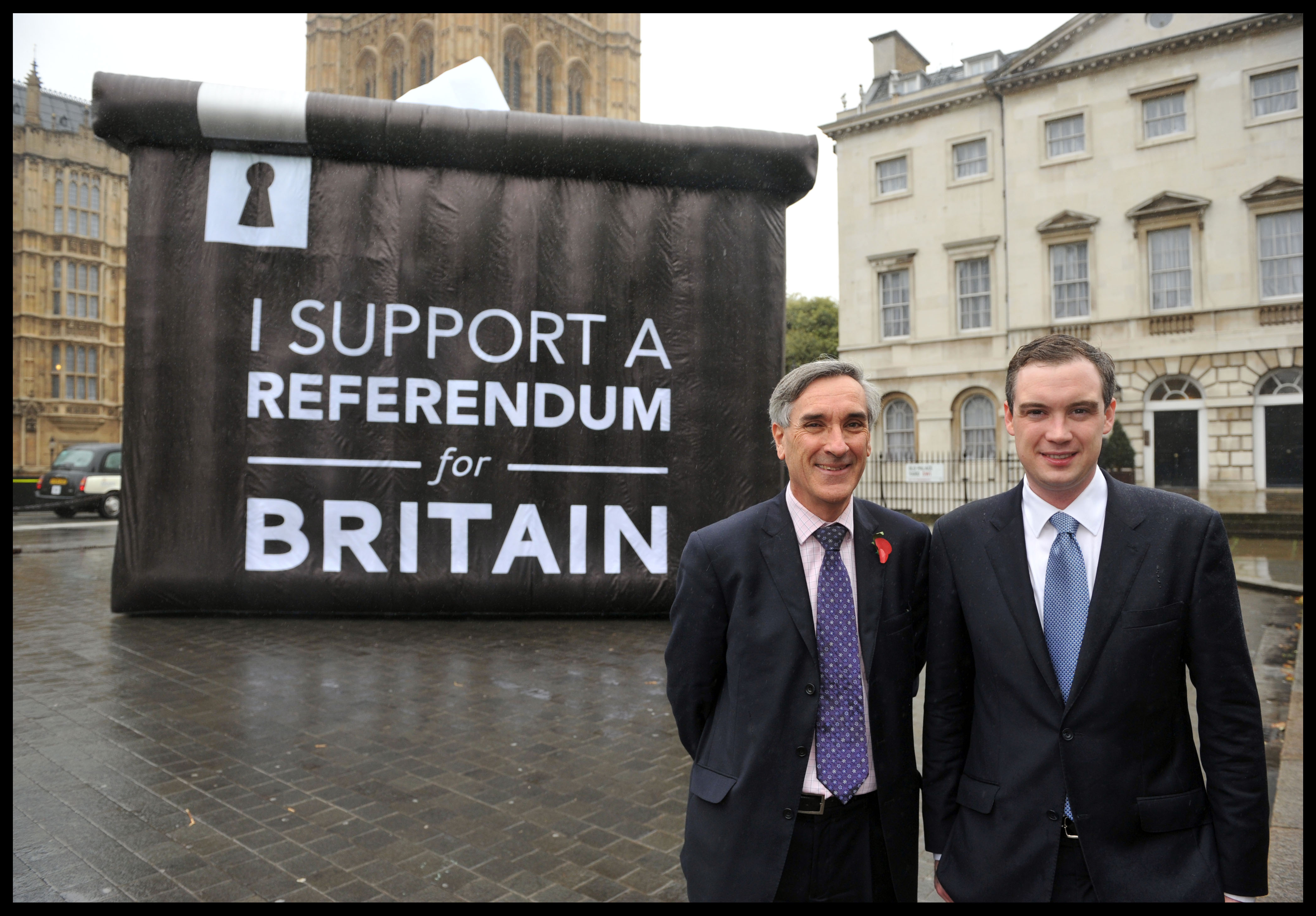
EU referendum – What’s the question?


               The Conservative backbench Bill before Parliament to grant a referendum on membership of the EU has as its question:

                 “Do you think that the UK should be a member of the EU?”

                Voters have the right to vote Yes, or No.

                The Electoral Commission have now considered this draft question. They have asked is it clear enough? Is it fairly weighted? They have considered other possible wordings.

              They have come up with two versions which they prefer. The first is inviting the same Yes/No answer. It is

                ” Should the UK remain a member of the EU?”

                 This is shorter than the Bill proposal. It also makes clear should anyone be in any doubt that the UK is currently a member of the EU.

                The second version requires a longer supplied answer: It is

              “Should the UK remain a member of the EU or leave the EU?

              Voters can tick a box to say “Remain a member of the EU”  or a box saying “Leave the EU”

           I am happy with the wording in the current Bill. Anyone voting in the referendum will understand we are currently in the EU, and will also understand that voting No means leaving. Of the two Electoral Commission versions I prefer the shorter one.

            Any amendment to the Bill slows down its passage, so has to be weighed carefully. What do you think?

PS The Electoral Commission amended the Scottish referendum question to “Should Scotland be an independent country?”. This question does not tell people in Scotland that they are not currently an independent country, and gives to the “out of the union” camp the advantage of answer Yes. Yet when it comes to the EU the Electoral Commission does wish to explain the UK is in the EU, and give Yes to those who want to stay in, not to those who want to some out. Their approach seems variable.