High prices for alcohol?


           The government’s attitude to alcohol is different to tobacco. Excessive alcohol consumption is reckoned bad for your health, but moderate alcohol consumption may not be. Excessive alcohol consumption can also be bad for civil order, with many some social crimes being  related to alcohol abuse.

           For this reason government does not seek to ban alcohol advertising or promotion. It does now, however, ask the question should there be a minimum price for alcohol to try to deter excess drinking.

         An enforced minimum price seems unfair. Rich people would be little affected by it, and could carry on drinking to excess. Poorer people would be hit. People with an alcohol problem might be more likely to resort to illegal means to sustain their addiction.

           The case for is based on the simple market proposition that if you raise the price less will be consumed. What is your view? If there is a minimum price, should the producer and retailer pocket extra profit? Should a higher tax be imposed?

           Is current alcohol taxation correct?

What do we want Nanny to do in our Nanny state?


              This week I wish to examine just how much we want the government to interfere in our lives in the pursuit of good.

Let us begin with the vexed question of tobacco.

             I am a non smoker. I accept the medical advice that smoking can be damaging to your health. I decided not to smoke as a teenager, when I discovered that my lungs rejected smoke when I tried a cigarette. I always disliked the smell of tobacco smoke, and the taste smoking left in my mouth.

           I am also a freedom lover. If tobacco remains a legal substance I have no wish to stop others smoking in ways which do not annoy others.

            The law has moved on, and now favours the majority who do not smoke and controls the places where smokers can smoke. Today the issue is should the law be moved further?

          Australia says the law should dictate the packets used for the cigarettes. After all, tv advertising has been banned, sponsored smoking in films and at sports events has been terminated and other actions taken to make it difficult to promote the sales of cigarettes.

                 As always, government has a conflicted of  interest in this topic. As health custodian it wants to cut cigarette consumption. As tax collector, it finds the duties on tobacco very useful.

                 Should government leave things as they are? Should it ban more advertising/promotion like the packet designs? Should it make smoking illegal?

What is a public service?


The Uk debate has a rather narrow implied  definition of a public service. MPs and media commentators see the NHS, state schools, the police and the BBC as public services.

To me the provision of bread, as well as water is a public service. Sky Tv is as much a public service as the BBC. Private sector health providers and public schools are public services like their state cousins. Private sector firms may often be working for the state as contractors helping provide public services.

The narrow UK debate seems to centre around a particular idea of how a public service can best be provided. If a service is free at the point of use, deliverd by state employees, and not subject to competition, that is a pure public service in UK eyes. In practice, this idea of a public service scarcely exists in the modern UK. It may be largely true of our defence and police forces, but it is not true of the other commonly identified public services.

In the case of health there are now charges for dental work, for prescriptions and for some items of service. The work may be done by a private sector contractor rather than a state employee. Our state schools face competition from public schools, offering  free places and scholarships to children whose parents cannot afford the fees. The BBC imposes a user charge or tax on all people with tvs, but faces competition from free to air and paying services. It also uses its market presence to advertise its own services extensively.

I find we need a different way of analysing public service from the simple public or private of the rather stultified UK debate. There are fewer and fewer pure public services on the narrow definition. The questions to ask when trying to analyse a public service are:

1. Do users pay at the point of use or not?

2 Is there choice for users?

3.Are the employees and organisations producing the service under state control or  not?

These questions give eight different types of public service or enterprise, ranging from the state monopoly free at the point of use with state employees, to the private sector business delivering a competitive service and charging the customer.  There are more and more hybrids as a result of public service reform by Blair and the Coalition.

The debate would be better informed if instead  of two teams backing either “pure” public service or pure free enterprise, we got down to discussing how each service with a state component can best be organised.

What a way to run a railway


One of the most absurd fictions shared by government and opposition in the UK is that Network Rail is a private sector company. As such Ministers fear to interfere with it, and the PAC under Mrs Hodge refuses to examine its spending habits. We have to rely on the Office of Rail Regulation to avoid capture and provide some small voice for the taxpayer.

Network Rail is as much a part of the public sector as the current Royal Mail or the NHS. It has no private shareholders. The members of the company limited by guarantee are selected by the management, who also select each other in most cases. It is the result of the state under Labour acquiring the privatised Railtrack.

You can see just how much part of the public sector it is if you look at the financing. The massive £30bn debt is effectively government guaranteed. 62% of the revenues of the company comes in the form of a government grant. The 27% that comes as payments from train companies using the network also comes from sources heavily influenced by the state, in some cases run by the state, and subsidised by the state. I have set out before some of the financial losses made by the company on its financial transactions.

The Office of Rail regulator thinks there is substantial scope for improvement in financial and operational management. In their report on the 2011-12 performance they said

“It is critically important that the rail industry delivers significant improvements in value for money. …compared to 2008-9…UK rail industry costs could be reduced by between £2.5bn and £3.5bn per annum by 2018-19” (70% of that applies to Network Rail)

They went on to express “serious concerns about aspects of Network Rail’s asset management” and concerns about the percentage of trains not running on time owing to faults of the network operator.

In the last year they reported on Network Rail did cut its costs. They need to do much more, both to reduce costs and to improve the quality of work and the responsiveness of the business to change.

Why the UK should not opt in to Criminal Justice measures in the EU

I set out the text of my speech in the Commons on Monday over the UK, democracy and criminal justice:

Mr John Redwood (Wokingham) (Con): Today’s debate should be about the very future of the United Kingdom’s democracy. I and many of my right hon. and hon. Friends believe that one of the great duties of a state is to settle on a fair and strong criminal law and to ensure that the crime-fighting resources are put in to maintain that law. We also believe that, in an increasingly global world of criminal activity, those functions can be properly discharged by the Home Secretary in Cabinet and by the police forces of our country only if we have proper co-operation and collaboration arrangements with other countries abroad. We need those co-operation arrangements, not just with other European countries in the European Union or the few countries in Europe not in the European Union, but with every country around the world. I am pleased to say that thanks to successive Governments and Home Secretaries we do have in place a set of pretty good arrangements with the major countries, and we have demonstrated our ability to negotiate successful arrangements for extradition and mutual crime fighting with those countries that are not in the European Union and to find ways of doing that with countries in the European Union.

Let me make it clear at the outset that those of us who do not wish to opt back in to European criminal justice measures are no more soft on crime than anyone else in the House. We believe that there can be an alternative way of ensuring proper co-operation and collaboration with France, Germany and the other leading European Union countries, just as we have those successful co-operation arrangements with countries that are outside the European Union.

Our objection to any of these measures, including the European arrest warrant, is not necessarily about the measure itself, and certainly not its purpose, but about the way in which the institutional structure is developed to back up the measure. We are trying to protect our democracy, this Parliament and future Home Secretaries from the event that the European Court of Justice, once we have opted into any of these measures, can use that opt-in as a device for making good criminal law in Brussels and in the Court that this House and the British people might fundamentally disagree with.

Dr Julian Huppert (Cambridge) (LD): The right hon. Gentleman talks about alternatives to some of these measures. Is he aware of the formal evidence given by the police, who said that alternatives to the European arrest warrant “would result in fewer extraditions, longer delays, higher costs, more offenders evading justice and increased risk to public safety”?

Does he accept that that is the police’s advice?

Mr Redwood: Of course we can find police and others who take the hon. Gentleman’s view, but I think that it is putting very different weights in the balance. He is giving us an immediate topical problem of view, and I am giving him something fundamental about a national democratic state and the future good government of our country. When I weigh those in the balance, there is no issue for me; of course we must protect our national democracy and then work away at any imperfections there might be in the cross-border arrangements because we have put democracy first.

Martin Horwood (Cheltenham) (LD): If the right hon. Gentleman is challenging the fundamental idea of an international arrest warrant operating among the 28 member states, is my maths correct that he would have to replace it with 784 bilateral extradition treaties, and that is just on one of these justice and home affairs measures?

Mr Redwood: My maths tells me that there are far fewer countries in the European Union than in the rest of the world, and we manage to have pretty good arrangements with the rest of the world. I have every confidence in the ability of the current and future Home Secretaries to restore our bilateral arrangements with the other 27 members of the European Union just as surely as we have bilateral arrangements with most of the other 200 countries in the world. The hon. Gentleman will remember that there was a time before this country was in the European Union, and certainly before we were in this current set of criminal justice arrangements, when we had perfectly good working relationships. I am sure that he and I would have liked them to be improved—one can always improve and make progress—but he should not be so defeatist about the ability of our Ministers and civil servants to defend Britain’s interests and come up with a good answer.

Chris Bryant (Rhondda) (Lab): The right hon. Gentleman suggests that it would be perfectly fine to abandon the European arrest warrant and rely on bilateral arrangements because we have such wonderful arrangements with so many other countries in the world. The Russian Federation, for instance, is covered by the previous version of the EAW, the European convention on extradition, but we have not managed to get Mr Lugovoy back, have we?

Mr Redwood: To find a country where there is a problem does not disprove my case. My case is that if there is good will—[Interruption.] The hon. Member for Rhondda (Chris Bryant) seems about to allege that all members of the European Union cannot be trusted and that we can do a deal only with the Commission. I have more faith in France and Germany than he does. I think that it would be in France’s and Germany’s interests, should Britain opt out of the European arrest warrant, to put in place really good arrangements, because they will want them to operate for them in Britain just as surely as Britain needs the arrangements to operate in France and Germany. As someone who does not like centralised European government arrangements, I find that I am often warm-hearted towards, and supportive of, the French and Germans and believe that we can make very good arrangements with them because it is in our mutual interests to do so. It is the rapid pro-Europeans who so dislike our French and German partners that they say that it all has to be bound up in central European government because we cannot trust France and Germany to come to a sensible arrangement with us over these important matters.

What is it about our country that these people do not like? What is it about our national democracy that they wish to tear down? A previous Government negotiated in good faith the third pillar arrangements for criminal justice. The idea of the third pillar was that, yes, we wanted enhanced co-operation and collaboration with our nearest neighbours, and of course I accept that there are more likely to be issues with France, Belgium and Holland, because they are very close, than with countries in Asia, so there is a reason for enhanced collaboration. We worked out a system in which we could have better procedures, enhanced collaboration and more co-operation, based on the mutual agreement of the states involved, not based on an independent united states of Europe Government, which is emerging as a result of this and other exercises but not from an independent court where there is no democratic accountability to the British people.

In recent months, we have had case after case from the European Court of Human Rights that this country and the British people have deeply disliked. There is very little we can do about that. If we give further enhanced powers to the European Court of Justice, we will have another series of such decisions from the European Court of Justice that we do not like. All major political parties will have to go to the electorate, shrug their shoulders and say, “We can do nothing about it. We still expect our salaries and to sit in the Parliament of the United Kingdom, but don’t expect us to revise this. We no longer run the criminal law and can no longer change the law in the way you want or expect. That is now settled in Brussels. Even your MEPs probably won’t be able to sort it out because the European Court of Justice is supreme above all elected officials and can provide the motor for making decisions on these crucial matters.”

The case before us today is very simple. Those who vote for opt-ins vote for European centralised justice and for the uncertainty of the European Court of Justice, which will in due course make decisions that the British people and their elected representatives cannot tolerate. Those who vote for opt-ins vote because they do not like this country’s democracy and they vote themselves out of a job.

Those of us who vote for the opt-out, and nothing but the opt-out, vote for the reverse. We vote for the House to take the responsibility. We vote to trust successive Home Secretaries. We vote to trust the judgment of the British people to judge their Governments and Home Secretaries, elect those who do a good job and throw out of office those who do a bad job. That is a true democratic system.

I do not want to live in a country where criminal justice has been transferred to independent experts abroad whom we cannot sack or influence. I do not want to go to my electors and say, “As a result of the vote we have had tonight and what happened subsequently, another major power of this country’s democracy has been seceded to the European Union in perpetuity in such a way that we can never get it back.”

It is a simple issue. I urge the House to vote for the opt-outs and against the opt-ins.
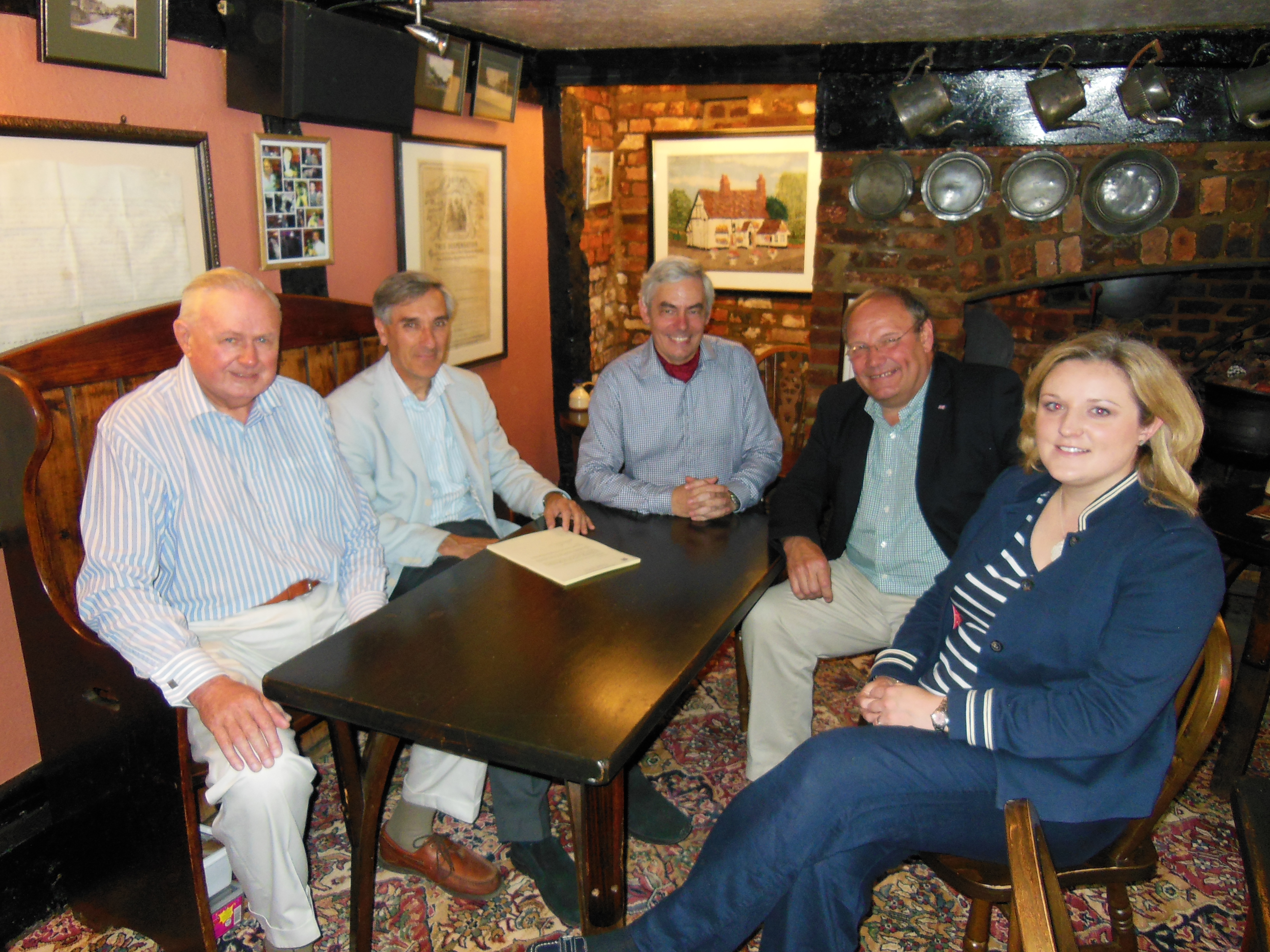
Surgery with Councillors

DSCN0091DSCN0093

The Rt Hon John Redwood MP meeting with (left to right, top photo) Councillors Barrie Patman, Anthony Pollock, Stuart Munro and Charlotte Haitham Taylor in The Swan, Three Mile Cross last weekend.

Progress on opting out from criminal justice measures


                  People writing into this site often ask what backbench MPs do all day. Eurosceptic ones have been busy since the government first announced its motion for yesterday to approve the opt out from the EU Criminal Justice measures, and to press on with opting back in to some of them.  There have been many meetings and discussions with Ministers, as MPs have explained that we want to opt out of all the measures, but are not  persuaded of the need or desirability of opting back in to some of the most important of them.

                          As a result of these discussions the government toned down its original motion. Eurosceptic Conservatives were still not happy. Three Chairmen of relevant Select Committees tabled a further amendment, to delete reference in the motion to the list of possible opt ins the government has already drawn up in a negotiation betwen Lib dems and Conservatives. Under pressure, Ministers decided to accept this amendment.

                                It means that last night the Commons did approve the all important opt out from the 133 measures. The wording on future opt ins was watered down, and leaves Parliament free to scrutinise draft proposals, offfer advice, and in due course have a vote on any measures the government does wish to opt into.  That was progress.

                              The Select Committees will now get work on whether some opt ins are desirable. Unfortunately from the Eurosceptic point of view both the Labour and Lib Dem parties want more opt ins, not less.

Wokingham Cricket Club stages Lords and Commons against the Aussies


             On Sunday The Don Bradman XI touring side narrowly beat the Lords and Commons in a good game at Wokingham Cricket Club. With 35 overs each to bat, the Aussies hit a lively 234. In reply Parliament managed 217, including an excellent century by James Morris MP. On a good batting track neither side looked like taking 10 wickets, as we bowled away in the summer sunshine.

             I would like to thank all the staff at the Ground for making our stay so pleasant and for providing a good traditional English cricket tea. Our guests from down under were most impressed by the quality of the facilities and the friendliness of all involved. It made up for the agony of watching their national  team just lose one of the most exciting and close fought Test matches.

NHS – front line staff, back office and management


           It is popular amongst many politicians and the public to say we need to spend more on more nurses and doctors, and less on managers and administrators. We need to spend more on medicines and treatments, and less on expensive computer systems.

            This may be true, but it should not go unchallenged. A hospital or doctors’ surgery does need managing. Someone has to make sure there are the right staff doing the right things, that the medical supplies turn up on time, the meals are served and the floors scrubbed. In the 1980s when the NHS was reviewed, the Report concluded that the NHS was then undermanaged.

           Maybe now we have too many managers and too many layers of management. Part of the aim of the current government’s reforms is to simplify and reduce the management overhead, which is a worthy aim.

            A successful hospital also needs good administration with excellent computer records. A nurse or doctor reviewing a patient’s progress, administering continuing treatment or preparing a patient for an operation needs quick and easy access to the patient record. It is important they have the full background so they know what to administer, which treatment to pursue, and what to watch out for.  One of the surprising things in some hospitals is how much is still done manually or with written records after years of high budget spending on computerisation.

          Some hospitals still have handwritten notes at the patient’s bed end. They dispense drugs based on the patient written notes. A proper computerised system would be better at ensuring the right drugs were administered at the right time, as the computer would remember it had already dispensed a given drug, and could check that it was the right drug against a bar code prior to the drug being offered to the patient. Some hospitals I am told now have these properly computerised systems, with the necessary checks against wrongful dispensing or overdosing, and with proper audit trails created by each action in the system.

           Sorting out the balance of work between medical professionals and adminsitrators is part of good management. Nurses and doctors do have to be involved in note making and recording, as it is their judgements which need to inform the system based on the evidence assembled from tests, talks with the patient and visual inspection of the problem.


Who should be eligible for NHS care?


         The government aims to legislate and change the administrative arrangements governing the rights of visitors, recently arrived people and illegal migrants to health care on the NHS.  They are currently consulting on what changes they should make, so your views are particularly relevant on this issue whilst the government is making up its mind on the detail.

          The government believes that there should still be an entitlement to free emergency care if a visitor, recent migrant or an illegal migrant is caught in a bad accident or develops a serious condition that needs rapid treatment. The issues to be settled are what entitlement if any do these categories of people have to the rest of  NHS care.

           If someone comes to work or stay here for a longer time period on a legal visa they currently can register with a GP for free primary care. If a visitor needs GP care during a shorter visit they too can currently onbtain free care from a GP. A visitor is not meant to receive free hospital treatment for anything other than an emergency whilst staying here. They can obtain health insurance or pay cash for any treatment they do want in a UK hospital, or wait until they return home.

          People exercising their right to work here under EU movement of labour rules qualify for free treatment like all UK citizens. The NHS is meant to cross charge the country they have come from for the treatment offered.  

          The government has suggested charging other new arrivals £200 as an initial payment or contribution to NHS costs, to be followed by a continuation of current practice of free treatment thereafter.

          Is this a sufficient levy and a fair approach, covering people like students and short term workers coming to the UK with a visa? Should temporary residents qualify for free GP care? Should hospitals have to take more care over charging people from 0verseas receiving treatment? How far should we go to ensure that we are running a National Health Service, rather than a World Health Service?

           I see this morning’s papers are full of news of high death rates and poor performance by a number of NHS hospitals. What should the government do about that?