Mr Redwood’s intervention during the Statement on Abu Qatada, 24 April

Mr John Redwood (Wokingham) (Con): Given the way in which successive British Governments have been made to look impotent by the European convention and regime, when will my right hon. Friend bring proposals before this House to ensure that the will of Parliament and of the overwhelming majority of the British people can be upheld, common sense applied and justice delivered in these difficult cases?

The Secretary of State for the Home Department (Mrs Theresa May): My right hon. Friend will have to wait and see what we intend and are able to bring to this House. I have already indicated that I intend to address some of these issues in a new immigration Bill if parliamentary time allows for it.

Well done the Co-op


           Let’s hope the Co-op’s decision to withdraw from buying the Lloyds Bank branches will make the authorities think again. The Co-op said that the increasing regulatory burdens on UK banking made it no longer in  their interest to expand their banking business. The weak economy they said  also impedes decent profitability.  Indeed, they are reviewing their existing bank at the same time, and could decide to sell or cut that as well.

          It is good it was the Co-op which took this view. People who hate banks on the left of the conventional political spectrum will find it more difficult to criticise the Co-op when it stands up for the need for sensibly regulated and profitable banking. Their statement was moderate and considered.

           Most participants in  the banking debate have come round to the view long proposed here that we need more banks to offer competitive services. If we are to achieve this the Regulators have to be realistic in their demands for cash, capital and staffing levels. The market has to sustain profitable banking, however loud the cries of bank critics everytime a bank dares to make a profit. It is profits that allow banks to increase their capital base and sustain more lending to people and companies that can make good  use of it.

           It is a difficult debate to conduct, against a background of such hsotility to banks and bankers whipped up by polticians keen to find a group more unpopular than themselves. The Archbishop of Canterbury called for the break up of RBS, a sensible cause. He did, however, also state that the banks had made two big mistakes – borrowing short and lending long, and lending to people who could not repay.

         The truth is all banks have to borrow short and lend long to some extent. That’s how they make their money.  Some current and on demand deposit account money can be lent to others for longer periods, as long as the bank keeps enough cash to handle demands for withdrawals.

          They also have to lend to some people that will not in the end be able to  repay. They back businesses, and not all will succeed. Good banks manage the risk of the different term structures on their balance sheets without misadventure, and keep the numbers of defaulting clients under control.

          We need more banks. The Regulators are still not getting it right.

Debate on the Lords Amendments to the Growth and Infrastructure Bill, 23 April

Mr John Redwood (Wokingham) (Con): I am grateful to the Minister for giving way, and he need not look so heavy-hearted, as I am going to say that I greatly welcome the changes, and that many Members on the Government Benches feel the Government have listened and come up with a sensible proposal. Will he just confirm that existing permitted development rights are not in any way affected by this new procedure, and that they are still there in perpetuity for people to use without any hassle?

The Minister of State, Department for Business, Innovation and Skills (Michael Fallon): Yes, I can confirm that, and I can also assure my right hon. Friend that I was not heavy-hearted; I was simply keen to move on to the employee shareholder clause, and I was wondering how long I was going to be occupied in explaining how my right hon. Friend the Secretary of State for Communities and Local Government (Mr Eric Pickles) had fulfilled his commitment last week to listen to the concerns expressed in this House and to come forward with what I suggest is a very reasonable compromise.

Germany and the UK – cars and banks

You would have thought the left and the Greens would be very hostile to the Germany economy in general and its car industry in particular. Germany burns a lot of coal and depends on manufacturing to a considerable extent. You might have thought that the EU, a well known leader in trying to curb carbon emissions and excess remuneration, would turn its full attack onto the car industry. After all, it has made its hostility to banks and bankers ever clearer, seeking to regulate their pay, stop some of their activites, and tax others. So much so that many in the UK now think the EU has been picking on its lead activity to do it harm.

The German car industry has been very successful at making large fast cars that appeal to rich people. Indeed, you have to be seriously rich to be able to afford the £100,000 for a top of the range BMW or Porsche, or the £165,000 for the S class Mercedes AMG. No, I am not thinking of buying one, as they are well beyond my budget for a car. I have never yearned for one. Nor am I jealous of those who like them and can afford them. That’s because I am no carbon campaigning green or an envious socialist.

If you do dislike people being too rich and think they ought to be taxed, then taxing luxury cars more heavily would surely be a good place to start. After all, it brings you two gains in your jealous universe. It hits the rich directly, and it may cut the number of high emission large engined cars sold.

In fairness to the EU, they have tried a bit of this. German lobbying and influence, however, has been most astute at ensuring the EU’s carbon attacks do not drive BMW, Mercedes, Porsche and Audi out of business at the luxury end.

Motor manufacturers are also famous for paying their senior executives very high pay. This has not become such a big issue as bankers pay has become, again owing to excellent news management and lobbying. The CEO of VW earned $23m in his best year. Remuneration in excess of $10m a year is common at the top end of the industry. So far there have been no EU proposals to cut this pay.

It all goes to show being good at EU politics is important if you wish to keep these contentious industries and activities going and if your country stays in the EU.

The EU wants faster and deeper cuts

On Monday Parliament received the Treasury’s 2012-13 “Convergence Programme for the UK: submitted in line with the Stability and Growth Pact”.  It was a timely reminder of more powers surrendered by the previous government.

We were told at the time that the UK would not submit its budget to EU scrutiny or decision prior to the Chancellor delivering his Statement to the Commons.  The UK would merely send the EU the Budget Red Book as a matter of record after the Budget.

As so often with EU matters, it is not as simple as that.  The government has sent a 235 page document to Brussels about our budget, spending and tax plans, and economic forecasts.  Part of this, is a series of extracts from the Budget Red Book and part of it a long extract from the report of the Office of Budget Responsibility.

However, page 5 in the introduction and pages 29-30 on the Excessive Deficit Procedure go further than was suggested at the time of the agreement on the Pact.  The introduction explains that the UK has to submit an annual Convergence Programme.  The country is under an obligation “to endeavour to avoid an excessive government deficit” under Protocol 15 to the EU Treaties.

The section of the Excessive Deficit Procedure is even more concerning.  The UK first accepted this requirement under Labour in 2008.  “In November 2009, the Council made recommendations to the UK, including a target to correct its excessive debt by reducing the Treaty deficit below 3% of GDP by 2014-15.”

The new government reports that it “remains committed to bringing the UK’s Treaty deficit in line with the 3% target set out in the Stability and Growth Pact”.  This is now planned for 2017-18, delayed from 2014-15.

This filing reveals the absurd paradoxes and contradictions of modern UK politics.  Labour who now say we should not cut the deficit so fast or so far signed us up to an EU policy which requires us to cut further and faster to comply with the EU Excessive Deficit Procedure.  Conservatives, who think it is right to cut the deficit and get more quickly to the point where debt as a proportion of GDP is falling, do not think the EU should be involved in these UK budget decisions.

It would be interesting to hear on this site from the bloggers who both think the deficit reduction is too fast and who think the UK should be following EU policies faithfully.

Japan’s fiscal and monetary boosts yield little

Over the last twenty three years Japan has tried stimulus after stimulus in a desperate bid to get back to the pre 1990 growth rates. Nothing has succeeded.

As a result Japan has gone from having a relatively low debt and deficit, to having the largest public debt as a proportion of GDP of all advanced countries. Japanese public sector debt is now over $12 trillion, and more than 230% of GDP. Money has been borrowed to boost current public spending, and to provide investment stimulus through large public capital projects.

Nor has Japan spared the monetary stimulus as well. Japan has tried liberal amounts of Quantitative easing, has run interest rates close to zero for most of the time, and has made clear it would prefer inflation to deflation. The latest programme of bond buying is just a larger version of what has gone before.

So why hasn’t the Japanese economy taken off? Crude Keynsian reflationists would predict that with this much fiscal and monetary stimulus combined the economy should be in overdrive. Some would accept that the extreme bubble created in the 1980s posed big problems whilst asset prices adjusted, and would agree that the banks remained broken by falling asset values and damaged loans for a long time. In retrospect maybe a sharper crash and more drastic bank write offs and recapitalisations might have speeded up the adjustment and the eventual recovery.

This to me is only part of the story. At about the same time as Japan’s bubble burst something else important happened. The Japanese model of incremental innovation in cars and consumer electricals and electronics which had spwaned a series of world beating companies suddenly met its match from competition elsewhere. The Japanese excellence at making things was copied by the US and Europe, adopting the Toyota type manufacturing systems. The US launched the digital revolution, which Japan found difficult to adopt and develop. Later, China and other Asian centres emerged capable of undermining Japanese competitiveness still further.

The truth is Japan’s era of supremacy making the world’s most competitive cars, tvs,cameras and the rest was undermined both by new products and services she did not develop, and by cheaper competition for the products she does still make. Japan needs a new industry or two and more world beating companies.

Commentators always think there is a simple monetary or budgetary fix. In the end earning a good living in a competitive world comes down to having better goods and services. Japan has lost her edge. In the UK the decline of finance and oil and gas, our two high value added lead sectors of the 90s and noughties, is the background to our current sluggish GDP performance. Spending a bit more in the public sector does not fix this, as Japan shows.

Launch of TiM Friends

friends launch 4 (3)

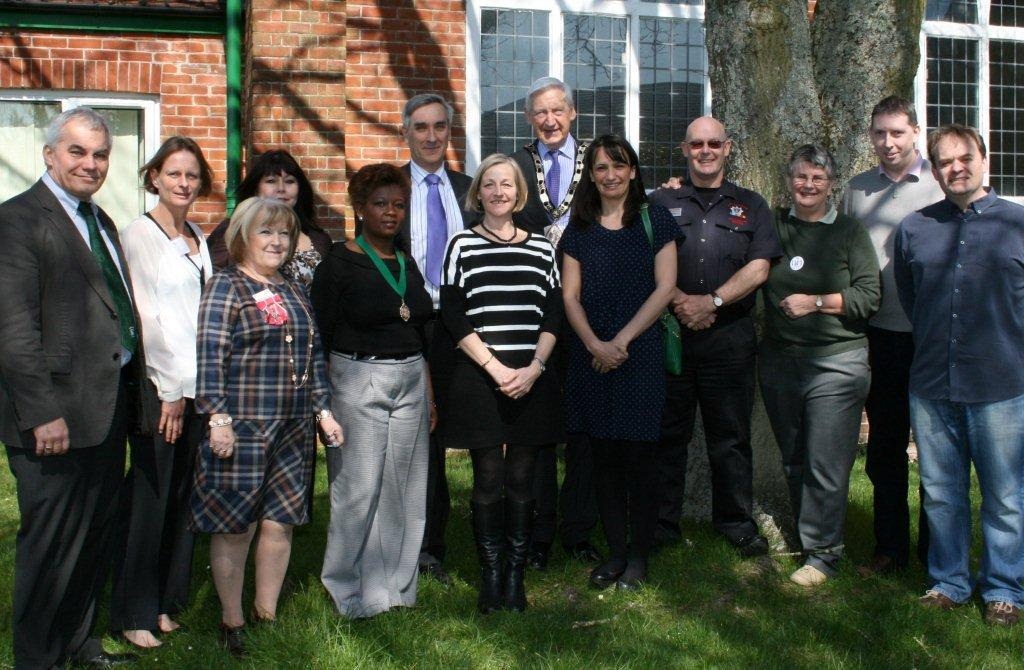
Image: The Rt Hon John Redwood MP and Councillor Adrian Edwards, Chairman of West Berkshire Council, together with representatives of TiM, Link Visiting, and supporting organisations.

Press release:

John Redwood MP was among the guests attending the launch of a new befriending service in Burghfield and Mortimer last Saturday, 20th April.

TiM stands for Together in Mission, where the “mission” is for local churches to work together on projects which benefit the community. TiM is made up of 10 churches and since 2009 has set up a community fun day, a community cafe (Café B which hosted the launch), and a School Pastors project at the Willink School. All of this has been in response to what local people have said themselves they would like to see set up in their communities.

TiM Friends aims to provide extra care and support for older folk who find themselves on their own, lonely, and who would welcome someone to chat to, take an interest, and become a friend. We will provide home visits, regular telephone calls and opportunities to get out and mix with others, perhaps at a lunch club or pie and pint day (more popular with men!). We believe this will make people feel valued and appreciated, and life a bit better overall.

The project has been set up using a model pioneered by Link Visiting, operating successfully in the Wokingham Borough since 1998. Recently, Link has been exploring ways in which further befriending schemes could be developed nationally, and has been developing partnerships with interested churches and faith groups. TiM Friends is the first such project to be set up using this approach.

John Redwood warmly commended TiM Friends, recalling that his mother had visited older folk after her retirement and just how enjoyable and worthwhile it was for her as well as for those visited.

The next step for TiM Friends is to recruit more volunteers. Bev French and Sian Laflin (the two project Co-ordinators) explained that a warm and caring personality was the best qualification for a volunteer and that training and support would be provided throughout. They hope to work closely with other local voluntary and statutory organisations to deliver the best service possible. We were delighted therefore that the launch was attended by Councillor Adrian Edwards, the Chair of West Berks Council, as well as by other local councillors, representatives of community and professional bodies, and local church leaders.

Find out more by contacting friends@togetherinmission.org.uk or look on our website www.togetherinmission.org.uk.

The launch concluded with a prayer of blessing given by the Rev Charles French of the Well Church, Burghfield Common.

Kill inflation

The best way to get the UK economy moving again is to boost real wages. The best way to do that is to control price rises.

Since 2007 there has been a continuous fall in real wages in the UK private sector. For the first couple of years it was sharp, owing to the deep recession. Thereafter it was a bit less pronounced, and mainly occured owing to persistent inflation. The Uk experienced higher inflation than most of the advanced country economies at a time of Credit Crunch.

The Bank has clearly decided to boost money despite the inflation outturn, taking the view that that can stimulate growth. It needs to worry more about the adverse impact on demand and growth that insidious inflation has on living standards and confidence.

Anyone who saves has some of their money stolen by inflation. It can make them even more cautious about spending, as they perceive the need to have more savings to make up for the erosion of value of their money. Anyone relying on work income can find their family budgets become very stretched by price rises. The public sector has increased people’s fears on inflation by indexing many more things to the CPI instead of the RPI and refusing to issue any more National Savings Index linked bonds.

The government is part of the cause of the inflation. Energy prices have been especially troublesome. Both the Labour government and the Coalition government have followed policies of taxing energy more highly and pushing up energy prices in the name of fighting global warming. This has strained family budgets, made UK industry less competitive, and given a great advantage to our competitors in the USA and Asia who have gone for cheaper energy policies.

I have written recently to the Energy Minister, renewing my call for us to follow a lower price energy policy. The recent sharp falls in the oil price will provide some temporary respite, but we need to go much further, and we need to end the extra burden we are having to pay. That means ending the carbon tax, generating more electicity from lower cost options, and exploiting more of our natural resources.

The government has also been keen along with local government to put up fees and charges across the public sector. It would be good to have a two year freeze on all public sector managed prices, allied to requirements that the public sector should not simply raise the subsidy needed for these activites on the grounds that they cannot raise their prices. They should be required to become more efficent instead.

The new Governor of the Bank should be told to renew the inflation target, and told that he should be setting out to hit it soon. The latest fall in world commodity prices, and the current little rise of sterling can help bring this about. Lower inflation would be great news for recovery, and for confidence in UK policy generally.

Mr Carney’s dilemma

Now he has the job, the new Governor in waiting for the Bank of England is letting it be known that there are limits to what a solitary Central Banker can achieve.

Mr Carney comes from the global establishment. Doubtless some of the new IMF fashion for more deficit stimulus is rubbing off on him. Doubtless the realisation that the UK is getting closer to an election will mean he wants a bit of room for political movement. After all, no-one wants this Coalition government to survive 2015.

The position he will inherit is not all bad, as some bloggers here suggest. It is interesting that when the UK suffered its first rating downgrade from AAA the cost of ten year borrowing was 2.1%. This week-end, with another agency downgrade just announced, the cost of ten year borrowing is under 1.7%.

There are three likely reasosn for this further fall in UK borrowing costs. The first is the UK authorities stand ready to buy more of their own debt. The second is they already own a large quantity. If they eventually decide to simply cancel the debt they now own, the UK state would have a relatively low outstanding debt. Many market participants are sceptical that the UK authorities will get around to selling this debt they own back to the private sector. The third is there are several Euro countries in a far worse plight than the UK, so the Uk is still to some a “safe haven” at a time of Euro trouble.

Any government would, however, be unwise to think there are no limits on how much it can borrow and print. The UK economy is being held back by a public sector that is both too large for the tax capacity of the current economy, and by a public sector that has not matched the best of the private sector in delivering quality and efficiency. Government does need to work away at bringing tax capacity and spending more into line. It also needs to relieve the 5 year squeeze on the private sector. Next week I will look again at ways to do just that. Some tax rates are too high, the state banks are wrongly structured and regulated, energy prices are too high, and infrastructure investment is too slow and too dependent on state finance.

Designs for Wokingham Town Centre

On Friday I was asked for my views on how the Town Centre could be improved, as part of the regeneration project being run by the Borough Council. I made the following points during a wide ranging discussion over more than two hours.

1. Car parking. Wokingham as a centre for retail and lesiure activities depends crucially on people coming into the town by car, to add to the relatively few numbers of people who can easily walk to the attractions of the centre from their homes. To help retailers and others deal with the competition of larger centres nearby, and with the impact of the internet, there needs to be more parking and cheaper or free parking. In particular we need more free spaces for half an hour for the single stop visit, cheaper parking for two hours, and some parking for 3-4 hours near the centre to accommodate people wanting a leisurely lunch or dinner, or wanting to shop as well as eat.

2. The centre of Wokingham sees the junction of two important A roads – the A321 Henley to Blackwater Valley towns road, and the A 329 Bracknell to Reading road. A longer term solution to the problem of through traffic is to have an eastern by pass of the town centre with a new railway bridge, to take the A321 traffic out of the centre. Until this has been built it is important to allow free flow of through traffic. The current system is far from ideal. Putting a roundabout at the end of Broad Street for the junction with Rectory Road will help. The new Station link road from the Reading road will help, as long as existing capacity is still available for local use. The highway planners need to look at the pinch point on Wiltshire Road near and at the junction with London Road.

3. “The public realm” – I was asked for views on how the main streets of the centre should be paved, lit and furnished. I pointed out that Wokingham has a medieval street pattern, with many wonderful urban buildings of various vintages producing a great blend of Berkshire market town architecture. The architectural idiom is a mixture of oak frame with wattle and daub, with the more predominant and later brick and decorative tile facades and roofs. The decision to have orange red bricks for pavements was a good step in the right direction, though they have proved slippery and in some locations are not quite the right red for the adjacent brick. The “palette” as the consultants call it for a new look Wokingham should draw on brick reds, oranges and ochres. I am not in favour of bringing in different materials and colours. Lighting has to be sensitive to existing styles, and the light compatible with older buildings and conservation area beauty.

4. I was asked if I thought it a good idea to narrow roads and blur the disticntion between road and pavement. I think this needs to be approached with considerable care. In the case of Broad Street it might be possible to narrow the road carriageway and have more trees and wider pavements in some places. Elsewhere doing this, removing pedestrian crossings and encouraging more potential conflict between vehicles and pedestrians might be both hazardous and put pedestrians off. If you are shopping you want the certainty of the pavement and do not want to have to be constantly thinking about possible misunderstandings of your movements by motorists sharing the space.

5. I stressed the need for a more intelligent approach to utility provision. The centre of Wokingham has been badly affected by endless digging up of the streets for water, gas and electricity workings. Each time the cables or pipes have been put back down the centre of the road and incarcerated in tarmac, meaning future misery for all concerned when repairs and replacement are needed. The new Wokingham should place utility provision in accessible corridors so people can get access without digging up the roads. Traders have suffered considerable loss of business from utility works.

6. I also stressed the need for care in choice of any new materials for roads and pavements, to ensure the use of hard wearing materials with the minimum of expensive and disruptive maintenance. Use of stone blocks for road construction can lead to damage from heavy axle weights, produces an irregular surface which is difficult for the elderly and for women with high heels, and is expensive to repair.