An alternative to the Communist party Manifesto

  1. Everyone one an owner – widen ownership of property and shares
  2. Lower rates of tax to encourage work and reward employees
  3. Breaking up state ownership and returning it to families – sale of Council houses and sales of shares in state enterprises
  4. Encouraging individual ension savings, backed by a system of National Insurance
  5. Abolition of exchange controls and conduct of a supportive money policy, with competing commercial  banks
  6. Denationalisation and promotion of competition in industry
  7. Introducing  broader freer markets to allow choice and fair exchange. Encourage easy small business formation.
  8. Attack high state debt levels through debt reduction and debt swap programmes
  9. Define the state’s role in providing for law and order, welfare and defence
  10. Free education and health care for all

This was the outline of my Popular Capitalist Manifesto. It was taken up by some of the Eastern European countries when they broke from the Soviet Union, and was translated for re publication.

It appears we need to win these arguments all over again given the relentless drift of the Labour party towards nationalisation, punitive taxation and a dislike of ownership and choice.

Germany and China celebrate Marx’s 200th birthday

Germany accepted the gift of a large statue to Marx from China to commemorate 200 years since Marx’s birth. Their were very mixed  views in Germany we read about accepting this gift, and even more mixed views of the legacy of the political philosopher. It is an important to remind ourselves of Marx’s policies, given the popularity of his work with  some in the Labour party.

There is no doubt of his influence. Some of the  teachers and lecturers I heard  were heavily influenced by what they thought Marx had said, though most of them also thought you could adapt Marxism to a social democrat framework. They were not normally willing to defend Marxism as practised in the USSR at the time. I read some of Marx’s works  to find out how a long dead intellectual could cast such a shadow over societies that we ended up with the tyrannies of Marxist states. They were all much poorer than the west, and so obviously lacked the  personal freedoms we took for granted.

One of my earlier political publications was a rebuttal of the Communist party Manifesto. That slim document was far more influential than Das Capital, as it was so much more accessible, with a strong ten point political programme which informed the ultra socialist agendas of  Marxist revolutionaries and tyrants around the world. The irony of the document was that its central attack on inequality and privilege led directly to a worse kind of privilege, the privilege that accrued to the political leaders of communist states and to communist party members which was then enforced with violence against anyone who questioned their rule.

So I wrote the Popular Capitalist Manifesto. It proposed doing the opposite in nine of the ten policies recommended by Marx. The one I agreed with  was universal free education with no child factory labour..

To remind you what Marx proposed:

The abolition of all private property

A heavy progressive income tax

The abolition of all inheritance rights

Confiscation of all property of rebels and emigrants

A monopoly state bank

Centralisation of all transport and communications in state hands

Wholesale nationalisation of means of production  and state planned farming

Establishment of industrial armies with equal requirement of all to labour

Shift of people into towns with erosion of distinction between town and country

Free education for all with abolition of child factory  labour

In a future  post I will set out my alternative to this Manifesto.


The local election results

After all the hype Labour failed to break through in the local elections. It continues to suffer outside London from its ambivalent stance towards Brexit. In London it did get a further small swing and is well in the lead in votes, Councillors and Councils. There its trimming away from its pro Brexit stance in the 2017 election probably helped a little, particularly with the EU nationals who vote in local but not in national elections. Much of the UKIP vote went Conservative.

Overall Conservatives won control of four Councils and lost control of six, whilst Labour lost control of 2 and gained control of 3. Both main parties got 35% of the vote on the national projections , with Lib Dems rising from their 10% at the General election to 16% in the locals.

The message for the government is clear. People want them to get on with it and see Brexit through quickly and   cleanly. That means taking back control of our borders, our money, our laws, our fish and our trade policy. There is little sympathy for the Remain led cries from the Lords and even from within government to delay, to recreate much of the EU we are leaving, to seek such a comprehensive partnership that we are left paying them money and accepting their laws.  A majority of the public does not believe Project Fear and does not think trade will be damaged  if we do not accept the EU’s terms for a deal.

I found on the doorsteps a refreshing interest in local issues and local concerns, with a good conversation about development, the state of the roads, and housing. Here the incumbents of both parties had to fight to persuade people they are doing a good enough job. Very few Councils changed hands, meaning the benefit of the doubt went to most Councils struggling with these difficult matters.

Slowing economies

We now see that most of the main western economies slowed in the first quarter of 2018. Part of this is likely to have been bad weather, possibly with insufficient seasonal adjustments in the figures. The UK economy slowed as  I predicted,  both through the EU slowdown and from the change of  domestic policy designed to slow it. This had nothing to do with Brexit. The Bank’s decisions to raise rates, withdraw substantial special credit lines from the clearing banks, and ask them to rein in consumer and car loan credit have had an effect as expected. The tax rises on Buy to Let, dearer homes and cars have reduced activity and investment. In the months after the referendum vote car sales and consumer sales generally flourished, with good overall growth, before these policy actions were taken to rein it in some nine months later. Shop prices continue to fall, boosting consumers’ effective spending power.

The government should be thinking about what it can do to speed growth up again. Across the Atlantic the Trump tax cuts are having very positive effects on growth and confidence. Consumers have more money to spend. Companies have more money to invest, to grant pay rises and to reward shareholders who in turn can spend more. Many US corporations are busy repatriating cash to the USA, and there have been numerous announcements of pay awards and of increased investment programmes to raise US capacity.

The US has also given itself a big boost by granting more licences to drill for oil and gas, and allowing more pipelines construction to deliver the results. Cheap energy and cheap feedstock for the chemical industry are two important underpinnings of a successful industrial strategy.

It looks as if this year the US is going to grow faster again than the EU, benefitting from a climate that favours enterprise. The US is also capturing more and more of the consumer spending through its highly successful technology based companies. The latest figures from Apple show huge cash generation, whilst Amazon continues to lift turnover from traditional  retailers on both sides of the Atlantic.


The EU budget 2021-27

It was interesting yesterday to hear the media telling us the EU would lose a net 15bn Euros from the UK’s exit from the EU, much in line with the £12bn net UK gain  figure I and others used throughout the referendum campaign. Remain supporters used to tell us it was nothing like as much as this. I hope they were listening.

It was also interesting to see the priorities for increased spending by the EU. They propose increasing defence expenditure 22 fold from a low base. They want to spend 2.6 times as much on  borders, and 2.5 times as much on civil protection as in the present budget period.  We were told there would be no EU army, yet work continues apace to increase the EU’s role in Member states defence.

They also propose three new sources of tax revenue for the EU going forward. There will be a 3% levy on Corporation tax to pay for the single market, as they move to legislate for a “common consolidated corporation tax base”. (Remember all the promises that tax was a red line remaining under national control?) The EU will take 20% of Emissions Trading revenue, and will up its share of customs revenue from 80% to 90%. There will be a new non recycled plastics tax.

The EU will sweep aside all remaining member states rebates over the period 2012-26. They will prevent countries that have “rule of law deficiencies” from getting access to various EU monies to give the EU more leverage over national policies and electoral results they do not like. They are setting up a couple of new funds to help convergence in the Euro area and to assist countries preparing to join the single currency.

It is a sensible budget given the ambitions to create a political union and to project it more on the world stage. The budget reveals what Vote Leave set out – this is not a mere trading arrangement, but a serious attempt at full economic, monetary and political union. This budget and related measures will give it more money per head to spend, and will give the Union more power over the member states.

Breast Cancer Screening

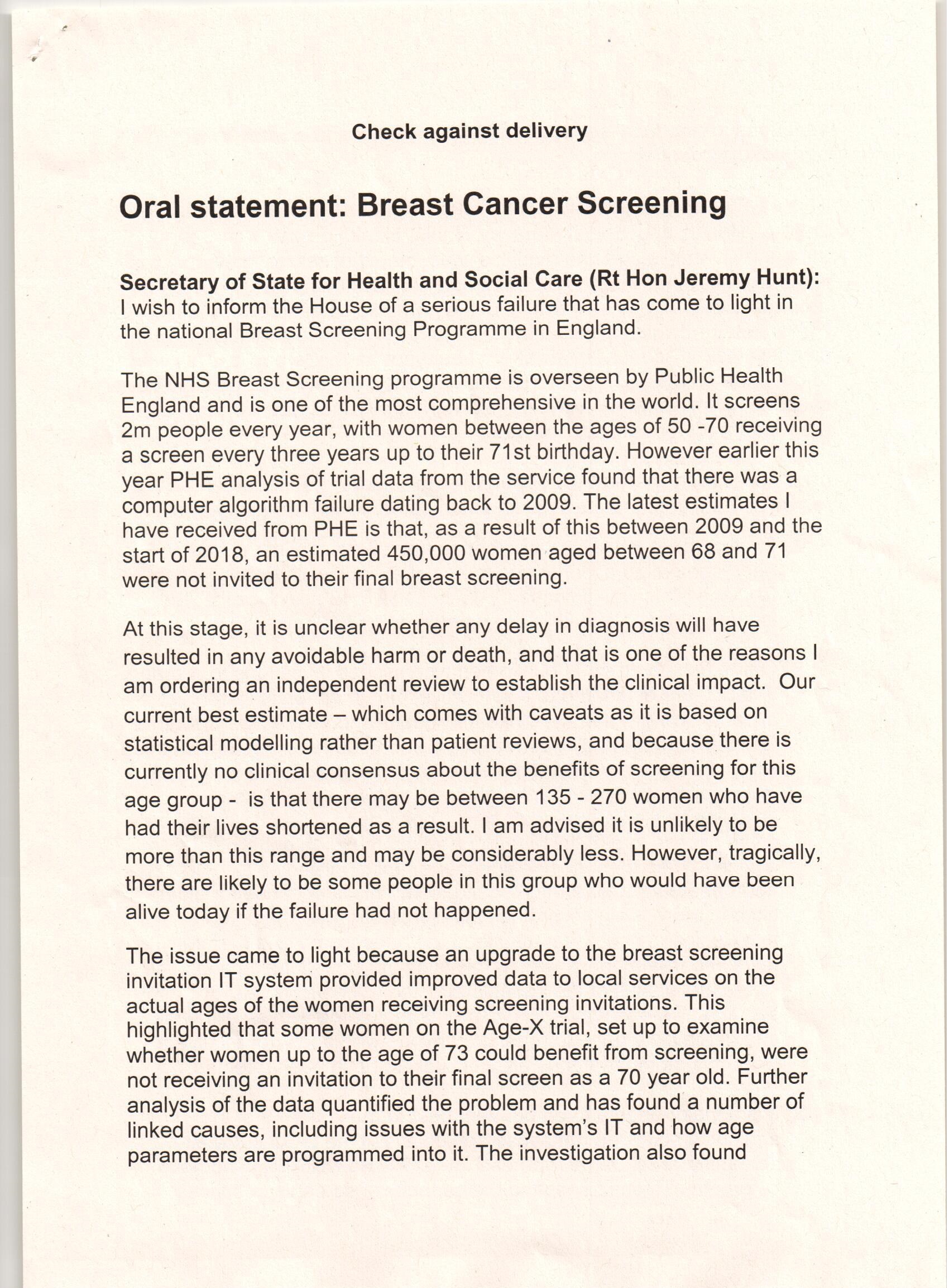
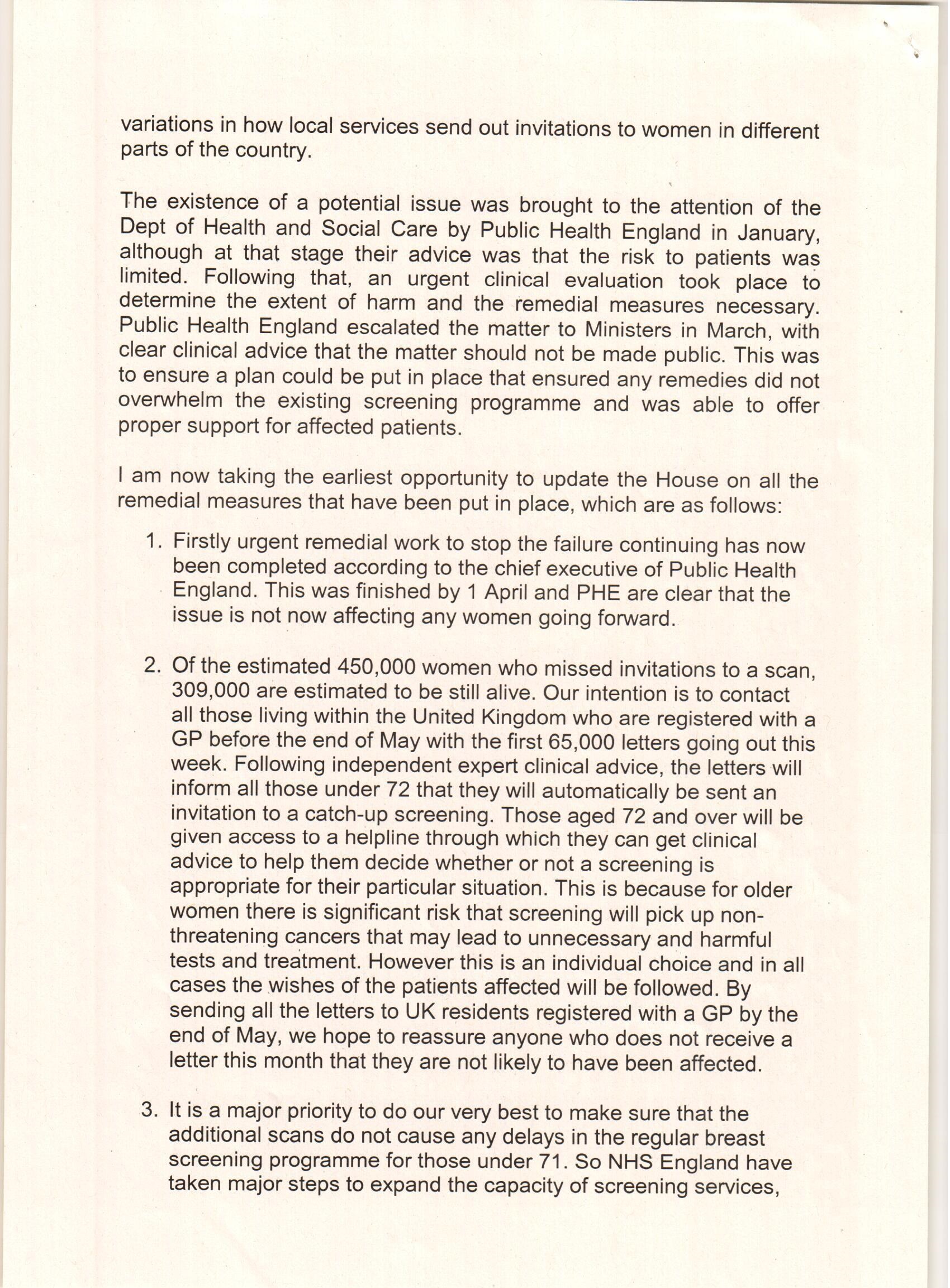
I enclose details of today’s statement from the Secretary of State for Health and Social Care about Breast Cancer Screening. Any constituents who have concerns should call the breast screening helpline number on 0800 169 2692:

Trade, trade and more trade

All we ever seem to talk about is trade. The Remain Lords and MPs turn every debate on Brexit into another debate on trade, so they can peddle their tired soundbites again. The clever ones spread disinformation, and the badly informed ones peddle their misunderstandings as truths.

Today the media will again declare it trade day, as we learn that the Brexit Committee will discuss yet again what will replace our Customs Union membership.  Will they prefer a New Customs Partnership, known perhaps appropriately as NCP as if it were a parking lot, or will they prefer Max Fac, maximum facilitation of trade at the borders? I trust they will opt for the latter. NCP means recreating many of the limiting features of our customs union membership. They need to remember that belonging to a customs union has two big drawbacks. It means we pay more for food and other goods that have tariffs on them. It means we can’t do trade deals that help us with the rest of the world. The UK with a large service sector usually finds that is ignored by EU trade negotiators.

So what are the myths they peddle? The first is that if we leave the EU with no agreement there will be all sorts of non tariff barriers to our trade. They do not seem to have read the comprehensive and detailed Facilitation of Trade Agreement which the WTO brought into effect last March to deal with any such problem. Both the EU and the UK will be full members of the WTO after March 29 2019, and both will obey these requirements.

Some suggest that the EU would deliberately create queues at Dover for lorries bringing in much needed supplies.  Let me reassure them. We will run Dover, and will have every incentive to keep the lorries flowing easily. What if they broke WTO rules and held trucks up at Calais? That would be a perverse thing to do as the majority of the trucks are carrying EU exports to our markets, so why would they want to damage them? If they tried to detain just UK lorries carrying exports to the EU they would be breaking WTO rules against unfair discrimination and in some cases disrupting the supply chains of their businesses needing UK components. Those businesses have legal rights and could take action.

There is an unwillingness to accept that in the 21st century most goods trade is conducted by large businesses acting as or through Authorized Economic Operators. These businesses file an electronic manifest containing all the details about what is on the lorry, where it travelling, what taxes and duties it needs to pay and how the load conforms with rules of origin, health and safety requirements and any other relevant legislation. Busy border posts allow most to proceed unchecked, as they know the details, levy taxes off site and trust the operator. They can of course delay or impound if they have reason to suspect non compliance or criminal activity, as they do today whilst we are still in the customs union. Anti smuggling is mainly conducted by an intelligence led approach. There are already substantial smuggling issues for our border with the EU as there are differential VAT and Excise rates. Adding customs to it does not create any difference in kind to what we are doing already. The TIR system was developed years ago to speed trucks through borders.

It is true that rules of origin do  require higher UK proportions in a few cases , especially in some vehicles. This is why the UK government is working with the industry to increase the proportion of UK components in cars assembled here  to meet the rules, which is a win for domestic industry.

The underlying big picture truth is free trade provides better living standards. The sooner we liberalise our trade with the rest of the world the better, as the gains could be helpful. It is unlikely the EU will want to impose tariffs on themselves, though they may threaten this if they think there is any lack of negotiating resolve in the UK.

In the latest research using economic models Professor Minford puts the discounted long term gains to the UK of leaving without a deal at £651bn, assuming we went on to a free trade approach.
Public service and the private sector

I set out three main conclusions from my analysis of the types of private sector involvement in public service.

The first is, bread and circuses, supplied entirely by competing private sector companies, are as much public services as the supply of water or the provision of health care.

The second is there is no  such thing as a service entirely provided by state employees using state assets. Every public service uses private sector services to help it deliver. The issues for debate are where should the borders be between public and private  in any given case, and which models of private sector engagement and support work best?

The third is there is no simple binary choice between a privately provided service like the bread supply, and a nationalised service. The interconnections between public and private are far more complex and  varied.

I looked in particular detail at the railways. Here Labour says we could improve it by nationalising it. Many do not seem to recognise that it is largely nationalised already. All the stations, track and signals are in public ownership. Network Rail controls the railway as a state owned and state financed entity. The private sector train operating companies have regulated fares, regulated train slots on the monopoly nationalised network, and timetables agreed by the government and Regulator. Quite often they are prevented from expanding or running better services by the restrictions of the monopoly provision of track and inadequate signalling capacity.

I also considered the NHS, where all parties agree we want to keep a public service free at the point of use, and no party wants to privatise. We need to remember however that most GPs run private sector businesses, owning  their own surgeries. All drugs used are supplied  by for profit companies, who also provide most of the research into treatments. A wide range of contractors are used for catering, cleaning, management services and the rest. Labour introduced sending some NHS patients for operations in private sector hospitals.

The sound bites and fury of these nationalsation debates ignore the complex realities.

The balance of the Brexit Committee of the Cabinet

I hear and read briefings that say it is important for the government that the Brexit Committee of the Cabinet has a balance with equal numbers of Remain and Leave members. This surely is an out of date or wrong idea. There are pro Leave Cabinet members not currently on the Brexit Committee who could strengthen it. There is also now a vacancy for Home Secretary. I hope Iain Duncan Smith is appointed, as he has published a good plan for a better and fairer immigration system post Brexit and could speed the government’s work on it.

The government as a whole is meant to be dedicated to seeing through Brexit. It is meant to be united in public with a strong position to maximise our chances of a good deal rather than no deal, which we have been assured we will pursue rather than a bad deal. Such a course argues for a good majority on the Brexit Committee of strong supporters of Brexit.

It also means that Cabinet Ministers outside the Brexit Committee who were of the Leave faith should also be more willing to pursue a good Brexit rather than thinking their task in private is to dilute or delay departure. The issue of Brexit was settled almost two years ago by the people and their vote. That was reinforced by the 82% vote in the last election for the two main  parties who both promised to see Brexit through, and by the strong vote of Parliament to send the Article 50 letter notifying the EU of our intention to leave next spring.

Any Cabinet Minister who tries to delay his or her department getting on with the necessary preparatory work to allow us to leave with or without a deal next March is undermining the government’s policy and the UK’s position in the negotiations. Cabinet Ministers who accept the collective line that we are leaving the EU, the single market and the customs union are getting on with preparing suitable plans. More importantly they should also be preparing their policies to take advantage of our ability to make our own laws, spend our own money and control our own borders once we are out. There are lots of wins for us as long as we do take back full control as soon as possible.

Those who have sought to delay exit by seeking a 21 month so called Transition should not also then seek to delay the necessary work for No Deal in case that turns out to be the best option.

Illegal immigration and the Home Secretary

Tomorrow I read that the Home Secretary will provide another Statement to the Commons on migration matters. Parliament will only know for sure when the Speaker announces topical  business at midday on Monday.

I assume she will reaffirm that no Minister wanted legally settled people who have been here a long time to be sent away, and will confirm that all actions are being taken to complete any outstanding paperwork quickly and helpfully in cases where proper documents have not been issued in past years.  That is what we want and expect, as people welcomed into our country should  not be  put under pressure by the system or have their status placed in doubt. If anyone has been deported wrongly their cases should be reviewed and matters put right as best the government can.

I also trust she will stress as the Prime Minister rightly did last Wednesday the crucial distinction between legal and illegal migrants. Service has to be improved and any errors put right for legal arrivals, but the Home Secretary  will presumably  continue with her tougher  policies towards illegals. Labour seems to wish to muddle this distinction.

The current Home Secretary agrees with the Prime Minister in wishing to reduce net inward migration to the tens of thousands, and is signed up to bringing that about. She issued a Home Office Annual Report for 2016-17 which she presumably approved which was crystal clear about the aim of reducing migration and the policy of removing illegal migrants. The Annual Report reminds us that that the government is committed to “Reducing annual net migration” and sets out how in that most recent year net migration had fallen by 84,000 or 25%.

It also states that a central aim is to “Clamp down on illegal immigration”.  Deporting foreign criminal offenders “remains a priority”. “We continue to use the provisions of the Immigration Act 2014 and by December 2016 over 5700 foreign national offenders had been removed”.

The Report continues with “The Home Office’s approach to returns goes wider than criminal offenders. In January 2016 we broadened our engagement activity in priority countries to maximise returns of all nationals in the UK illegally”. The Report also details numbers of people using the four Resettlement Schemes the Home Office promotes. The Report does not contain any individual targets beneath the general public target to cut net migration, but is peppered with  numbers of how many people are involved in each of the detailed policies to try to implement the general target.

The Home Secretary will be expected to offer a robust defence of her approach , as well as updating us on how she is sorting out problems for those legally here. I also want to know when she is going to share with us the work she should be doing on a UK migration and borders policy for once we have left the EU. It would be wise of her to correct again her slip over the Cabinet’s long standing decision that we will be leaving the customs union when we leave the EU.