
John Redwood's Diary
Incisive and topical campaigns and commentary on today's issues and tomorrow's problems. Promoted by John Redwood 152 Grosvenor Road SW1V 3JL

Anyone submitting a comment to this site is giving their permission for it to be published here along with the name and identifiers they have submitted.

The moderator reserves the sole right to decide whether to publish or not.

European banks have a new business model

Sometimes truth is stranger than fiction. Who would have thought that a German led Euro area would decide to print Euro 80 billion a month to buy up corporate as well as government bonds from around the Eurozone? And who would have predicted that same German led Euro area would offer free money to commercial banks to lend on, or even offer banks a payment for borrowing money to lend to others? All those words about prudence, all that commentary about the need for a well run and disciplined currency have gone out of the window. The Euro authorities try to offer some hope to the many unemployed of the zone, and the Central Bank struggles almost alone to salvage some growth after years of recession and disappointing performance.

As strange is the wish to have some inflation. The zone has been more than successful at getting inflation down and keeping it down, something it shares with the rest of the advanced world. We have low inflation in most places today as a result of three mighty trends. The first is the large migrations, bring willing people from low wage and no wage societies to richer countries where they are prepared to take relatively low wages by the standards of their host country. The second is the creative destruction of the internet, slashing the costs of various business activities and giving so many more people cheap and easy access to the world market through a webpage. The third is the result of massive investment in commodity and energy capacity in past years, which has produced a state of oversupply in the main energy and commodity markets. China for example produces too much steel with knock on effects to the rest of the world’s steel industry. These pressures are being fought with monetary means. There is a desperate rush to the bottom as major currencies are deliberately expanded to try to devalue more than the next one. Each tries to steal a competitive edge and to trigger some domestic inflation from higher import prices.

There is of course an irony or contradiction in EU policy towards inflation and growth. The authorities are demanding each commercial bank holds more cash and capital for their current level of loans. That slows down loan and credit growth. The zone limits each country to borrowing no more than 3% extra of its GDP in any given year. This rules out further fiscal stimulus from the state making payments and investing money which it could currently borrow at very attractive rates. Yesterday the ECB hinted that it would like member states to spend and borrow more, but said this should only be done by those within the current targets. Germany is the country with most scope to expand her spending. Traditionally Germany is reluctant to do so, though she will need to spend a bit more on the migrants now arriving. It also said that member states at or near the 3% limit should nonetheless rejig their spending and borrowing to provide a better direct stimulus to growth from the spending they do do. The ECB wants an infrastructure led recovery.

The ECB should study Japan. Japan has had several phases of state led stimulus through extra spending and borrowing, with many large infrastructure programmes. Japan has gone through more phases of money creation and bond buying than the rest of the world, and has negative interest rates. Japan did succeed in devaluing the yen in recent years, but has now encountered upwards pressure on its currency despite the unorthodox monetary policy. The change of approach by the Chinese authorities to their currency, the yuan, and revised estimates of delays in increasing US interest rates have at least temporarily pushed the yen up. Japan’s monetary stimulus and fiscal stimulus combined have not been sufficient to push the Japanese economy into decent sustainable growth. The falling population makes this more difficult, and the numbers do look better on a per head basis. Much of the Euro area has the same problem of a falling population reducing demand directly, and an ageing population often leading to a more savings oriented culture. Japan has ended up with the biggest state debt relative to its output of any advanced country but without the growth that was meant to bring. It is only possible to sustain such a colossal debt by buying it up with newly created money, and keeping interest rates low or negative.

The ECB has done what it can. Its measures yesterday exceeded most people’s expectations. Any sensible person wishes them well, as the world would be a better place if the Euro area could grow at a decent pace and make bigger inroads into the high levels of unemployment. The problems remain that many people and businesses do not want to borrow, even at low rates, and banks still have balance sheet constraints limiting how much use they can make of this very generous offer of free money to lend to others. Some people and businesses already have debts enough, but others do not. They lack confidence or the income to be willing to borrow to invest or spend.Meanwhile the European dream is a nightmare for the younger people of the currency zone, with too many out of work and without hope of owning a home of their own. The older savers are not best pleased either.
Full text of article for OMFIF on Brexit

I wrote this article for OMFIF (Official Monetary and Financial Institutions Forum) and will share with you the version before it had to be shortened:

Out of the EU the UK will have more influence in the world. We will be better off. We will regain control of our borders, our spending and our taxes.

The Leave campaign is full of energy and belief – belief in the ability of the British people to govern ourselves. We believe that the twenty first century needs networks of countries, companies and individuals, requires us to look out to the five continents of the world and to collaborate and trade with the areas of greatest growth and dynamism as well as nearer to home.

Free of the treaty entanglements, taxes and controls of the EU we will be better and happier Europeans. We will be freer to join the clubs, sit at the top tables and influence for the better the main world decision making networks and associations.

Shouldn’t the UK as the world’s fifth largest economy represent herself at the World Trade talks, and do deals with like minded countries around the world? For 43 years inside the EU we have been denied our voice and vote in the WTO by the EU, who have failed to sign trade agreements with the US – the UK’s strongest ally – and with China., India, Brazil and all the other big traders of the globe.

Shouldn’t the UK, a member of NATO and the Five Eyes intelligence grouping also be a full member of the World climate talks and the various world standards bodies? Won’t the UK as an independent country with her own voice and vote in more world bodies have more friends and allies, not fewer, as others will wish to work with us?

Out of the EU we will be able to raise our own taxes in the way of our own choosing, and be able to spend them as we see fit. Today we have to impose certain taxes including VAT, and have to spend on items like benefits in ways required by the EU that often do not meet with the wishes of UK electors. Our Prime Minister has just shown how impotent we are to make minor changes to welfare entitlements which were popular when promised in the last election.

Out of the EU we will have £10 billion more a year to spend, the money we send them and do not get back. We can guarantee to every university, farmer and region of the UK currently in receipt of EU money that they will get the same out of the EU as in, as we first have to send all that money from UK taxpayers to the EU before we get it back.

Out of the EU we will be free to have fair immigration. Today we have to restrict non EU immigration but allow unrestricted EU migration. Running our own system., we still want to welcome anyone with skills, good qualifications, money to support themselves and to invest in the UK. Our universities will still be able to attract the best talent and our businesses hire the best engineers or managers. More of our lower paid jobs will go to our own citizens, as we will be able to control numbers and ease the enormous current pressures on housing, benefits, the NHS and the rest of our public services. As the head of the Remain campaign said, our wages should go up as a result.

This is the bright vision of a better tomorrow the Leave side wants to talk about. Instead we are expected to answer an ever more desperate and absurd set of fears spread around by the people who wish to remain.

We are told we have to stay in to prevent European war. I have good news for the Remain people. Modern Germany and France are peace loving democracies who will not fight each other when we leave, nor will they seek to invade us.

We are told they wont trade with us any more. How bizarre, when they sell us so much more than we sell them I don’t see them wanting 5 million unemployed on the continent as they ban all exports to us. The German government have made clear that they do not want new tariffs and barriers in the way of their exports to us, so accept there cannot be new barriers in the way of our exports to them.

We are told we will have to be like Norway and pay in contributions to carry on trading. What poppycock! Over 160 countries worldwide trade successfully with the EU, and some have grown their trade with the EU more quickly than we have done – but they do not pay a penny into the EU system by way of fees.

They say we no longer share intelligence and take actions to help each other remain safe. Of course if the UK learns of a terrorist plot against France it will pick up the phone and tell them, and I am sure France will do the same for the UK if need arises.

I find it is absurd that those who wish to remain in have such a low view of our partners. They think they are vengeful, and will seek to thwart us if we leave. More importantly, they think they are stupid, and will wish to do harm by damaging their own exports to us or even getting into war without us there as a stabilising influence!

Were we to stay in there will be endless more rows, as even the people who want to stay in say they do not want us to join the Euro, Schengen or the forthcoming political union which are at the heart of the present EU project. Were we to stay in we would be uncomfortable as they go on their wild ride to political union.

We would also need a second referendum quite soon after the first as the rest of them amend the Treaties in ways which trigger such a vote in the UK under our present Referendum law. We know there will soon be a new Treaty , as we have been promised Treaty change as part of the deal the government has just negotiated.

I am a good European, who thinks my continent needs to be democratic and freedom loving. Europe is not my country and never will be. I want my country to restore her own self government. That will make us happier as Europeans. It will leave the others free to complete their currency union and political union without us.

Now is the time for the UK to do what we have always done best. Now is the time to claim back our freedom. In this referendum we must restore our democracy. We are the heirs of Magna Carta, the Bill of Rights, and universal suffrage. We should not want to be the people that thought freedom too difficult or self government too risky. It is time to trust the people, not faraway elites who have made so many mistakes in the name of European union.

Government fails to explain EU statement that all member states will remove Turkish visa rights

I asked an Urgent Question in the Commons yesterday  just after Prime Minister’s Questions. I pointed out that the government’s statement that we will not be part of the agreement to waive all Turkish visas is not what the EU Statement of Heads of State and Government says. The government was unable to deny the text from the Heads of State and government, or to explain it. I proposed that they either get it amended or negotiate a UK opt out. The government after all wishes the UK to rely on just an agreement between member states for its new deal with the EU, so these EU documents are meant to be accurate and important. See yesterday’s blog for the detail.

Leave the EU and get a pay rise

I agree with Lord Rose of the Britain stronger in Europe campaign. He has in the past told us the UK can do well outside the EU. More recently he has confirmed that if we stay in the EU there will continue to be substantial migration, which will keep down wages at the lower end of the jobs markets.

I disagree with Lord Rose when he says that rising wages are “not necessarily a good thing”. If someone has been well paid for much of his life, he should be careful recommending much lower pay for everyone else, and particularly careful about entering politics to preach the joys of sacrifice, low wages and a plentiful supply of cheap labour for others.

The government rightly wishes to see wages rise. It has put in its new policy of a living wage, requiring wages to be higher by law. Leaving the EU would be a quicker and easier way of achieving this goal. Now we know 630,000 EU migrants last year were granted National Insurance numbers, we can see just how big the downwards pressure on UK wages must be from new arrivals. It is a strange policy combination to require people by law to pay more money when open borders means queues of people willing to take less just to get a job. Out of the UK we could impose sensible controls on inward migration to take low paid jobs.

I was never a fan of the policy of enlargement of the EU. The UK’s official stance was to foster enlargement, with some people thinking that would slow down progress to political union and to so called deepening, or more EU government. The opposite happened, as some of us feared at the time. Instead of enlargement leading to loosening, it led the established member states to want to tighten controls and have more centrally determined policies. It also encouraged them to have more majority voting so smaller poorer countries could not hold up their wishes for more EU laws.

What it also did was encouraged large numbers of people in low wage countries to use their rights under freedom of movement to go to the UK and Germany where there were jobs available with much better wages. This prolonged domestic unemployment in the richer countries, and stripped the poorer countries of some of their most talented and enterprising people. Well skilled Eastern Europeans were prepared to do unskilled jobs in the UK because the wages were so much better,.

The UK owes it to Europe to leave, so we can have higher wages and employ more of our own people, and more of the talented and energetic people of eastern Europe can stay in their own countries to get them richer faster.

Why should we believe Mr Carney on Brexit?

Mr Carney gave unfortunate testimony to the Treasury Committee yesterday, which has been spun as helpful to the Better Stay in Europe campaign because he did not set out the pluses of leaving as well as he could.

Mr Carney of course now has a UK track record of making inaccurate or unhelpful forecasts. Throughout his time as Governor he has not used his main power, the power with the MPC to shift interest rates. When he first arrived he introduced forward guidance. He told us interest rates would not go up before unemployment fell below 7% but implied they might after that.

When unemployment fell below 7% he gave different guidance on raising rates. He said he would look instead at wages, spare capacity and productivity to decide when to put up rates. Unemployment was clearly no longer a guide to capacity or inflationary pressures.

When real wages and productivity started rising and more growth occurred, he then said in the summer of 2015 the decision on raising rates would “would come into sharper relief” at the turn of 2016.

When 2016 turned there was another change of tack. We were told that growth was lower so there would be no rate rise.

Markets, who had expected interest rates to be at 2% by 2017, have adjusted to rates still being at 0.5% in March 2016, with no immediate impulse from the Bank to raise them.

I set this all out now because it serves to remind us how Mr Carney has so far been unable to issue decisive guidance or to estimate the likely path of inflation, growth and money accurately. It should lead all to ask why then should we think his views on Brexit any better informed?

The Bank he represents has a long history of catastrophic misjudgement on the UK economy prior to his arrival. This is the Bank that recommended entry into the European Exchange Rate Mechanism, which first created a bad inflation, and then a nasty recession. This is the Bank that presided over the credit crunch and did not use its facilities to keep solvent banks sufficiently liquid at the height of the crisis. In both cases the Bank ignored advice from those of us who thought the ERM would do damage, and who thought the Bank should lend short term to commercial banks in need whilst at the same time working behind the scenes as one of their regulators to get them to strengthen their balance sheets.

The EU/ Turkey agreement

The Turkey refugee facility to be paid to Turkey by the EU which stood at Euro 3bn prior to the latest meeting will be paid for out of a mixture of EU and member states budgets. One third comes from the EU, and two thirds from EU states proportionately to their Gross National Income. The direct UK share of the 2bn of this facility will be £250 million, which will come out of the UK overseas aid budget. Presumably any expansion of the money to Turkey which has been discussed in the latest meeting will also be a further charge on the UK budget.

The Agreement does not look well crafted or helpful to the EU. The EU has offered visa free access for all Turks from June this year, and has agreed to take a Syrian for every Syrian returned to Turkey under the new more aggressive policing of the EU’s external frontier. Illegal migrants from other countries will simply be returned with no commitment to take anyone in their place.

It is difficult to see how this system is going to work. Who is going to return the illegal migrants? How will the take up of Syrians from Turkey be organised and shared out between the EU member states? Why will any of this deter more people from coming to the EU? Won’t it encourage more migrants to destroy their passports and documents and claim they are from Syria?

It also leaves the UK government with some explaining to do. Why did they sign an agreement which apparently means the UK too has to accept visa free access for all Turks from June? Mr Cameron says we are outside Schengen and none of this applies to us, but maybe he was just referring to the EU agreement to share the task of accepting Syrians from Turkey. It does not seem to include Turkish visa free access, as the Agreement published by the EU sets this out for the whole EU. There needs to be urgent clarification of the visa free access issue. The Agreement says “visa liberalisation roadmap with all member states with a view to lifting the visa requirements for Turkish citizens at the latest by the end of June 2016”

How much trade do we do with the EU? Under 40% of our exports.

People who want to stay in the EU wrongly think our trade is at risk. They then compound their error by telling people half our trade is with the EU.

They clearly have not read the balance of payments figures. Less than half our goods exports are to the rest of the EU, and well under half our service exports are to the rest of the EU. The total of our published export trade with the rest of the EU is 43.6% (latest figures available, Q3 2015).

You cannot get to half our trade even if you add in imports as well as exports. What the Remainians never point out is that we import so much more than we export to the rest of the EU, so the percentage of our imports from the EU is a lot higher than the percentage of our exports.

In Q3 2015 54% of our goods imports came from the rest of the EU, but the total imports were still below half when you add in services.

All these figures also have to be adjusted for the Rotterdam/Amsterdam effects. Quite a lot of our exports go first to a large continental port, and then are shipped onwards to a third country outside the EU. This is counted as trade with the EU. Taking this off means less than 40% of our exports are to the rest of the EU. The ONS assumes around half the published trade with the Netherlands is in practice trade with the rest of the world.

The chugger state

Most MPs concentrate on representing people who need the state for support and often see the state as an ally. I too represent my constituents when they need welfare, state help with housing, school places and care from the NHS. By definition most of an MP’s job is going to be helping those who need state assistance, and supervising or seeking improvement in the large free at the point of use state services.

I also seek to represent my many other constituents who do not see the state as helper, and have to spend their time complying with state dictats and paying all the bills. Parliament has been much less good at representing taxpayers and all the people who set up, manage and work in the private sector companies that supply much of our goods and services and provide most of the jobs and incomes.

It has also not been kind to many savers seeking to live on their past prudence. To many people who get up and go to work to pay the family bills and to keep our country civilised with plentiful supplies of what we need the state can come across as hostile and unhelpful. At times the state is the worst kind of chugger, extracting money in so many ways. The state as chugger of course is more worrying than a too persistent fund raiser elsewhere, as you have to comply with every demand the state makes.

One of the worst features of the modern state is the great complexity. They have so many ways of demanding your money that you have to devote considersable time to compliance. The state expects you to know when you have to pay and to get it right according to their process.

You park your car in a municipal car park and then have to be sure you get back within the stated ticket tine. It puts pressure on your meetings or shopping as you seek to conform. It means fewer impulse buys or leisurely cups of coffee at the weekend as you are time limited. You often are not allowed to buy as much time as you might need.

You drive to your next engagement. You need to be ever vigilant for the hours of operation of bus lanes, endless changes of speed limit, box junctions, cycle ways on the carriageway, left and right turn rules and the rest. One mistake that does no harm to anyone and you may well face a penalty fine.

You have to remember to pay the Council tax bill to be allowed to carry on living in your own home, whilst some Councils have now made it difficult to pay unless you are prepared to put in a direct debit.

Every payment that you receive needs to be recorded so you can explain if it was not income or pay tax on it if it was income.

If you save you may find the rules of those savings change after you have committed your money, as many have discovered with pensions savings over the years. The government can change the tax they levy on it even though you are locked in to a contract based on different tax rules.

Every time you have to deal with the state there are requirements to produce documents and reference numbers. Despite all the money spent on government computers there us still no single simple access and one ID per person to make your reporting to the state easy.

Whilst I agree we need rules and need to raise revenue, we could do so much better by making it easier for people to comply. The complexity means quite a lot of people do not bother to take on something extra or grow their business, for fear of the blizzard of state demands extra effort by them will bring forth.

Given the way that the state gets reports on people’s savings income and on employment income from companies that handle our savings and employs them, why can’t the state send a tax return request with the details they know already filled in? Why are people who wish to defer NI on other income because they are paying their full amount through their main employment made to fill in the same details each year on a new form?

I wish the next budget would be friendlier to taxpayers, would try to make their lives a bit easier, and would understand you raise more revenue if you set sensible taxes and allow people to profit sufficiently from their extra effort, investment and hard work.

Output and transfers between the regions of the UK

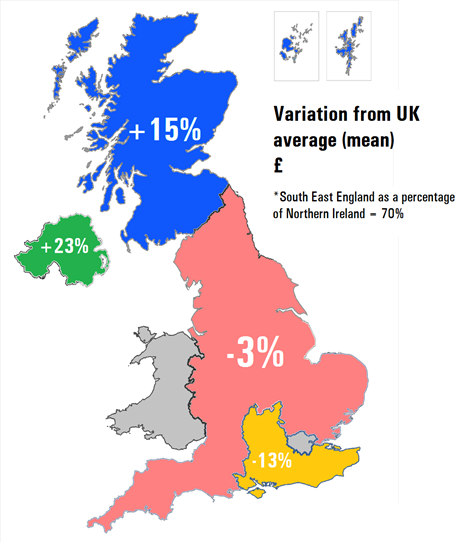
In the light of the Scottish financial settlement I am offering these important maps taken from National Statistics. (ONS publications) The first  shows just how much more public spending per head Scotland and Northern Ireland receive compared to England, especially south east England. It  illustrates the extent of the regional transfers of money around the UK.

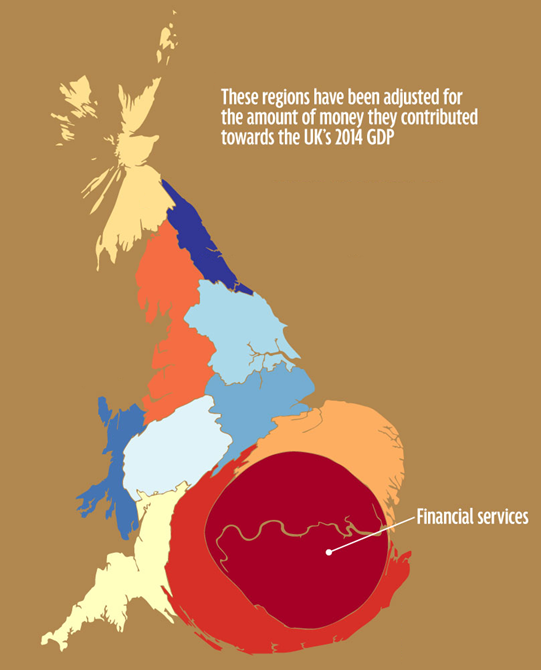
The second map shows just how much bigger London, the south east and East Anglia have become as a result of more rapid economic and population growth than the rest of the country. These three parts of the UK now represent almost one half of our economic output. This is displayed graphically by the redrawing of the map in line with economic output. As a result we see a very large London, and a large south east and East Anglia.

It appears that the latest financial settlement for Scotland gives the SNP all they asked for. The grant to Scotland has to be adjusted for the extra responsibilities the Scottish Parliament now has, and for the extra revenues they now control. The formula allows adjustments to be made for the likely slower growth of population in Scotland than the rest of the UK, the main thing the SNP insisted on.

Variation from UK average map.02.03.16

GDP Map
