Probate fees – a successful consultation

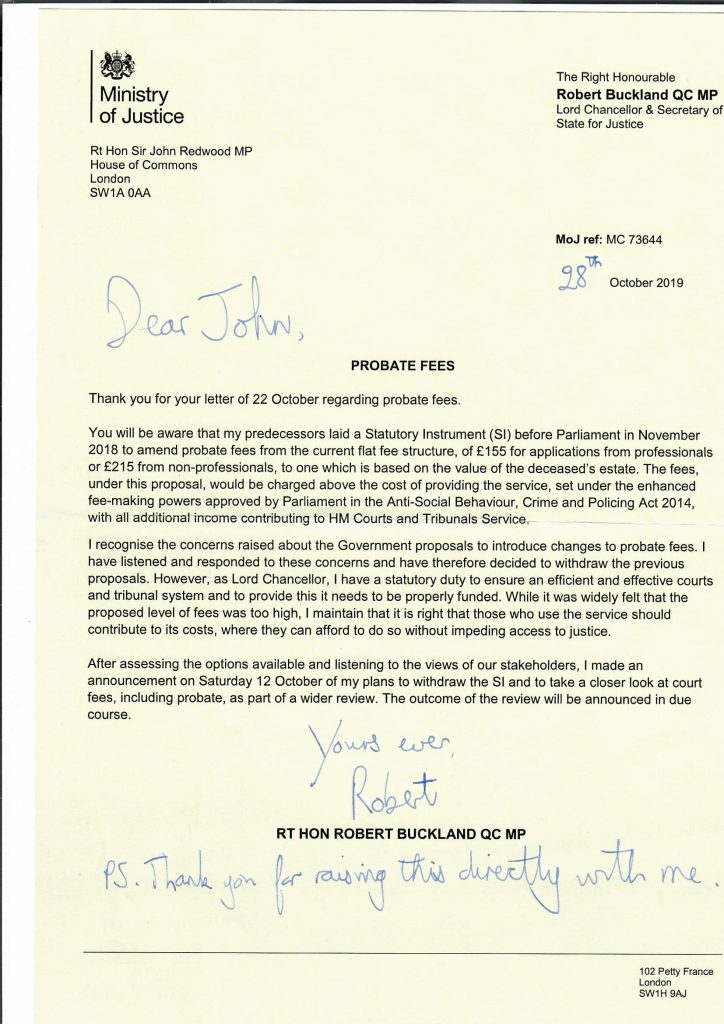
The government issued a Statutory Instrument to increase fees for probate considerably, based on the value of the estate being wound up. There were many objections to these proposals including my submission on behalf of constituents. The government has listened to these concerns. The Lord Chancellor has now written to me to say he has “decided to withdraw the previous proposals”.

He now intends to review the whole question of court fees including probate, in the light of the strong feelings that the probate increases were far too large.

Government consults on new police powers over unauthorised encampments

The Home Secretary is consulting on giving the police new powers “to arrest and seize the property and vehicles of trespassers who set up unauthorised caravan sites”. The idea is to have something similar in our law to that used in the Republic of Ireland.

The Home Secretary said “The public want their communities protected and for the police to crack down o n trespassers. Our proposals aim to ensure encampments can be challenged and removed as quickly as possible”

Speaker election

As this Parliament struggles its way to a premature close making a further mockery of the Fixed Term Parliaments Act it has decided on one last decision to carry its waning power into the next Parliament. It has decided to persevere with the election of a new Speaker on Monday. Whilst the new Parliament could choose a different Speaker on its first day, this would be unlikely.

The election campaigns of the candidates have not been front page news. On many issues the candidates agree. They all want the role to be less flamboyant, more referee and less player. They all say they wish to raise standards of behaviour and to show respect for MPs and the institution.

To me the crucial question is how will they wish to redefine the balance in Parliament between allowing strong and telling criticism and investigation of government whilst at the same time allowing a government to govern,

Some reforms of recent years are good and should be kept. More frequent Urgent Questions and topical debates keep Parliament relevant and make governments answer when things are worrying or going wrong. Too many Urgent Questions that are not urgent, have been asked before or are not of wider interest can absorb too much time for no great purpose.

Question Times have been extended informally. The new Speaker should review with interested parties how long Questions should normally last and make arrangements accordingly. Making the PM or Ministers stay long after the appointed time is discourteous to people with busy diaries.

Opening up the House for better public access, and allowing use of Speakers House for charities and other civic institutions has been welcome. The Parliament buildings belong to us all and should serve the wider community.

The more recent constitutional experimentation should stop. Legislation should  be proposed by a government, with a Money resolution to show it fits into the budget and Queens consent where needed to show it is compatible with the way the government is using prerogative powers. Parliament rightly has plenty of powers to delay or make difficult the passage of an unwelcome government Bill. It should not create powers to speed through legislation the government opposes on a one day only temporary alliance of MPs against the government.

The next Speaker also needs to come to a view with the Commons on what remedial and improvement works need doing over the next decade to the fabric of the buildings.
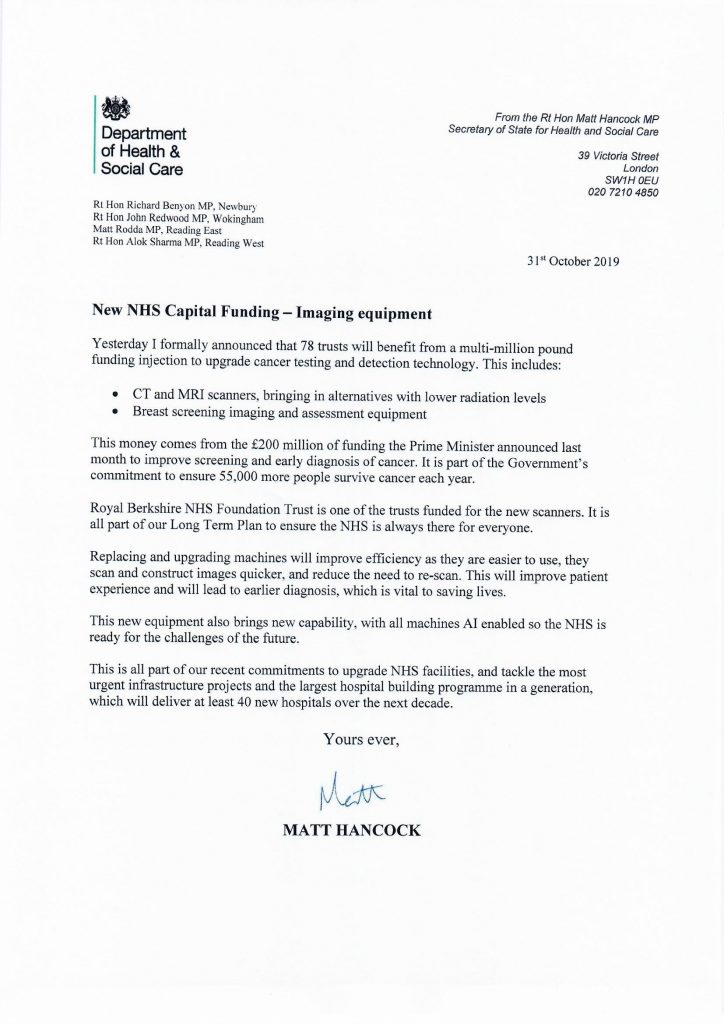
Wokingham Tesco fuel

Some time ago I raised with Tesco management the issue of sometimes blocked  access to one of the four fuel pumps  they put into the car park of the Wokingham store.

I am pleased they did put in a new route which gives fair access to all four pumps with an orderly queue which has improved the facility.

Taxing the rich

I will let you into a well kept secret. Each time Conservatives have cut the top rates of Income Tax or taxes on wealth the rich have paid more tax.

When Margaret Thatcher and Nigel Lawson in budgets cut the top rate of Income Tax from 83% to 40% there were howls of protest from Labour about a loss of revenue and the moral outrage. Instead the better off paid more tax in cash terms. They paid more tax in real terms after allowing for inflation. They paid a bigger percentage of total Income Tax.

How? More rich people came here or stayed here. More kept Income and wealth here to tax. More worked harder to earn more, and more took risks with their money to set up businesses and create more jobs which in turn produced bigger dividends. It was a win win for all.

The same thing happened when George Osborne cut the top rate of tax from 50% to 45%. Lib Dems in the Coalition blocked more tax raising rate cuts. With labour they want taxes to penalise success and deter risk taking.

Corbyn’s UK were he to become PM would be a hostile place for business builders, risk takers and hard workers with good earnings. Jealousy is not a good emotion at the best of times. It is a dreadful basis for an economic policy. We need to get tax rates down.Not only will more people be more successful but there will also be more tax revenue for schools and hospitals. Labour’s launch was unusual with its lists of people and roles they want to bash.

The choice in the election

The polls and betting suggest the choice is between a Conservative led majority government or a Corbyn Labour led minority government. There is a large divide between what Labour is offering and what the Conservatives propose.

Labour’s approach is  based on  large increases in taxes and borrowing, to finance a large expansion of the state. In particular they want to nationalise large swathes of the utility sector with discounted  compensation to existing owners, and wish to take 10% stakes in quoted companies.

The Conservative approach is likely to be based on the controlled increases in public spending on heath, education and the police they have announced, with some tax cuts to come. I would like to see the 1% of GDP stimulus from this combination that I have been arguing for.

We know from past experience at home and present experience abroad that the Labour high tax high spend high borrowing strategy will miscarry. Taxing the successful, hard working and prudent more will send some of them abroad and others will be less motivated to grow their businesses and create more jobs. Excessive borrowing by the state can crowd out credit for business and for individuals to buy assets for themselves. The Labour leadership have admired some latin American countries like Venezuela in the past for their generous expansion of welfare and state spending, only to see the misery economic collapse creates. Well intentioned socialism often ends up creating shortages in the shops,  a balance of payments and overseas borrowing crisis, and more poverty as businesses pull out and jobs are destroyed.

Conservative and Coalition economic policy since 2010 has stabilised a badly damaged economy and has created conditions for many more jobs including full time and better paid jobs to  be created. Inflation has stayed under good control, productivity has been disappointing and real wage growth like much of the rest of the advanced world weak. Banks are now stronger and debts under better control.

The right things to do  now are to pursue policies that can help lift productivity and therefore real wages at a faster pace, to ease conditions sensibly without alarming international investors.

Probate Fees

I am pleased that the Government is dropping proposals to raise probate fees, following representations from myself and many others.

Foreign leaders and elections

It is usually best if Presidents and Prime Ministers stay out of each other’s  elections . In free societies media interviewers can ask foreign leaders to make comments and they do so if they wish.

There are two big differences between President Obama’s intervention in our referendum and President Trump’s remarks yesterday. President Obama was clearly encouraged to intervene by the UK government who were committed to Remain. They  used the intervention to try to persuade voters, drawing attention to it as part of their case in the referendum. The UK government did not ask President Trump to make comments yesterday and is not planning to use his comments in their election campaign.

The retreat from globalisation

Tariffs and other barriers are going up between the USA and China, the USA and the EU, around Iran, between Japan and South Korea and between India and Pakistan over Kashmir. There is a new economic nationalism abroad.

It is also pronounced in some businesses and industries. The vehicle industry in particular is retreating to home factories under the weight of falling demand for diesel and petrol cars.

The Japanese car makers are moving more production from the EU to Japan, partly owing to a rare move to zero tariffs in their new Agreement with the EU. Ford is pulling out of European factories. If the Fiat/Chrysler/Peugeot merger goes ahead they may wish to concentrate EU production in the two home bases of Italy and France.

Globalisation is not always the right answer. Complex supply chains come about often because companies find cheaper components and raw materials from afar which they reckon they can weld into their production to cut costs. Sometimes this turns out to be a false economy. Long distance travel for components both increases travel costs and in some cases adds an additional risk of delay to supply. Too many competing suppliers may not breed good long term relationships between assembler and component maker.

There is a rival school of thought to globalisation which says working closely with a limited number of suppliers that are nearer to the main factory may produce better results. Today suppliers often have to operate full transparency with large corporate buyers, who will expect to know their costs, margin and investment rate. For certain finished products to qualify as coming from a given country for Free Trade Agreement purposes there is often a minimum total value requirement which affects how many components can be foreign sourced.

President Trump’s America first policy is designed to onshore jobs that have gone abroad. It is finding that in the current climate of industrial recession worldwide, with a particular problem in the vehicle industry, it is difficult to increase manufacturing jobs by these means. As the UK comes out of the EU we need to rebuild UK capacity to make more components for industry at home and produce more of our own food.

One of the reasons we need to get on with our exit from the EU is the opportunity it will give us to have our own trade policy, to lower our average tariff and to do a better job at promoting home produced food and goods . It has been damaging to be caught in the US/EU crossfire in the recent tariff disputes.