The war in Syria

The pace is quickening over possible UK military intervention in Syria.

I have set out the worries I have about bombing, and explained why I think there needs to be a proper peace process. To tackle ISIL on the ground there also needs to be local ground forces capable of doing the job. I have put these points directly to Ministers, and they are seeking to improve their responses to these legitimate concerns. We also need to redouble our security at our borders and strengthen our intelligence at home, as some extremists may be in our own community, where we wish to proceed by arrest, trial or deportation. I have asked for this, and the government has announced measures to improve our internal response.

I think we all agree that ISIL are a dangerous and violent group who do pose a threat to us in the UK as well as to many in Syria and Iraq. That is not in contention. Nor do most worry about killing violent men who have themselves already murdered people and plan to murder more, if there is no safe means of arresting and prosecuting them in the normal way.

The issues that remain relate to how UK bombing alongside French and US bombing that has been happening for some time will make the difference, who finds the targets and directs the bombers, who will act as the ground force needed to carry out the task of removing ISIL from Syria, who amongst the warring factions are our reliable allies if we intervene, and how will the peace process progress.

I would be interested in constituents views on all this as we approach a possible vote on the UK joining the allied air action.
Sorting out the balance of payments

The UK has been running a substantial deficit on its balance of payments with overseas countries for some time. The Office of Budget Responsibility has good news for us on this deficit. It forecasts that it will fall from over 5% of our National Income in 2014, to around 4% this year, 3% next year and then to around 2.5% thereafter. It points out the deterioration up to 2014 was caused by a weaker income balance, and suggests that going forward returns on UK investment abroad will pick up again.

If the deficit falls as estimated, then the UK will need to sell fewer assets overseas and raise fewer borrowings, which would be good news.

What we need to remember is the big role in all this of the rest of the EU. The net contribution we pay into the EU and do not get back in any form is over £10 billion a year. That is all a loss on our balance of payments account. If we vote to come out there will immediately be a £10 billion plus improvement in our balance of payments as a result. That is almost one fifth of next year’s forecast balance of payments deficit. The balance of trade is an account split into two parts, EU and non EU. The EU part remains in persistent heavy deficit, whilst we have a surplus with the rest of the world. EU trade has always been arranged in ways which favour Germany and some other continental countries and do not favour the UK. The UK accepted early and substantial liberalisation of trade in manufactured goods where Germany was strong, but has struggled to get a freer market in defence, business and financial services where the UK is stronger.

The UK has also chosen to be generous with its overseas aid. This too is a substantial and growing item entailing the movement of cash abroad, weakening the UK balance of payments. Germany with her huge surplus on her balance of payments does not make such a large contribution to other countries as the UK. The OBR has lowered its 2012 forecast for exports by 23%, reflecting slower world growth especially in the Eurozone and consequent slower trade growth.

Tax credits

I received a number of constituency emails urging the government not to go ahead with the planned cuts in tax credits. I spoke in favour of ensuring people were better off as a result of tax and benefit changes in the Budget debate, followed that up with conversations and blogs, and lobbied the Chancellor to drop his proposals. So did others.
I am pleased to report that he has cancelled all the cuts, so your representations have worked.

Spending £4 trillion

Listening to some people about the Autumn Statement, it appears you don’t get much for £4 trillion these days. That’s the amount the government plans to spend in the five years of this current Parliament. They aim to increase total spending by 8.7%, comparing 2019-20 with 2015-16. That’s why we hear endless arguments about cuts and the drive to a smaller state! We heard all the same arguments  between 2010 and 2015. At the end of the last Parliament public spending was higher in cash terms and in real terms than in 2010.


We need to remember that the government’s strategy has always been to sustain public spending, and to get the deficit down with a huge increase in tax revenue. The aim this Parliament is to get the tax revenue increase from growth in the economy. This will also have the effect of lowering state spending as a total of the economy as a whole, and leads to all those siren cries that this means the state sector is being cut, when instead it is just growing more slowly than the rest. there were also tax rises, with a new tax on buying Buy to let homes and the apprenticeship levy on business.

The Chancellor was right to abate the severity of his proposed cuts to tax credits. I agree with the strategy of boosting pay through working smarter and paying more for more output. I agree with the policy of cutting income tax on working earnings. As real incomes rise so it is possible to withdraw benefit  support to incomes. It makes little sense to tax people on modest incomes, only to recycle the money to them through a tax credit. The Chancellor was right to remove his severe cuts to tax credits before people have the benefit of the wage rise and the tax cut.

The boost to home ownership for sale is just what the economy needs. We are short of homes, and especially short of affordable homes for sale. This policy should help boost housebuilding and construction materials output. Brick kilns are coming out of mothballs, and new ones are being put in. There will be investment opportunities for  a wide range of building related manufactured items.


Big surge in tax revenue forecast – £105.2 billion this Parliament

The Autumn Statement forecasts higher tax revenues in every year of this Parliament compared with the March 2015 budget. In total the new estimates show us paying an extra £105 billion in tax over the five years, with increases of 4% in tax revenue compared to March forecast in both 2017-18 and 2018-19, with smaller increases in the other years.

The forecasts also show an increase in other receipts, mainly the gross operating surplus on public sector trading, which more than offsets the increase in the UK’s own resources contribution to the EU which rises by 29% for the five years compared to the March figure.

Capital Gains tax receipts are now forecast to be 6.4% lower over the five years than the March forecast, reflecting the Treasury’s inability to model the impact of higher rates on revenue. They have had to progressively lower these forecasts in the light of experience and have done so again.

There are strong gains in VAT, in National Insurance  and in Income Tax, though self assessment income tax is now forecast to bring in less this year than the March estimate.

Big increase in spending – £155 bn more this Parliament than March 2015 budget

The big surprise in the Statement is a large further increase in spending on top of the substantial increases announced in the June budget.

In June the Chancellor raised the total spending planned for this Parliament  by £70 billion. In this Autumn Statement he has raised it by another £86 billion.

Current year spending goes up by £13  billion or 1.8% compared to the March and  June forecasts.

2016-17 spending goes up by £33 billion compared to March, or 4.4%.

2017-18 spending goes up by £43.6 billion compared to March, or 5.9%.

2018-19 spending goes up by £42 billion, or 5.5%.

2019-20 spending rises by £23.7bn or 3%.

Borrowing stays lower owing to the assumption that low interest rates will stay with us for longer, saving money on the national debt, and on the assumption that tax revenue will improve more than expected before.

Who are the West’s enemies in the Middle East?

I have read enough to know how little I understand about the complex theological and political struggles within Islam, and about the large number of differing terrorist groups operating in the wider Middle East. I do not speak or read Arabic and have not read enough  of the literature or history of these  very different countries. I have read enough to be suspicious of simple solutions seeking to elevate just one group into a position of being the only or main problem. I wish in this blog to pose some questions to those who do know more, and to those who seek to frame our strategy towards the region.

Time was when the enemy of the West was the Taliban. Today they have been brought into Afghan society and  form part of the democratic dialogue. Then the enemy was Al Qaeda. They have not gone away and still exercise considerable influence in a range of countries. Now the evil one is ISIS.

Recently news came that 7 people were brutally beheaded in Afghanistan by Uzbek fighters. Al Qaeda in the Arabian Peninsula has taken territory in Yemen and has a presence in Aden. Do these  present a threat to us? What should be our response?

Meanwhile Jabhat al Nusra seek to extend their influence  in Syria and Al Qaeda in the Islamic Maghreb increase their activities and smuggling profits in Libya. Does this concern us, or do we wish to co-operate with them because they are against ISIS?

Are we on the side of the Sunni or the Shia factions fighting the Syrian civil war? Or do we believe it is possible to form a Syrian democracy that can hold the peace between these two and offer decent civil rights to all?

The UK government accepts that it will need a political strategy for Syria to run alongside any bombing attacks. It seems to be seeking a new government of the whole of Syria, based on the military elimination of ISIS and the voluntary surrender of power by Assad. Does it wish to help a coalition remove Assad after the removal of ISIS? Does it believe Assad will go voluntarily? Who are the moderates and where are their forces who will fight for a vision of a united Syria under democratic rule? Who in Syria has the belief in toleration towards Christians, Sunnis and Shias and has the force to establish such a society? Will the West end up accepting the Russian view that Assad is the least bad option in an all too violent society?

By encouraging the Kurds to take action in the north of Syria we are encouraging them to gain and hold territory that they think should be part of a Kurdish state. What do we say and do if they want to extend that into Turkey against our wishes and against our Turkish ally in NATO? Who could establish a government for all of Syria who would have the Kurds confidence and persuade them to give up territorial gains they have made?

Is the West clear that it can help establish a united Syria at peace, or does the West think now there has to be partition between a Kurdish Syria, and a Sunni and a Shia one? Or does the West now accept that the days have gone when great Western powers could draw lines on a map of the Middle East to conjure states out of the rival tribes and the desert?

Either way, knowing who  our enemies are is crucial, and knowing who we might inadvertently help if we intervene on one side or another is important.


Mobile phone coverage in Wokingham

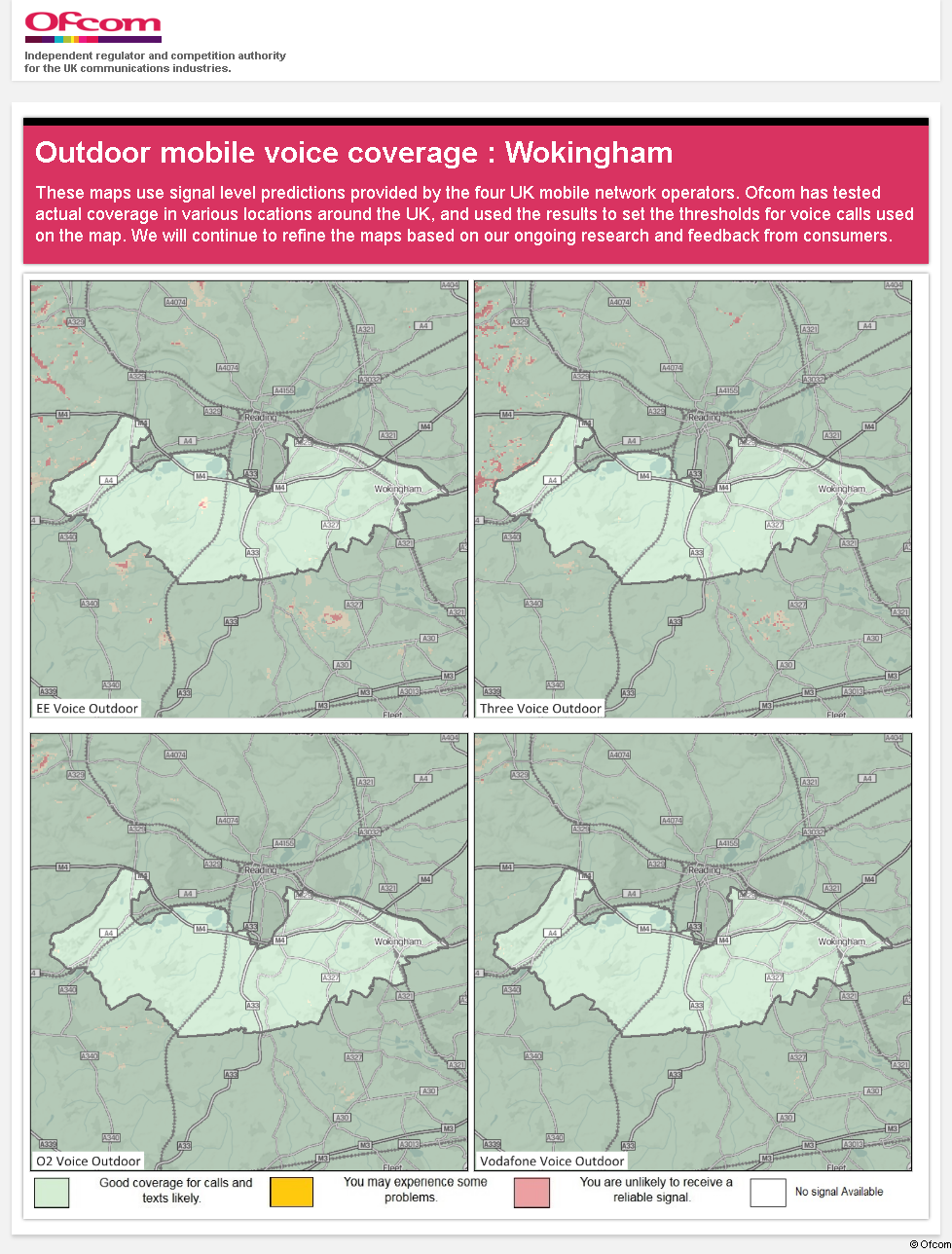
I have received the enclosed letter from Ofcom about mobile phone coverage in Wokingham:

Dear John,

In August we launched our online Mobile Coverage Checker to help consumers check the coverage they could expect anywhere in the UK. Using data from the four UK mobile phone network providers, our interactive map shows the predicted level of coverage both in doors and outside. It shows coverage for voice calls, 3G and 4G data connections.

It has proved to be a very popular tool for businesses and consumers: with over 286,710 people using our maps since their launch and around 1,500 people still using the checker each day.

I thought you might find it useful to see what the predicted mobile coverage is for voice calls in your constituency.

Outdoor mobile voice coverage

We also thought you might be interested in highlighting the checker to your constituents, who can use it to give us feedback for the local area. The feedback we get from the public is really important in helping us improve the maps, as people can tell us whether their experience matches what our database tells them – more than 4,000 people have done this so far. Please feel free to tweet or post on Facebook about the online tool. If you want to highlight the tool locally you might want to tweet or post something like:

“Want to know what mobile coverage you can expect in Wokingham? Have you tried the @ofcom mobile coverage checker? http://t.co/gYVvMG4Lj2”

“Want to know what mobile coverage you can expect in Wokingham (even inside your house)? Try the @ofcom mobile coverage checker and let them know what you think! http://t.co/gYVvMG4Lj2”

Because of this feedback we are able to update these maps monthly and do testing of our own to validate the coverage data from mobile phone networks. And we have plans to develop this tool further and will be rolling out improvements in the New Year.

Later this year, we will also be launching a mobile ‘app’ for smartphones and tablets, which will allow people to test their Wi-Fi connection. We estimate that consumers’ home broadband experience may not be working as well as it could in around a fifth of UK homes. The new app will help identify if someone’s broadband isn’t performing as it should be, and suggest simple trouble-shooting tips to help address it.

So please let me know if you would like more information on Ofcom’s work on promoting better mobile coverage and how we are helping consumers get the best out of their contracts.

Yours sincerely,

Sharon White
Chief Executive

Meeting with Minister on aircraft noise

Yesterday I chaired a meeting with the Aviation Minister, Mr Goodwill in my room at Westminster. Also present were Philip Lee, MP for Bracknell, and John Howell, MP for Henley, and two officials from the Transport department.

I explained the background to the change of air routes over the 3 constituencies represented at the meeting. I asked the Minister to require NATs and Heathrow to go back to the position before the trials of new routes. In particular I asked that he requires planes to fly considerably higher over our part of the world, and to disperse both take off and landing approach routes as used to happen. All agreed that slowing planes on their way in to the UK to cut the number of planes stacked over built up areas would be a win win, saving fuel and reducing noise and risk. It is possible to remove the need for stacking any planes over built up areas. All agreed flying higher would help cut noise.


I will follow up with the Minister when he has time to consider our submissions.

Defending the UK

The Defence Review answers some of the criticisms  bloggers on this site have made in recent years. The order for new fast stealth fighter jets has been increased, meaning the new aircraft carriers will have planes to fly from them. The maritime reconnaissance role will be served by  new planes, after a gap in UK capability. 8 new frigates will be ordered. The new carriers are well advanced in build. When they come into operation they will have frigate, destroyer and submarine protection.

The army will receive more new armoured vehicles, with a larger mobile force available to intervene, or support allies. Up to 10,000 troops will also be trained and available to reinforce the police at home should there be dangerous terrorist attacks requiring a forceful response.

I raised with the Prime Minister the issue of control of our borders. I welcome the  additional cash and personnel to strengthen our intelligence gathering. We can only keep safe if the authorities stay ahead of the threats to our way of life, and use the intelligence they have gained to good effect. I suggested that our borders be strengthened with specific links from the Intelligence services to the  border management, so that if for example terrorists are displaced from the Middle East by military action there they cannot gain entry to the UK, whatever their legal status, if their aim is harm or they are trained in terrorist ways. He accepted that more should be done to tighten border controls.

I also raised with Defence Ministers after the statement the need to continue to press for better value for money within the defence budget. In particular more can be done to release MOD land in places where it has substantial development value, and to provide new and better facilities elsewhere for our service personnel. I also relaunched my proposal for better assistance to service personnel in buying their own home. Everyone in the military should have a home base. They should be helped to buy a home of their own near the base in the normal way. Alternatively if they are using married quarters or other  service housing on a base they should be able to buy an interest in  it from the MOD for the duration of their time in the services, only to sell it back at a profit based on an agreed index of comparable freehold property prices when leaving the service. They would then have a deposit for a home of their own.