Business rates

I have been lobbying the government along with other MPs to do more to alleviate high business rate increases hitting some firms in our areas under the revaluation proposals. The government has offered substantial rate relief to many small businesses, but there remain numerous businesses that will experience rises in their rates bills at a time when they can ill afford the extra money.

Today the Communities and Local Government Secretary announced that he is working on a scheme with the Chancellor to offer more help, which will be welcome.

Design and use of UK airspace consultation

The Government is currently consulting on proposals to:

• Support the reform of airspace, thereby maximising the economic and social benefits of aviation

• Minimise the negative local impacts of aviation

Ministers are seeking comment on proposals to update policy on the management of UK airspace including:

• The role of an Independent Commission on Civil Aviation Noise to ensure noise impacts are openly considered

• Providing industry with the ability to assess noise impacts and guidance to help them manage change more effectively

• Bringing compensation policy for airspace changes in line with policy on changes to aviation infrastructure

• Greater flexibility for London’s major airports, so they can adapt noise management to the needs of their local communities

The consultation can be found here: http://bit.ly/2m3y2Hj. It closes on 25 May 2017.

The Forest School

I was sad to receive a copy of the resignation  letter of the Head teacher of the Forest this week.  I wish her well in retirement and understand her wish to pass the leadership of the school on to someone else.

In the letter she draws attention to the current level of the Forest budget. I agree with those in Wokingham who would like our schools to have bigger budgets, as they are at the bottom of the league tables for receiving public money. I campaigned on the Conservative party Manifesto in 2015 that proposed a move to fairer funding in this Parliament. I  worked with MPs from other parts of the country in the previous Parliament who shared the problem of relatively low levels of financial support for their schools. This Parliament I have urged successive Secretaries of State to press on with putting in a suitable scheme that rebalances the cash going to each school so that those getting least are better treated.

The present Secretary of State has promised to introduce such a scheme and is consulting on the details. I have urged her to give more to the poorly financed schools. I have also asked for further transitional relief. Some was awarded in recent years as the Coalition government agreed with me and the MP Group making the case for fairer funding.

I did have a meeting at the Forest to discuss budgets and to suggest ways to attract more money. The immediate pressures have been created by a shortfall of pupils applying to the school, which the Forest attributed to the opening of Bohunt. The main sums of money are given to schools on a per capita basis to cover the costs of each pupil. This will remain true under the new funding scheme, so it will  be important for a school that wants a decent budget to recruit pupils up to its capacity. With more pupils and more income it is possible to offer a wider range of subjects and to have more equipment and staff. If fewer pupils attend then it does mean fewer staff and may also entail a narrower range of subjects.

Night flight restrictions at Gatwick, Heathrow and Stansted

The Government is currently consulting on proposals for night flight restrictions at Gatwick, Heathrow and Stansted. The Government’s proposals relate to:

• Environmental objectives
• The length of the restrictions
• The structure of the restrictions
• Movement limits at each airport
• Noise quota limits at each airport

The consultation can be found here: http://bit.ly/2j4uhwI. It closes on 28 February 2017.

Housing numbers

During my last meeting with Wokingham Borough I was reminded that Wokingham has a target to build  856 new homes a year from 2013. (LEP study of housing need Feb 2016) That makes Wokingham’s share of the West Berkshire total 30%, with the other Councils  providing the rest of the 2855. Reading itself has a lower target of 699, despite having substantial brownfield redevelopment potential, the coming of Crossrail and the possibility of more starter home and smaller flats in the centre.  Bracknell has to build just 635 a year. Going forward there needs to be a fair division of the requirement.

The total numbers needed in the future also should take into account any change of migration policy designed to lower the numbers of additional people coming to live and work in the country as a whole. The current high numbers of new home sis partly the result of adding 330,000 extra people each year to our population, as we wish anyone coming to live and work here to have access to decent housing. If the government sticks to its target of a substantial reduction and takes the necessary measures on leaving the EU, could  the targets be lowered.

Were the Council to agree to a new settlement at Grazeley of 15,000 homes that would on its own provide 17.5 years worth of housing against targets. Would the development be spaced out over such a time period? Is it feasible to say no to building on any other large sites throughout such a  long time period? Or  might Grazeley  add to the build rate? If other sites are granted on appeal or run over from past grants of planning, then we need to build even more infrastructure to take care of a faster build rate than present plans.

I am writing to the authorities to ask what thought is going in to future targets in the light of these issues.

Heathrow expansion – Draft Airports National Policy Statement

The Government is currently seeking views on the draft the Airports National Policy Statement. Details of the consultation can be found here: https://www.gov.uk/government/consultations/heathrow-expansion-draft-airports-national-policy-statement.

There are a number of consultation events taking place, such as one in Bracknell on Thursday 16 February 2017 at Carnation Hall. Further details are available on the consultation page.

New houses and Grazeley

I was given some more information about the Council’s possible project for a new town at Grazeley with 15,000 homes at a meeting on Friday. This is the project the Council is currently consulting about.

My comments included

1. Will the Council seek some guarantees that were it to go ahead at Grazeley there would be a direct reduction in pressure on other sites around the Borough?
2. What will the bid be for infrastructure investment? It would need to be large given the number of people who would go to live there.
3. What impact would 30,000 more cars have on the area? What extra capacity would be needed on our current highway network?
4. What would the impact of the railway plans be on Mortimer and on current rail use on that line?
5. How many primary and secondary schools will be needed – the indication is 5 and 2 – and is there provision for them?
6. What would the impact be on flooding and drainage patterns?
7. What extra provision will be needed for NHS and social care services?

Our infrastructure and public service provision is struggling to catch up with all the latest developments. Before committing to any major new project there needs to be detailed plans to tackle the extra required and to deal with the backlog.

The Sustainable Drainage System (SuDS) Strategy

Wokingham Borough Council has adopted a new strategy to ensure new developments have appropriate sustainable drainage systems to manage the risk of flooding, improve water quality, and biodiversity.  Please find below their press release:
Suds now part of major builds

 
Wokingham Borough Council has adopted a new strategy to ensure new developments have appropriate sustainable drainage systems to manage the risk of flooding, improve water quality, and biodiversity.

 
The Sustainable Drainage System (SuDS) Strategy, approved by the borough council’s decision-making executive, is a blueprint based on national standards for developers and civic planning officers when designing developments ranging in size from minor schemes up to the scale of Strategic Development Locations.

 
SuDS mimic nature, dealing with rainfall where it falls; allowing it to evaporate or soak into the ground. Any remaining water is then drained to the nearest traditional watercourse or sewer at the same rate and volume that would have happened naturally before the new development was built.


“A healthy and safe water environment is fundamental,” said Cllr Angus Ross, executive member for environment.

 
“There are areas in our borough with increased risk of flooding, and some of our watercourses have poor water quality. This strategy shows how SuDS address these. SuDS use cost effective solutions with low environmental impact. They’re designed to be easy to manage, resilient, needing in some cases only sunlight to work, and are aesthetically attractive.”

 
SuDS are increasingly being used to counter the problems of flooding caused urbanization where natural surfaces and vegetation are replaced by concrete, asphalt, or roofed structures. Where this happens heavy rainfall cannot easily be absorbed back into the environment without overloading more conventional drainage systems, creating flooding, contaminating drinking water sources, and harming wildlife and the environment.

 
Examples of SuDS include basins (shallow landscape depressions that are dry most of the time when it’s not raining), rain-gardens (shallow landscape depressions with shrub or herbaceous plants), swales (shallow normally-dry, wide-based ditches), filter drains (gravel-filled trenches), bio retention basins (shallow depressions with gravel and/or sand layers), reed beds and other wetland habitats that collect, store, and filter dirty water along with providing a habitat for wildlife.

 
A consultation last summer into the borough’s SuDS Strategy was carried out, and the majority of those taking part were very supportive of it.
Now that the new SuDS strategy has been adopted by Wokingham Borough Council, planning applications for developments will need to meet the requirements of the local standards set out in it.
Planning application approval, if granted, will then need to include clear instructions on how the SuDS for that development will be maintained. 


Further information:More from Cllr Angus Ross, executive member for environment at email: angus.ross@wokingham.gov.uk 
Update from the Environment Agency

I have received the following update from the Environment Agency:

Maintenance programme

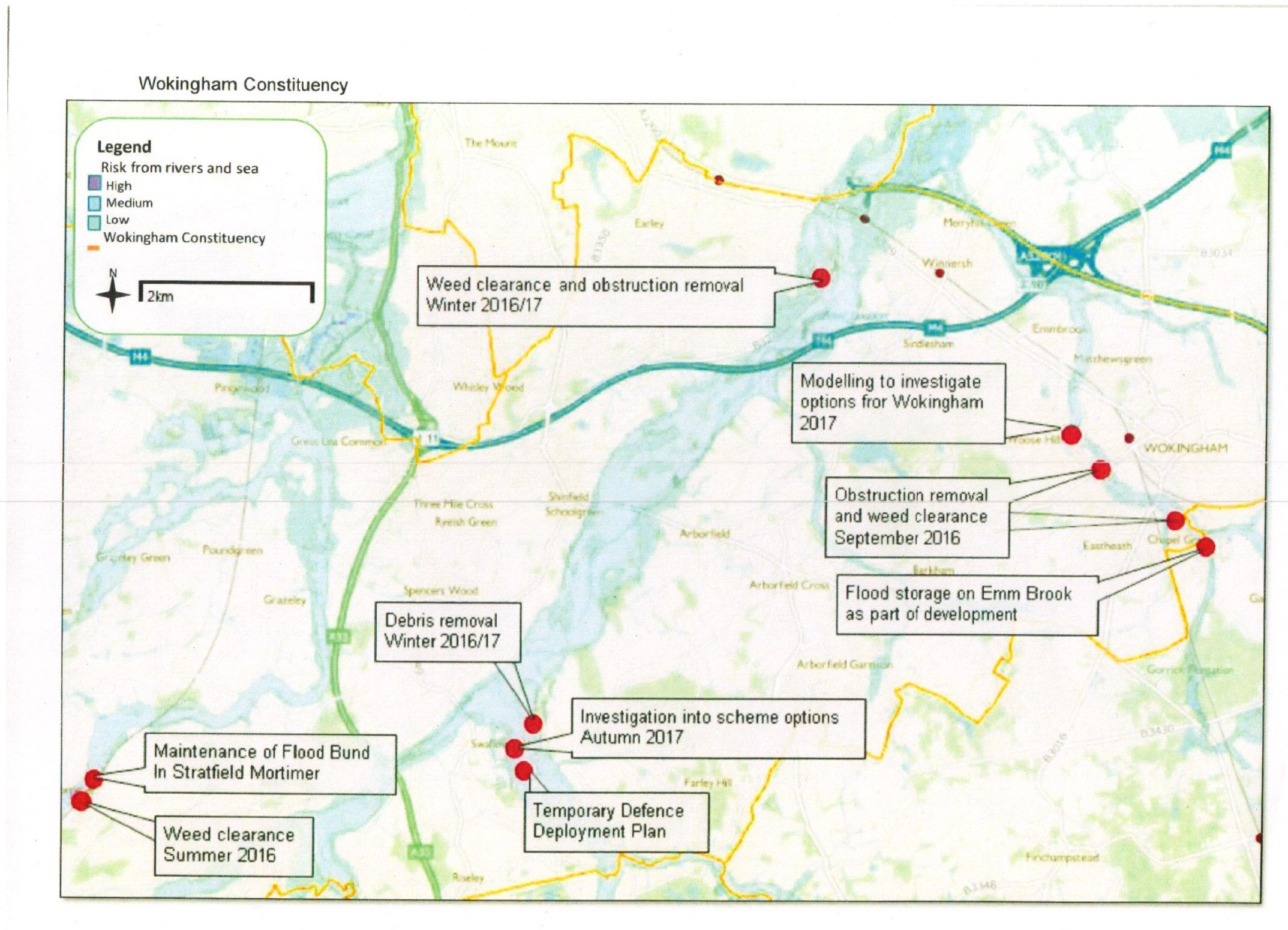
  • In 2015/16 we carried out river maintenance at 15 locations in your constituency. This work took place along 14.5km of rivers including the Loddon, Swallowfield Ditch, Emm Brook and the Kennet. It included removing obstructions, tree and shrub maintenance and carrying out selective weed and vegetation clearance. In 2016 / 17 we are carrying out a similar maintenance programme. The attached map shows the main locations and types of work we’re doing.

Emm Brook and South Wokingham Distributor Road

  • We have been engaging with Wokingham Borough Council (WBC) over the design of the South Wokingham Distributor Road (SWDR) since the early planning stages, and we will continue to work with WBC as the plans progress. The aim is that the SWDR reduces downstream flood risk from the Emm Brook, notably in locations which have historically been affected by river flooding. The developer anticipates completing the design for the relief road and residential development this calendar year with a view to start construction of the different elements of the scheme in 2018 and 2019.

Planning consultations and permitting

  • Since April 2016 we have commented on 78 planning applications within Wokingham. In line with our remit our responses ensured that the layout of development sites, where there is a risk of flooding from rivers, is appropriate; for example, siting dwellings where there is a low risk. Redevelopment does occur within floodplains and in these situations we provide advice so that floor levels are set above flood levels. In the vast majority of cases the local planning authority will take our advice on any flood risk objections. However if planning permission, for a major application, is given against our advice and the effects of flood risk are significant, we would use a call in process (through the Secretary of State) to reconsider whether planning permission should be granted. We did not call in any applications in 2016 in Wokingham.

Swallowfield Temporary Defence Deployment Plan

  • In 2016 the Government funded 32km of additional temporary barriers nationally (bringing our total national stock to 40km) to protect local communities during flooding. We have a draft deployment plan for Swallowfield where our assessments show there is potential to protect the community. We are consulting with partners and the community to finalise the arrangemen

Appraisals for future flood risk improvements

  • Our future programme for permanent flood defences includes Swallowfield and Lower Earley. We will appraise whether options such as flood walls and embankments are viable in these locations. River modelling is needed to make these assessments and we will test these options once the modelling is available. We will have the outcomes from the appraisal in autumn 2018.

Local Partnership Meetings

  • The Berkshire Flood Partnership is made up of all Berkshire Lead Local Flood Authorities, Thames Water and ourselves. The next meeting is on 7 March 2017. The meeting is chaired by Cllr Jesse Grey of Royal Borough of Windsor and Maidenhead.

We also meet with the Loddon Valley Residents Association and Loddon Basin Flood Action Group

Map1