Assessing a good deal

The best way for the government to negotiate from here with the EU is to remind them what No deal does for us, and then ask what they would prefer to that No Deal. An Agreement needs to be better than No Deal for them and for us.

No Deal ticks four of the five boxes to provide us with a good deal.

  1.  It means we pay them no money over the legal requirments for regular contributions up to departure in March 2019.
  2. It means from March 2019 we can make our own laws, with the ECJ no longer having any sway over our legal system which will be under the control of the UK Supreme Court.
  3. It means we will regain control of our fishing grounds and territorial waters
  4. We can set out our own borders and migration policy with a system which is fair for the whole world

The only box it does not tick is our preference to have a full free trade Agreement with the EU instead of relying on WTO terms and rules.  If the EU understands our intent to leave without an Agreement, it is still possible – as it is massively in their interest – that they will want to take up our offer of free trade as well.

The Deals which some in the UK and on the continent are sketching do not do as well as the No Deal/WTO option. They often envisage large sums in payment to the EU after we have left in March 2019 which would be unacceptable to many UK voters. They seek to keep some EU involvement in our law making, with a continuing role for the ECJ. They do not immediately restore either our fishing grounds or control over our borders. They may offer tariff free trade in goods, or go further and offer a service sector package as well.

Many versions of this kind of Deal would be a bad deal. The Prime Minister is right to be positive, warm and enthusiastic about a more all embracing Agreement, with the UK continuing to make an important contribution to Intelligence, security, defence culture and much else besides. She is offering a full free trade agreement in goods and services. She has hinted that for a good deal she would consider an Implementation period where the UK might make further financial contributions and accept some temporary  joint or independent influence over our courts and laws.

If the government goes beyond this it soon reaches the territory of a bad deal which many people in the UK will not accept. We voted to leave. We do not want a full two years further delay after March 2019, we do not want to pay them large sums of money  beyond the £30 bn leaving present we are giving by paying full contributions  during the waiting period to exit and we do  not want to still be unable to take back control 2 years nine months after the vote.
Why are house prices so high?

The government wants more houses to be affordable. There is a particular shortage of affordable homes to buy in popular arenas.The government has developed policies to help people save a deposit for their first house and to raise the mortgage finance necessary to purchase. This has now helped a lot of first time buyers. Its critics say it is a further self defeating boost to the prices of the properties people want to buy, though this is an unfair exaggeration.

House prices have been driven higher by the interplay of four main forces. First, the pursuit of easy money  policies through QE and ultra low interest rates has allowed people to borrow much more relative to their income, allowing higher prices.

Second, the big boost to demand, as the country finds housing for a large number of new arrivals  in the recent years of high net inward migration.

Third, the relatively low level of new building as a result of the crash at the end of the last decade and the cautious recovery from the slump by house builders concerned not to overcommit again.

Fourth, the concentration of demand for  rent and for ownership in London, the south east and a few other locations of fast job growth.

A slower rate of advance in house prices, maybe encompassing a slow reduction in real prices, might help. A sudden house price fall would be bad for confidence and would set back building more homes.

In order to bring potential supply and demand into better balance the government does need to make progress with a new migration policy, and with its initiatives to get more homes built. There is some  progress with more factory based manufacture and assembly of systems and parts of hones. The more that can be done in the factory, the less the time needed on site. It can raise quality, reduce weather interruptions and speed total construction time.

Slower money growth and higher interest rates could curb prices but would also prevent more people buying a home  at all. Spreading new jobs and prosperity more equally around the country would help, as there are more affordable homes in the less pressurised parts of the UK.

In nany locations there is plenty of scope to adapt old retail and commercial property to residential. It can be done by demolition and rebuild, or by adaptation and improvement. Many places need to change the shape and size of their shopping and business areas given the changing face of retail and business in the age of the internet.


The tragedy of Spain

The Spanish government has decided to double up its strong arm approach to the Catalan independence movement. The first time it used force, trying to close down the unofficial referendum, it shocked the democratic world and made its position worse.

Once again the Spanish government has decided to take tough unilateral action. This time they plan to close down the Catalan government. What if the Catalan government refuses to be closed? What if it meets in exile? What if some of its employees decline to do the bidding of the Spanish government? Will there now be a struggle to get control of the governing machine in Catalonia? Will this make martyrs?

The Catalan leadership has been careful to let the Spanish state make the tough moves first.Presumably it thinks that  will lead to more local and international support for its cause. The Catalans have consistently sought dialogue and requested legal ways of assessing and responding to Catalan opinion.

It is true the Catalan leaders are acting outside the constitutional law. It is also the case that a democratic state has to keep most of the people most of the time in support of the constitutional franework. If a state loses the consent of a large number of people  to its rights to pass and enforce laws, it will not be able to govern democratically but will need  to resort to using force if it wishes to impose the law without dislogue or compromise.


Universal credit

Wokingham will soon be part of the Universal credit system, as its phased introduction comes to us. The system comes to the Reading office in December and to the Bracknell office probably in February next year. So far the rollout around the country has not produced too many difficult cases. The government I am assured is monitoring responses very carefully and is willing to amend where there are problems in the system.

There has been active debate recently about the time it takes for someone to get their first benefit after applying. It is true that it can take up to six weeks from the first application. The benefit is paid monthly in arrears, and it is the full amount of state support for those who rely on it. This would be unacceptable for people who are out of work and have no other income or savings without a system of advances.

To deal with this the government makes available advances or loans to cover the period before the first benefit payment is received. Anyone who is out of money and applying for Universal credit should apply for such  an advance which can be paid promptly. The advance is repayable with no interest charge over the following months when the individual is in receipt of the benefit following assessment. The benefit paid covers the assessment period of four weeks and any waiting period after assessment, which  is paid in arrears. There is a possible seven waiting days before assessment.

The government is looking at whether the assessment and waiting period can be reduced. The reason it is relatively long is the complexity of the calculation and the need for evidence of circumstances, as the benefit covers housing, unemployment, family needs and any disability. It replaces a number of benefits with their own forms and application systems. Any reduction in time taken would be welcome, but the calculation needs to be done accurately based on good information to be fair to everyone.

I am of course willing to take up any application that is causing problems when the system is introduced locally, as I do not wish to see anyone without money to buy their food and cover their basic living costs whilst awaiting the outcome of the application.

More broadband for the railways and the rest of us

The railway network contains some great routes that run straight into the centres of our busiest towns and cities. There is spare land adjacent to the track that would take fibre optic cables as well as other utility systems.

The railway needs better wi fi for passengers. All too often on a train the wi fi cuts out in a cutting or tunnel, if you have been able to log into what are still often unfriendly and complex systems. A comprehensive fibre network with communication points with trains would greatly improve reception and access.

More importantly such fibre would also empower a new generation of digital signals which we need to increase train capacities as I have discussed before. With more real time information about where every train is on the system and the speed at which it is travelling it will be possibly to safely deploy more trains on the same tracks to deal with capacity shortages that are common and chronic at peak times. This is a much cheaper answer to the capacity issues than building new track.

These fibre networks can also have sufficient capability to assist the spread of ultrafast broadband to homes and businesses across the country. There can be cabinets alongside the track at intervals to enable adjacent housing and industrial estates to link their local fibre connections to a larger trunk network alongside the railway.

We need to make more intelligent use of these fabulous routes into our main centres. Carrying modern fibre would help a lot as we build the infrastructure for a truly modern economy.I Am pressing Ministers to get on with this scheme. I am also urging them to find other additional routes for fibre cable beyond these track side ones that do not involved putting the fibre under roads. It is high time we got our infrastructure into more accessible places and stopped digging up roads every time we needed to mend or improve.

Affordable homes for rent and purchase

I attended the debate on a Ten Minute Rule Bill led by Christopher Chope MP to promote more affordable homes for rent and purchase.

The idea behind this bill is a good one. Private capital will be raised to pay for a substantial number of new homes where planning permission allows development. These homes will be rented out at 80% of market rents, enabling people to save for a deposit. They then have the option to buy the property, taking out a mortgage to do so. They will be entitled to a 10% discount on the purchase to cut the size of deposit they need to save.

Mr Chope estimates that the private sector can raise £40bn to put up 200,000 homes at £200,000 average price.

I would be interested to hear thoughts  on this proposal. 10 Minute Rule Bills do not usually become law, but this is an idea which the government could adopt and implement if it has good support and if the detail works.

Expect more gloom from the Office of Budget Responsibility

The official forecasters got 2016 horribly wrong, slashing estimates for the post vote economy. Instead it did well, with credit available, more jobs being created, good growth in car sales and rapid expansion in services.

This year the growth rate is being  slowed by a deliberate monetary tightening from the Bank and from the after effects of tax rises in both the 2016 and 2017 budgets. I have pointed to this likelihood for sometime based on the tax and monetary policies being followed. Official forecasts were revised up a bit from the very low levels made after the referendum. The OBR forecast of 0.3% growth for the third quarter of this year was just 25% lower than the outturn figure. I now read in the press that the Office of Budget Responsibility is going to cut  its forecasts for productivity growth, which in turn will mean lower growth estimates for  output and tax revenues. This will face the Chancellor with a more difficult set of figures against which to make his budget judgement.

I have no problems with more pessimistic forecasts if that is needed to make them more accurate. My complaints have been about a run of pessimistic forecasts that have been wrong, where I have  put forward a more accurate alternative. The adjustment to the official figures will take place against the backdrop of a year so far where the deficit has come in well below forecast. Without further changes to forecasting assumptions, that would have left the Chancellor some welcome leeway for tax cuts and spending rises in areas that need them.

It may well be the case that the last set of productivity forecasts by the OBR  were too high. It is also the case that the OBR has been underestimating tax revenue growth. Their models seem to assume loss of revenue when you cut a rate, yet in many cases as with Corporation Tax, higher rate income tax,  CGT and Stamp duty lower rates have in practice led to higher revenues. The government  needs to avoid lurching  to too tight a fiscal policy to try to hit targets based on estimates that have in the past proved faulty.  The deficit is a figure based on changes in two much larger figures, income and spending. Small changes in assumptions elsewhere can bring big and unrealistic swings in the deficit forecast.

The budget does need to provide sufficient cash for the NHS, schools and social care. It should be tough on any idea that we will pay large sums to the EU, as we need that money at home and we do not owe them beyond our contributions up to departure.  Saving the EU money is the favourite spending cut of many voters. The government needs to revisit how it can instil discipline in spending on the railways. It should ensure the overseas aid budget pays for all military costs involved in disaster relief and peace keeping. It should examine ways of making more affordable housing for sale available to meet people’s aspirations and reduce the strain on social rented housing which has a substantial public spending cost.

The budget also needs to look at how it can use selective lower tax rates to boost output, productivity and tax revenues.

Meeting with Minister Hancock over broadband roll out

I had a meeting with Matt Hancock to draw his attention to some small business constituents who are finding it difficult or impossible to secure access to superfast br0adband at an affordable price. I also raised service quality issues for a range of constituents who do have superfast services but do not always find they offer the speed and capacity required.

The Minister said he as well aware of these issues which are common across the country. He is working on ways to expand coverage more rapidly and to ensure good quality service. He promised further initiatives to foster more and  better service. He also sought my views on how we should undertake the next stage, going from superfast to ultrafast which will require fibre into the home or office.

I will keep people posted with progress, and will continue to work with Superfast Berkshire who are responsible locally.

The EU imprisons some civil servants

One of the strengths of the old UK constitution was an independent civil service. They could give honest and fearless advice to Ministers, who would decide following discussion with them. Civil servants would then implement the decision. Only Ministers announced and defended new policy. Ministers took the blame if mistakes we made whilst defending their officials who could not speak out for themselves.

This model was changed in two ways during our time in the EU. Government created more public bodies to carry out policy or to regulate. This gave to their senior officials a voice, and meant they had to accept responsibility themselves without the full protection of the Minister. As the powers of the EU expanded, spreading a vast canopy of EU law above our own law, so officials starting telling Ministers that many of the things they wanted to do were illegal under EU law and therefore could not figure in the Ministerial decision. All too many so called Ministerial decisions were instructions from officials who took their orders from Brussels.

Now we are leaving the EU I am told some important officials are finding it hard to adjust to serve a sovereign UK government. They are still running to Brussels for instruction, and telling Ministers that things are against EU laws which Ministers wish to change or will no longer apply. It is true Ministers want to keep big areas of EU law like employment and environmental laws, but there are other areas where people and politicians  want change.

Many want to press on with negotiating trade deals with non EU countries. Some officials claim this is against EU law and cannot be done until we leave. I see no evidence of that in the Treaties. Clearly we cannot sign a trade deal until the date we leave, but what is stopping sorting one out ahead of departure? To do so will not damage the EU. As we are leaving their jurisdiction there is no crime the day we leave.

We want a UK fishing policy. Lets get on and design and legislate one so its ready for April 2019 when we depart. Of course that’s against current EU rules, but as long as it only applies from the day we leave there is again no violation of the Treaty. Civil service jobs have just got a lot more interesting. Instead of having to relay the EU instruction to a frustrated Minister the two can now work together on  a better answer for the UK. Its called democracy and it could catch on.


National Funding Formula for Schools

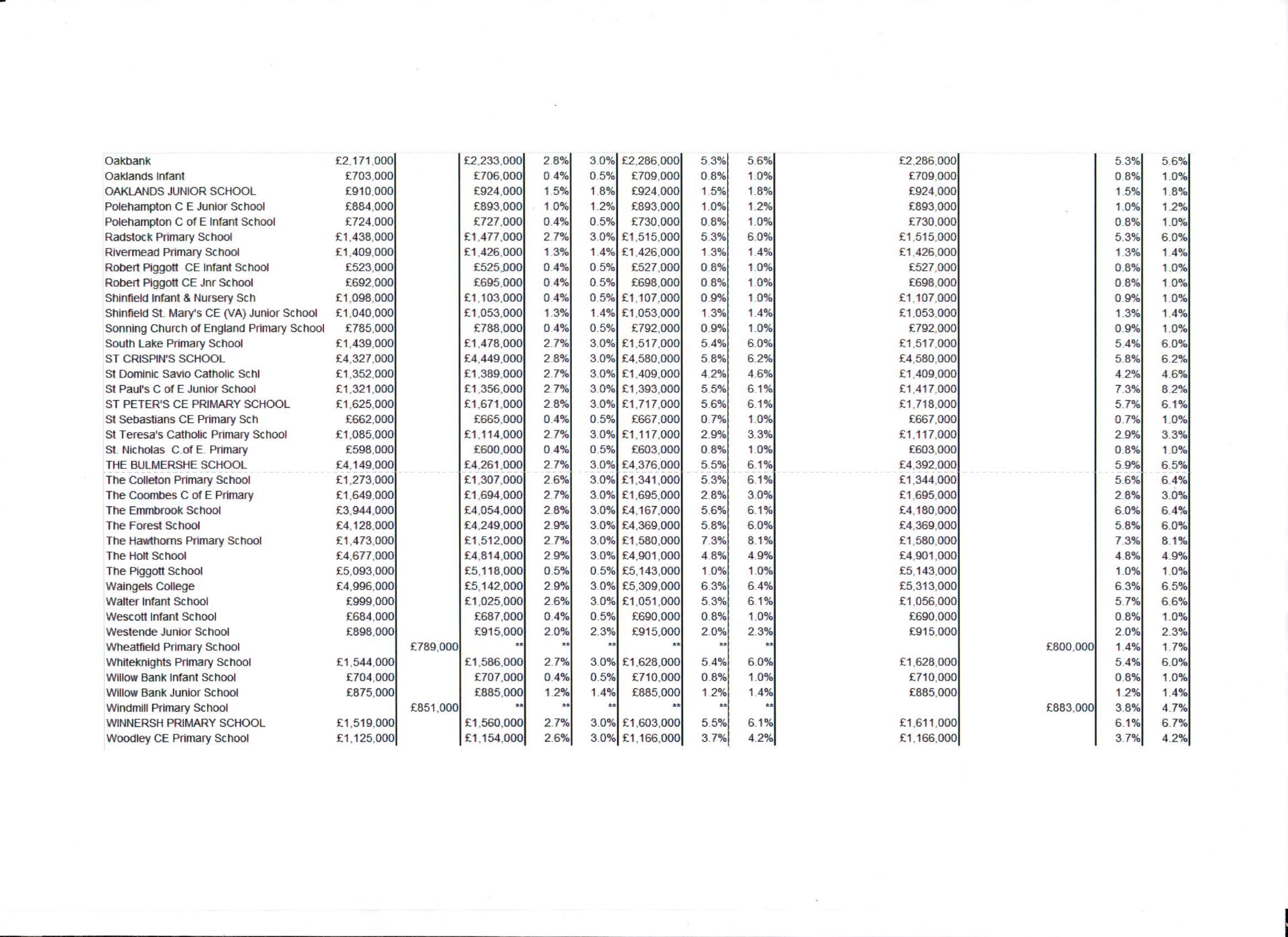
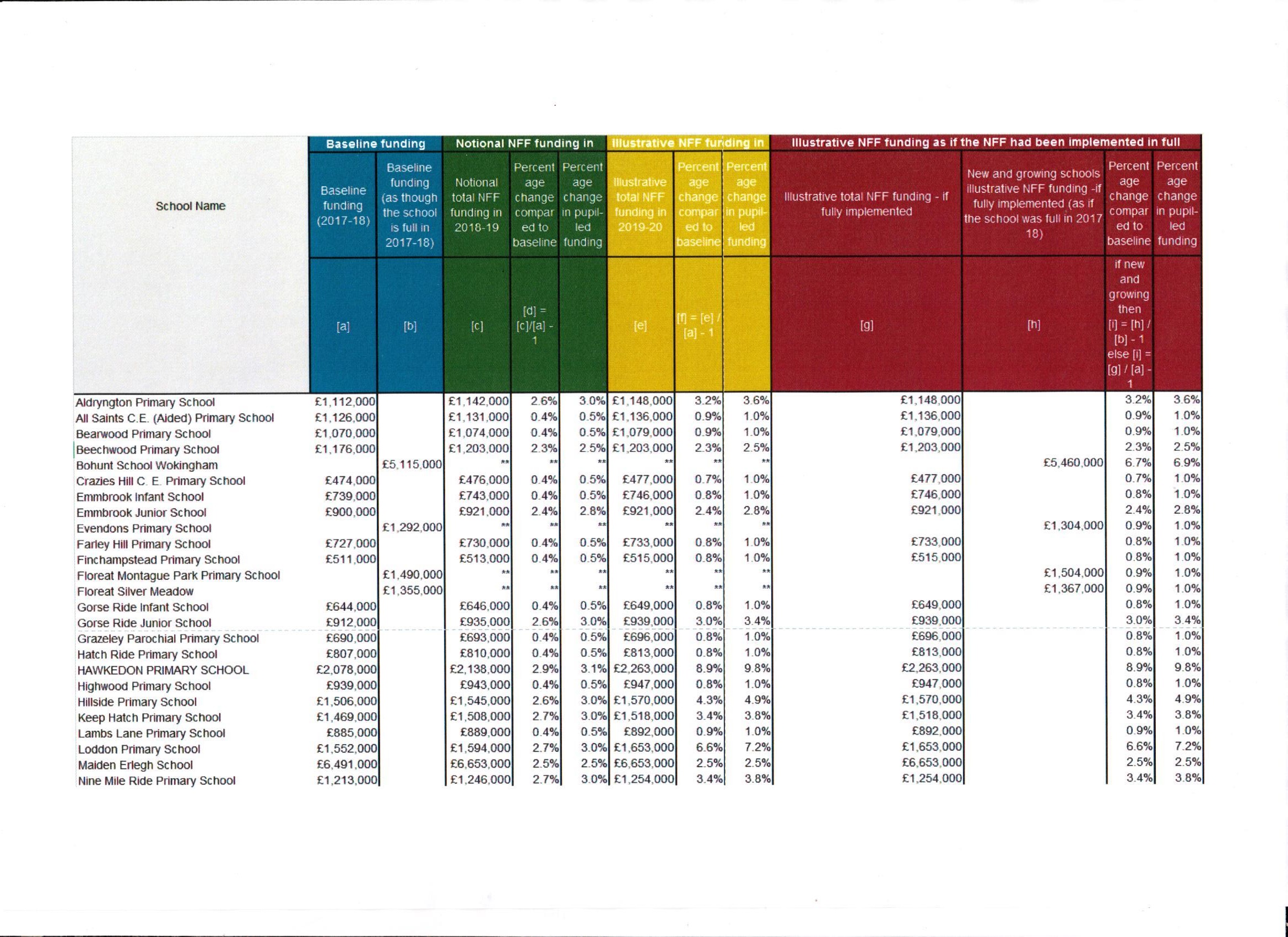
I lobbied the government to increase the total amount going to schools over the next three years, and to increase the proportion of the total going to Wokingham schools which were poorly funded by national standards. The government has now decided on its new National Funding Formula which does give increases to Wokingham schools, and  creates a guaranteed minimum of per pupil funding for every school in England. The government has also increased the amounts placed in the total settlement for schools as the figures below show.

Ministers have recently published figures which show how the provisional allocations under the new National Funding Formula for Schools: