Output and transfers between the regions of the UK

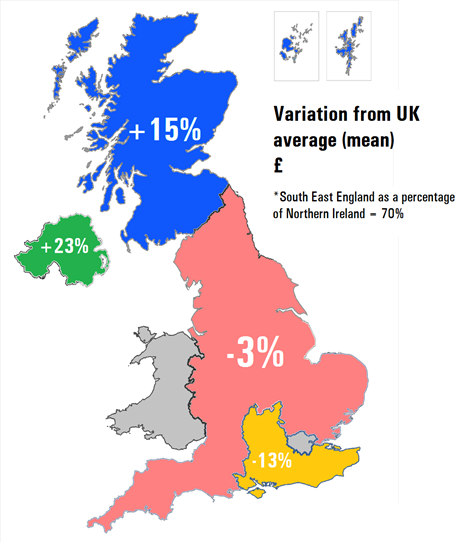
In the light of the Scottish financial settlement I am offering these important maps taken from National Statistics. (ONS publications) The first  shows just how much more public spending per head Scotland and Northern Ireland receive compared to England, especially south east England. It  illustrates the extent of the regional transfers of money around the UK.

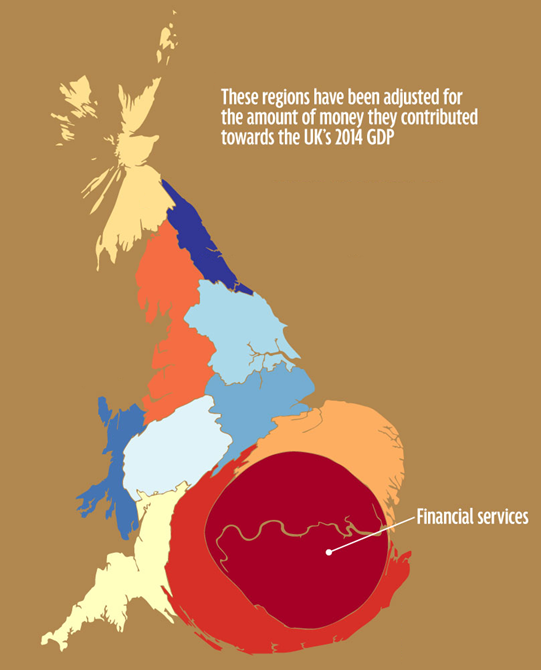
The second map shows just how much bigger London, the south east and East Anglia have become as a result of more rapid economic and population growth than the rest of the country. These three parts of the UK now represent almost one half of our economic output. This is displayed graphically by the redrawing of the map in line with economic output. As a result we see a very large London, and a large south east and East Anglia.

It appears that the latest financial settlement for Scotland gives the SNP all they asked for. The grant to Scotland has to be adjusted for the extra responsibilities the Scottish Parliament now has, and for the extra revenues they now control. The formula allows adjustments to be made for the likely slower growth of population in Scotland than the rest of the UK, the main thing the SNP insisted on.

Variation from UK average map.02.03.16

GDP Map

How many EU migrants have come to the UK?

Conservative MPs are concerned about the big difference between the number of NI numbers issued to EU migrants in recent years and the official figures for EU migrant numbers. I was pleased to see this morning that this concern is shared by John Wjhittingdale, in the Cabinet. New National Insurance numbers for EU citizens have been issued at a rate more than twice the number of EU migrants recognised in the official in the last five years. An additional 1.25 million people are involved. Last year alone the figures for new NI numbers at 630,000 were 145% higher than the 257,000 EU migrants officially recognised.

We need to know the answer for proper planning of public services and housebuilding rates, and to inform the debate on whether we now need to regain control of our own borders through Brexit.

Burghfield Lakes development

Yesterday I visited the Burghfield Sailing Club to see the latest exhibition on the Burghfield Lakes development, to respond to their consultation.
They have reduced the numbers of homes since the original scheme. They are putting in water handling to reduce flooding in the area when we get excessive rains, in addition to needing extra water handling to cater for the homes they wish to build. The development includes lakeside homes which float if water levels on the lake rise too much, and affordable homes.
If constituents do have concerns or are interested they should look at the latest plans at the Sailing Club exhibition and be aware that the company will soon be submitting an outline planning application.
I asked a number of questions about access, flood prevention and the nature of the properties. The lakeside homes do I am told meet requirements for home insurance and mortgages.

My contribute to the debate on End of Life Care, 2 March

John Redwood (Wokingham) (Con): I will draw on conversations that I have had with people around the country who have experienced a relative dying relatively recently, as well as on my own observations. I will not mention a particular case, because if I did have a difficult case, I would take it up privately in the usual way.

The first conclusion that I have formed, which I think the Secretary of State has wisely come to, is that a patient undergoing the last stages of their life and their family need a named doctor who is in charge. The family and the patient, when the patient has capacity, need to have access at reasonable times to that doctor to find out where they have got to and what the next stage is likely to be.

I believe that Ministers have put in place a requirement for there to be a named general practitioner for every patient when they are at home or in a care home. That is very welcome and let us hope that it works, so that there is someone people can turn to, whom they trust and know. However, when, as so often happens, people enter hospital and may not come out again, because of the way in which rosters and rotas work, it means that every day or every other day, there is a different group of doctors and nurses in charge of them.

That can mean one of two things. Sometimes, the family and/or the patient are constantly retold very bad news because the new team feels that they have a duty to tell them. It may not be helpful for people to keep getting the same bad news. Alternatively, the family or the patient with capacity may want information at a particular time, but no one is up to speed because they have only recently taken over and have not had time to read the notes. Indeed, reading the notes is not necessarily as good as being continuously in charge of the patient and talking to them over the days or weeks in which the treatment is undertaken or as their last days draw near. I therefore urge Ministers to get behind the idea that it is best if there is a named senior doctor—perhaps a consultant or registrar.

Often, people in their last few weeks or months of life have complex and multiple medical conditions, so a series of different consultants are involved, but no one consultant feels as if they are ultimately in charge. I am told that in some hospitals, patients are moved from ward to ward at very short notice, with different specialties in mind. The family then turn up and do not even know where the patient is, because they think that they will be where they last saw them. That can be very disruptive for the family. More care and attention is needed in some cases to deal with that issue.

The second issue, which has been mentioned by other colleagues, is the interface between social care and hospitals. All of us who visit hospitals as Members of Parliament and sometimes as family members will have observed that a very large number of patients in a lot of our wards are extremely elderly and very frail, with lots of complex medical conditions. Some of them may not be easy to treat. Others might be better off in a care home or at home, but there has been a failure to put together the set of services that they need.

I do not really believe that that is a money issue, because in many cases one could buy an awful lot of social care for the cost of the hospital bed that the person is occupying. Social care might even be cheaper.

I am not recommending that we take people out of hospital because somewhere else is cheaper, but if they would be better off somewhere else, if they want to be somewhere else and if there are no longer any medical interventions that the hospital can make, it is sensible to take advantage of social care if it is also cheaper.

Kelvin Hopkins (Luton North) (Lab): I hear what the right hon. Gentleman says, but when local authorities know that they have to pay for care when somebody comes out of hospital, they will try to persuade them to stay in hospital for as long as possible. Different budgets put different pressures on different institutions.

John Redwood: The hon. Gentleman is right. Throughout the time he and I have been in the House, under Governments of different persuasions, we have all known about the problem, we have all said that we need to solve it and still we have not managed to do that. I hope that our current talented Ministers can do something that no previous groups of Ministers have been able to achieve. There is an experiment because, with the devolution models that Ministers are considering, if the health and social care budgets are put together under the same authority, the excuse that there is a budget row goes. One would hope that the best interests of the patient were dominant and that authorities would realise that, in some cases, the best interests of the patient also enabled them to save money through switching from an expensive hospital bed to a decent care package. That could be helpful, and I hope that Ministers will do that.

For the families of those who die, the need for care does not end at the moment of death. That is generally understood by the public sector, but there are serious problems with delivering the support and administrative back-up that families need when a loved one dies. Several people who have been through this recently told me that the first thing that happens is a delay in getting a death certificate. Without a death certificate, nothing can be done to settle things. People cannot even hold a funeral because they cannot instruct a funeral director until they have a death certificate.

Not only is there a delay in getting the death certificate from the medical staff at the hospital, but people cannot register the death because of the insistence on a face-to-face meeting with the registrar, which can mean a further delay of many days before a slot becomes available. Quite a lot of families therefore end up with one, two, three and four weeks of delay before they get the death certificate, which is necessary to trigger the funeral and any financial changes consequent on a person’s death.

The Government have introduced a sensible “Tell Us Once” system so that when a person dies, the family can fill in quite a complicated electronic form, which is meant to tell all Departments with which the dead person may have been involved what the Government need to know. There are two problems with that. First, families often do not have all the knowledge that they need. Unless they have that knowledge, the Government seem unable to cross-refer and discover that, for example, the person had a benefit as well as a pension. It would be helpful if Government computers talked to each other more adequately so that the Government could do more of the work and families just had to notify them of the death and did not have to know every detail of the dead person’s financial affairs.

Secondly, because the delays with the death certificate and registrar appointments often mean that registration of the death is delayed, the Government make payments to the deceased person, and the families, having used “Tell Us Once”, get a set of not terribly friendly letters—I appreciate that they have been dressed up a bit—saying, “Your dead relative owes us this much money”. The families cannot necessarily get their hands on that money, but they are none the less obliged to pay the Government back, at an unsettling time when they are mourning and grieving and were not expecting a tax or benefit bill.

In the interests of handling the families better, the Government should speed up their side of the administration so that the death can be registered promptly, the Government do not make wrong payments and the families are not faced with letters demanding money back when they have other things on their mind and are trying to deal with the hurt. It does not make it better when the Government say, “We’re very sorry you’ve had a loss” if they go on to say, “but you owe us this much money. The usual rules apply. See you in prison if you don’t pay”.

We need to improve greatly on dealing with the first few weeks for the poor grieving families, who do not necessarily know the process, are very lost because they have lost their loved one, and are not helped by delays and sometimes the incompetence of the regulatory authorities.
The new EU deal does not safeguard the City

One of the most important parts of the UK/EU negotiation was the attempt by the UK to gain guarantees that the UK as   part of the EU will not be drawn into Euro related regulation of the finance sector nor into the financial consequences of the Euro.


The UK began by asking for the Union to be described as a “multi currency Union”. The final text allowed instead “not all member states have the euro as their currency”. It  also drew attention to the fact that all but two countries (UK/Denmark) do have to adopt the Euro in due course.


The UK sought a repetition of past assurances that the UK will not be responsible for any bail outs of Euro members. The text states “ Emergency and crisis measures designed to safeguard the financial stability of the Euro area will not entail budgetary responsibility for Member States whose currency is not the euro, or as the case may be, for those not participating in the banking union.” The EU is allowed to bill the administrative costs to the EU general budget, but other costs from any emergency will be reimbursed, implying that the UK may  have to make an initial contribution,as it did with the Greek loan in the summer of 2015.


The UK sought to keep its own rule book and ability to supervise its own banks and financial institutions, given the drive to common regulation and control in the Euro area.  This produced the following balanced text:


“The implementation of measures, including the supervision or resolution of financial institutions and markets, and macro-prudential responsibilities, ………(for non Euro countries)…is subject to the requirements of group and consolidated supervision and resolution, a matter for their own  authorities and own budgetary responsibility, unless such member states wish to join common mechanisms…

This is without prejudice to the development of a single rule book and to Union mechanisms of macro-prudential oversight for the prevention and mitigation of systemic financial risks in the Union and to the existing powers of the Union…”


In  practice the UK will come under an increasing volume of EU financial regulation, both as new Directives and regulations are passed, and as the ECJ and the European Central Bank augment their powers as need arises and individual cases dictate. There are no new mechanisms to prevent Euro area member states using their power to form new EU regulations and outvote the UK.


The UK also gave new ground to the Euro area by accepting the following limitations on its future actions:


“In order to fulfil the Treaties’ objective to establish an economic and monetary union whose currency is the euro, further deepening is needed……It is acknowledged that Member States not participating in the further deepening of the economic and monetary union will not create obstacles to but facilitate

such further deepening….”


The intention to create a single currency area with full monetary, capital markets and banking union is clear, and the UK has agreed to not to impede it. As a result there will likely be an increasing number of issues over the common rule book and EU wide regulation of the finance sector. In recent years there have been several important disputes between the UK and the EU over these matters. The UK had to dig in to secure protection against possible  loss on its share of the loan to Greece in 2015. The government withdrew its court case against EU rules limiting bonuses in the financial sector, on the grounds that the case was “unlikely to succeed”. The UK has been worried about the Alternative Investment Fund Managers Directive with its capacity to drive hedge funds away from the EU altogether, but unable to stop it. The UK was also unable to block the restrictions on short sales introduced by ESMA.

The UK has so far impeded the Financial Transaction Tax which some EU member states wish to impose. This could return to pose difficult issues over where and whether  the tax could be charged  on a trade were the continental countries to reach an agreement to press ahead without UK consent. Would London have to levy the charge on a German-French transaction handled through London? What if a UK person or corporate were one of the parties?


Living alongside the Euro area as it moves to complete its full banking and capital markets union will pose problems as the EU intends to use the legal authority of the whole Union, not just the Euro area,  for many of the measures it thinks it needs. The Union as a whole has a defined legal personality and well established decision making institutions which are not matched by the Eurozone. Much of the Eurozone’s business has to be cleared through the EU.  The general  EU budget also could become an issue.Whilst the UK has the promise that this will not  be used for emergencies and bail outs, the Euro itself may require larger regional programmes, administrative expenditure and other items where the general Union budget will be used.


Letter from Highways England on A329(M)/M4 junction

26 February 2016


Dear Mr Redwood

Thank you for your further letter of 18 January about the new road layout on the A329(M)/M4 Junction 10.

I note your observations about future capacity requirements on the A329(M) in light of the new housing developments.

The improvements to this junction were carried out under the government’s Pinch Point Programme to facilitate planned economic growth to improve traffic flow on the M4 by relieving congestion on the slip roads at Junction 10. We worked closely with WBC to develop and understand the impact of the growth proposals through the Local Plan process.

The improvements have successfully reduced observed queues on the M4 and associated safety risks. To address concerns relating to the junction improvements and the safe operation of the A329(M) we held a meeting with Wokingham Borough Council on 19 January. At the meeting an agreement was reached to install cameras to observe driver behaviour and undertake traffic counts. The results of this investigation will inform discussions with WBC to identify the feasibility and programme of any further improvements on the A329(M). The video survey and traffic counts are programmed to complete by spring 2016.

Our project sponsor, Ed French, will contact you once we have the monitoring results and have discussed proposals with WBC.

Yours sincerely

David Brewer

Executive Director

What has been the most damaging EU policy so far?

When assessing our past membership of the EU the UK has plenty of reason to worry over damage done to our interests, jobs and economy by EU membership. I would be interested to hear your views on which EU policy has been most damaging. There are so many to choose from. I list below some of the more obvious candidates.

1. Common Fishery Policy. Has led to the loss of fish stocks, the imposition of tough quotas, and the elimination of much of the British fishing fleet. Making our fish a common resource has not been good for the UK.

2. The European Exchange Rate Mechanism. Our membership of this quack remedy for our economy led first to a rapid inflation and then to a deep recession. It lost us around 5%of our national output.

3. The Common Agricultural Policy. UK farmers have been denied sufficient quota to meet our and their needs in some sectors. Our beef farmers were badly treated over handling BSE. Food consumers have had to buy dearer continental product instead of importing from cheaper places elsewhere thanks to tariffs and controls. Emerging market countries have been denied fair access to our markets, impeding their development.

4. The Common energy policy. Whilst the UK’s home grown Climate Change policy of the Labour government was unhelpful for keeping the lights on and supplying enough affordable power for our needs, the UK is locked in by the Renewables requirements and the combustion controls to expensive and unreliable power and to premature power station closures.This worsens fuel poverty and spurs de industrialisation.

5. The Euro. Fortunately we won the battle to keep the UK out, but we are adversely affected by the mass unemployment, slow growth and no growth which this currency scheme is inflicting on much of the rest of the EU.

My contribution to the debate on the European Union Referendum, 29 February

John Redwood (Wokingham) (Con): I welcome a fairly early date for the referendum. I do not know about you, Mr Speaker, but there is only so much that I can take of all the stories of the pestilence, famine and plague that are going to be visited upon us by the very European Union countries that the Government say we love and work well with. The Government have this strange vision that those countries would suddenly change and become extremely unpleasant were we to want a relationship based on friendship and trade rather than on the current treaties. I personally think that 16 weeks would be quite enough to do the job that I would love the Government to do, which is to win it for the leave campaign by using this highly inappropriate tone and by constantly slanging off our European partners by telling us just how unpleasant they would be. I would have thought that a Government wishing to encourage us to stay in the European Union would want to be rather more obliging about our European partners and to paint a picture of how things might be better were we to stay in, rather than concentrating only on ascribing false futures to the leave campaign.

I am interjecting in this debate because I am worried that 16 weeks might not be long enough for the Government to carry out all the tasks necessary to fulfil the requirements of the legislation. In particular, I have been moved to that view by listening to my hon. Friend the Member for Stone (Sir William Cash), who is often absolutely right about these points and their salience. The Government have an important duty to provide impartial information to the public as part of the task of preparing them for the referendum. Having seen their work so far, I am afraid to say that it fails by all standards. It is not impartial, it is not well researched and it is often exceedingly misleading. I am using parliamentary language, Mr Speaker; I might use richer language were I not inside the House. It seems to me that the Government are going to need a lot more time to work with their ever willing officials to come up with balanced, mature and sensible information about what the future might look like under either scenario.

One thing that the Government have clearly had no time to prepare so far—this is a particularly worrying lacuna—is information on what the future might look like if we stay in. We have had no response from the Government on how they would respond to “The Five Presidents’ Report: Completing Europe’s Economic and Monetary Union” or on how they would handle demands for capital markets union, banking union, full economic and monetary union and political union. Would such a situation immediately trigger a requirement for us to veto the next treaty, would we seek a comprehensive opt-out from it, or would the Government want to work with their partners and agree to some modest treaty changes that would affect the United Kingdom, in the spirit of “The Five Presidents’ Report”? Any such changes would be triggered after about 2017, so probably within this Parliament. Could we then look forward to a second referendum if we stayed in the European Union?

Under the European Union Referendum Act 2015, there would need to be a referendum on any treaty changes made as a consequence of “The Five Presidents’ Report” and the clear desire of our partners to go along the route to political union.

Sir William Cash (Stone) (Con): Has my right hon. Friend had the opportunity to see not only the White Paper that was produced a few days ago but the latest jewel in the crown from the Government, which is entitled “The process for withdrawing from the European Union”? It contains page after page of tendentious remarks, assertions and assumptions that cannot be substantiated. I can see the Minister for Europe wriggling around a bit on the Front Bench, because the bottom line is that he will not be able to answer these questions, but they will be tested before 23 June.

John Redwood: That is why, in my amiable way, I was suggesting that the Government might like to rethink their position on the timing of the referendum. Having seen that piece of work, I agree with my hon. Friend. I was frankly ashamed that such a document could come from the United Kingdom Government. It bore no relation to what the leave campaigns are saying about how we would like the Government to handle the British people’s decision if they decide to leave. It did not give any credence to the idea that we would be negotiating with friends and allies who would have as much interest in a successful British exit as we would, should that be the will of the British people.

Ministers never seem to understand that the rest of Europe has far more exports to us at risk than we have to the rest of the European Union, because we are in massive deficit with those countries. I have had personal assurances from representatives of the German Government, for example, that they have no wish to see tariffs or barriers being placed in the way of their extremely profitable and successful trade with the United Kingdom. To issue a document implying that all sorts of obstacles would be put in the way of such trade over a 10-year period simply beggars belief.

Sir William Cash: May I give my right hon. Friend an example? These documents contain scarcely any serious objective analysis from bodies such as the Office for National Statistics or the House of Commons Library, and their arguments are tendentious. I am sure he will remember, because this is at the forefront of his mind, that in current account transactions relating to imports, exports, goods and services, we run a deficit with the other 27 member states of about £58 billion a year, and that Germany runs a surplus in those same goods, services, imports and exports. If that is a single market, I’m a Dutchman.

John Redwood: I am sure that my hon. Friend is many fine things, but a Dutchman is clearly not one of them. He has, however, revealed an important fact, and it is the kind of fact that we would expect to see in a balanced document setting out the position on trade. I hope that the Minister will leave enough time in his urgent timetable to ensure that those sorts of important facts—

Sir William Cash: With references.

John Redwood: With references and proper statistical bases. Those important facts should be put in front of the British people. Indeed, the Minister would be wise to do that from his own point of view—perhaps I should not help him as much as I am apparently trying to do. The Government have been rumbled on this. The press and a lot of the public are saying that they want factual, mature and sensible information setting out the risks of staying in, the risks of leaving and what it would look like in either case, but that is not what we are getting.

We have had another example in the past few days. We have been witnessing a long-term decline of the pound against the dollar for many months, because we are living through a period of dollar strength. In the past few days, when Brexit was in the news, we were told that the pound was going down because of fears about Brexit, whereas that was clearly not the case on other days when the pound had been going down. However, on those same days, the Government bond market had been going up. The prices of bonds had been rising and our creditworthiness was assessed as being better, but I did not hear the Government saying that the idea of Brexit was raising Britain’s credit standing. We could make that case just as easily as we could make the case that the fear of Brexit was leading to a fall in the pound.

That is the kind of tendentious information that I hope the Minister will reconsider if he wishes to keep up the normally high standards of Government documentation and use impartial civil service advice in the right tradition, which we in the House of Commons would like to see. I can see that a few colleagues are not entirely persuaded that those high standards are always met, but I shall give the Government the benefit of the doubt. I have certainly seen many Government documents that achieve higher standards than the ones on this matter.

I again urge the Minister to make sure that he leaves enough time in the action-packed timetable to produce high-quality, balanced information that includes the risks of staying in and the wild ride to political union that others have in mind, as well as what he sees as the risks of leaving. For instance, the Government should point out that if we stop paying the £10 billion of net contributions—money we do not get back—that will immediately improve the balance of payments by one fifth next year. Would that not be a marvellous advantage? I do not see it being pointed out in any of the current material in order to show some kind of balance.

Mrs Anne Main (St Albans) (Con): My right hon. Friend is making a hugely powerful argument. The answer is quite simple: the Government do not want the facts in there—they do not want the British public to know. The British public will come to that conclusion, and it is not a good conclusion if we are to have a balanced debate on the referendum.

John Redwood: I fear that is right, but I also fear I am beginning to give the Government too much help. Obviously, I would like them to lose on this occasion, because I think we will be much better off if that happens. I will therefore vote with the Government, because 16 weeks is quite enough of “Project Fear” and of people misrepresenting a whole lot of things that are going on by saying, “These are the results of the fears of Brexit.” That will do the job I would like the Government to do and help the case I am trying to make, but the Government have a long way to go in the interests of good government and in meeting the legal requirements that they have placed on themselves to provide impartial information. I just trust that in the next few weeks they can lift their game.

The net saving is £10 billion

Various lower estimates for the UK’s saving from leaving the EU have been put about. Let me remind people where the £10 billion figure comes from. It is the last official ONS figure for a whole year, 2014, published in the Pink Book. It is based on the following figures:


UK payments into EU


Vat contribution                                                                              £2388 m

GNI contribution (based on recently revised up GDP)         £13762 m

Customs duties                                                                               £2949 m

Total (inc small items)                                                                 £19107 m


Payments to UK

Fontainebleau abatement  (Thatcher rebate)                        £4416 m

UK charge for collection of customs duties etc                      £741 m

Agricultural receipts                                                                    £2309 m

European Social fund                                                                    £221m

Capital receipts (universities, regional etc)                           £1478 m

Other receipts                                                                                    £70 m

Total Receipts                                                                              £9235 m


NET ONE YEAR COST OF EU                                                                      £9872 m