It is good the government is moving an amendment to confirm our exit date. It is two years nine months later than many Leave voters wanted. It means we will have paid the EU an extra £30bn after we decided to leave in extra contributions which gives them a win. Around £8bn of that extra cost came about thanks to Gina Miller and the courts, delaying our exit by a costly nine months. Let’s now get on with it and have no more delays.
Author: johnredwood
Negotiating with the EU – again
There are more talks underway between the UK and the EU. So far the EU has acted toughly with unfriendly actions and rhetoric, whilst the UK has behaved with diplomatic charm constantly stressing the wish to have a positive and wide ranging relationship once we have left. It is important that the UK continues to be warm and friendly about the future relationship, but also important that UK negotiators are not tempted to make offers on money or on the rights of the European Court against eventual promises to talk about trade and the wider relationship. We should not pay for talks, and there is no need to pay for trade either.
The EU has broken normal diplomatic conventions in the way they are handling their side of the talks. Usually states negotiate government to government, or in this case EU to government. They do not at the same time open talks with the opponents of the government. Instead the EU has welcomed delegations from the official opposition, from parties and individual MPs hostile to Brexit, and others who are in disagreement with the UK government. I see press articles which look as if they have been sourced from the EU or its friends claiming that the UK government may be about to fall, or there might be change to a Labour government, or there is about to be a change of PM where there is no evidence to support any of these claims. At the same time the EU issues instructions to its member states seeking to prevent them talking to the UK on the grounds that they want a single view for the negotiation which will be the view set out by the Commission. There have been stories and quotes implying the EU wants to punish the UK for leaving. Their idea of punishment seems to be more punishment for them, as it entails imposing tariffs and obstacles to trade where they have a large surplus.
The EU has insisted throughout that there is a Brexit bill to pay though it cannot produce any legal basis for such a bill. It has insisted on only talking about three main chosen issues, and declining to talk about the important wider issues of the future relationship at the same time. As both sides agree nothing is agreed until everything is agreed it is silly to refuse to talk about the wider issues. With the clock ticking the UK government should now privately explain to the EU that if there is no prospect of talks about the free trade offer the UK is making before the end of this year then the UK will have to tell businesses to get on with planning for exit under WTO terms.
The UK is offering the rest of the EU great free access to the lucrative UK market. Translating this into the format to register as a free trade agreement with the WTO is easy as we already have the full framework in place. For the EU now it is a simple binary choice. Do they want to carry on with the access they currently enjoy to the UK, or would they prefer to access the UK as a third country under WTO rules and with WTO tariffs?
The official and the political government
One of the difficult things any Minister has to grasp and handle is the distinction between their government roles and their political roles.
In the UK if a Minister wishes to act as a Minister, changing policies, spending government money or leading the administration in their department, they need to do so working with the relevant officials, and keeping the department and the wider government informed of their actions. Cabinet members have various delegated powers to spend money and change policies, and in some cases Statutory powers to operate in a quasi judicial capacity without consulting other departments and colleagues. Any major decision or decision that has an impact on other departments needs to be cleared in correspondence or debated at Cabinet or Cabinet Committee unless it is a decision solely entrusted to a named Secretary of State.
If a Minister wishes to be involved in a local or national election, wants to change Manifesto policy for their party, wishes to attend a political function or otherwise act as a party politician they must not involve the civil service. They may not normally use a government car to get to the event unless there is a security need to do so. They have no duty to report the matter to the government machine, and will only tell the official government of decisions or problems that they come across at any such event that are relevant for the government to consider.
If a Minister travels abroad and wants to meet senior representatives of a foreign government it is normal to advise the Foreign Office and to study any brief they send so that the Minister sticks to the government view of the issues that relate to the UK’s relationship with that country. If a Minister goes abroad for a holiday or to visit friends and family there is not usually any need to consult the Foreign Office or to understand the government line on all the issues, as the Minister is not speaking as a Minister or becoming involved in public policy. If a Minister goes to a foreign country to participate only in a conference or series of meetings that are clearly party political, again they cannot use government assistance and do not have to tell officials.
Various officials in Whitehall clearly do not like Priti Patel for whatever reason. They started briefing against her, claiming she had held meetings when on holiday in Israel that should have been reported to the Foreign Office, and cleared in advance of holding them. The Prime Minister was brought in to adjudicate. According to the press she asked for a full statement of what Priti Patel had done on holiday and told her she should not freelance in this way. When it subsequently emerged that the Minister had not made a full statement of what she had done, the Prime Minister clearly decided to take further action.
It is ultimately for the PM’s judgement whether any given meeting or event was a political or an official one, and whether any given Minister has stepped too far from government policy in what they have said and done. It is clearly best if Ministers can work well with their officials, or can at least trust the official machine with details of their activities. It can also be the case that sometimes officials have their own reasons for wanting to criticise their Minister through unofficial and anonymous briefings, or by report to the Prime Minister. Only the Prime Minister can ultimately decide the merit of these criticisms. Establishing control when something has gone wrong is not easy. Some say sacking the Minister gives the PM control, but it also gives a win to the officials who wanted the Minister out.
Daily reckoning website
I have just been informed about this website. I have nothing to do with it, and have not authorised it to publish any of my material. People going to it should know it is in no way backed or supported by me.
A bad revolution
I have no trouble with the political passing of the Tsars 100 years ago. Russia deserved better. A way had to be found to involve the people in the government. The murder of the Tsars was part of the dreadful violence the revolution unleashed. The revolution caused more misery and suffering. As is the way with most violent revolutions the revolutionaries unleashed a tyranny on those who disagreed, and a pogrom of those they did not like. The small independent farmers were wiped out. Religions were suppressed. Dissidents were tortured, imprisoned or killed. A revolution born of war fatigue ended Russian involvement in the First World War, but the Communist government then hurled Russia into even greater losses through killing many of her own in internal mass murders. They followed this with a major commitment to war with Germany in the 1940s.
The revolution peddled the myths of Marxism, whilst the revolutionaries battled each other over how far they should spread their power and message abroad. The proletariat were told they would inherit the earth. Instead they lost their remaining freedoms, drafted into industrial labour, placed in rented flats and made to live and work as the state dictated. The production machine was heavily slanted to making armaments, at the expense of consumer items for the public. The favoured few at the top of the single ruling party lived and worked in the palaces of the Tsars and in modern luxury whilst most Russians were denied cars and consumer goods that became common in the west as the century advanced.
Russian literature is so often the story of struggle and of the secret service, of torture and autocratic rule. Living standards fell well behind western ones whilst freedoms were also denied. It is strange that various western intellectuals thought the Communist system superior and were prepared to write for it or even to fight for it or spy for it. In my youth I developed a passionate dislike of the Communist message and its social consequences. I saw the USSR shoot people who tried to leave the eastern bloc, whilst anyone in the west was free to go and live in the USSR if they chose. I noted that even the most ardent pro Communists amongst the intelligentsia usually opted to stay safely living in the freer west.
Business Rates in Wokingham
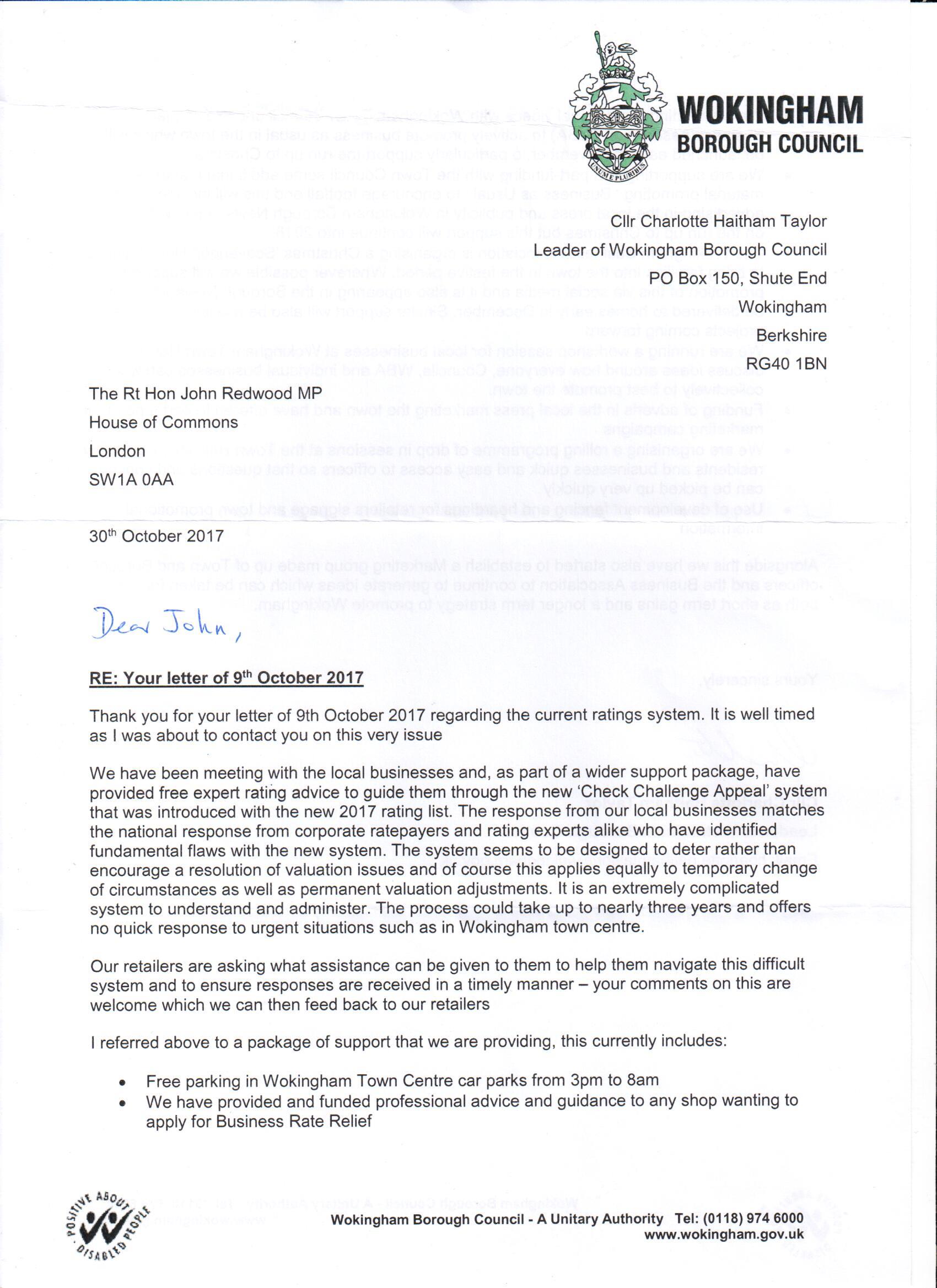
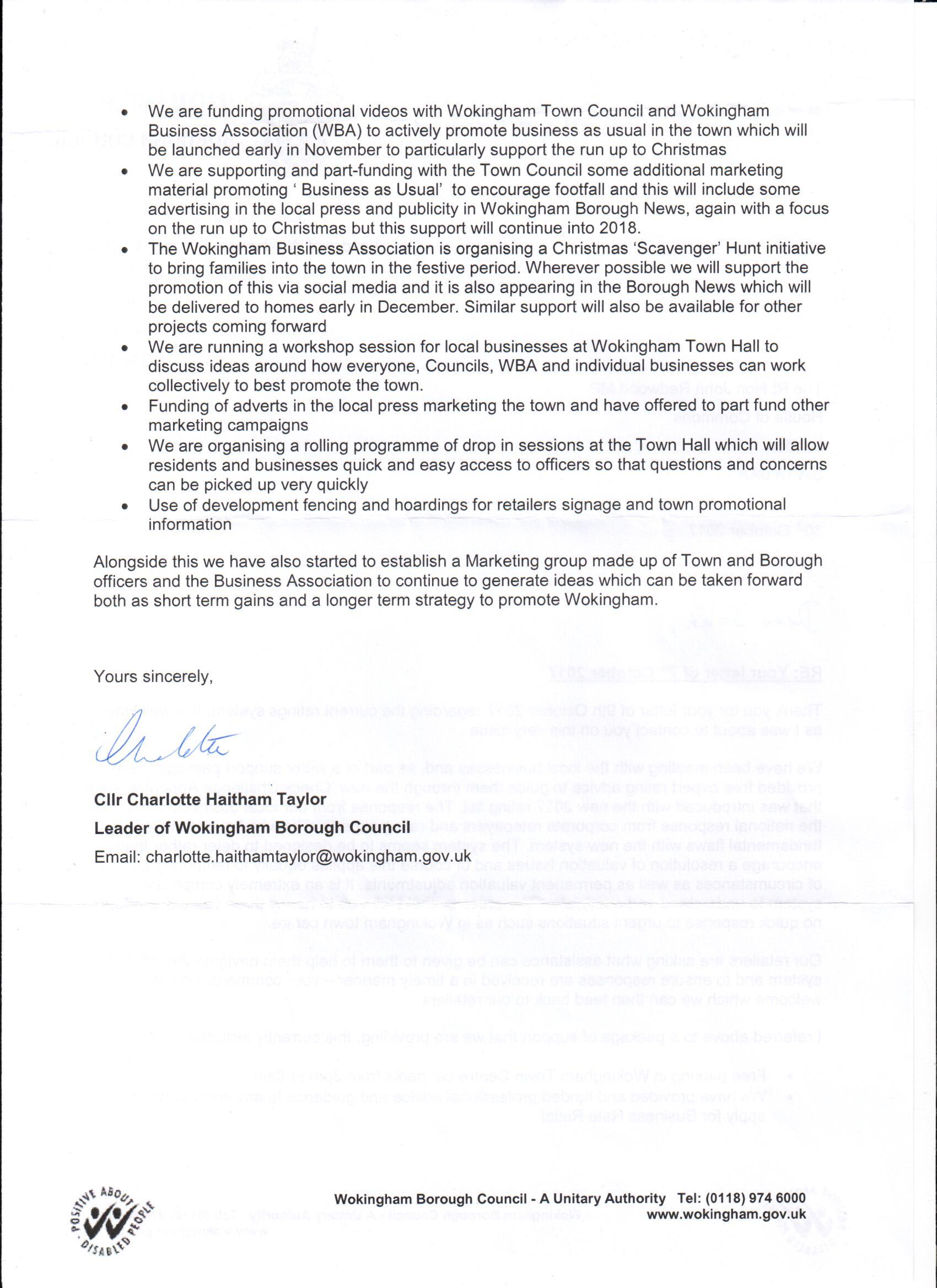
I have received the enclosed letter from Councillor Charlotte Haitham Taylor, the Leader of Wokingham Borough Council.
Councillor Haitham Taylor explains that the council is taking steps to provide relief to businesses in Wokingham affected by the regeneration works.
I welcome these steps and would encourage any local businesses affected by the regeneration works to seek further help from the council.
Tax havens in the EU – why does the BBC miss them out?
I noticed in all the BBC allegations about use of tax havens they of course made no mention of why it is that most UK collective investment fund investments are now made through Dublin or Luxembourg.
The EU invented the passported investment fund that can be easily used throughout the EU called UCITs – Undertakings for collective investments in transferable securities. These have replaced many of the domestic UK unit trusts that savers used to use. 88% of these vehicles are established in either Dublin or Luxembourg rather than in London which remains the principal centre for investment expertise.
One of the reasons behind this dominance by two of the smaller world centres is the favourable tax regime. In Ireland overseas investors in the funds pay no Income tax, CGT, Subscription tax, Corporation Tax or Redemption tax to the Irish authorities. Obviously holders of the units do pay income tax on the dividends and CGT on the gains in their country where they are registered to pay taxes. UK investors large or small pay Income tax on dividends and CGT on gains in any offshore fund they hold anywhere in the world, unless their gain is below the taxable threshold or unless they hold the investment in a pension fund or ISA which are tax exempt. Ironically given the coverage it is the smaller savers who can more easily use sensible tax avoidance schemes like pensions and ISAs to avoid tax on their holdings.
In Luxembourg too there is a very favourable tax regime to encourage the establishment of UCITs. Dublin has proved more attractive because it also offers a very low Corporation Tax rate of 12.5% if the sponsor company for the UCIT also wishes to move there.
It is curious how Labour and the BBC concentrate on favourable tax regimes in UK offshore centres but not in these two larger EU locations. I see nothing wrong with the approach of the Irish or Luxembourg authorities who have successfully competed with a tax and services offer which has attracted a lot of business away from London and other large centres. I do detect bias in the recent treatment of tax avoidance stories.They have been unwilling to point out up front that offshore funds do not allow UK citizens to avoid tax on their investments, and do not point out the huge volume of offshore funds generated by EU policy favouring places other than London within the EU.
Standards at Westminster
I understand the interest in the various stories about actual and alleged misconduct by MPs at Westminster. I have no intention of writing about them and will not be publishing any comments about individual cases. I do not know the rights and wrongs of individual cases and have no wish to get in the way of any enquiry or legal process.
If criminal wrongdoing has taken place it must be prosecuted. If an MP has behaved unprofessionally but not criminally then there needs to be an apology and some recognition of the error. If an MP is falsely accused they deserve a fair and independent process to clear their name.
The Prime Minister and Leader of the Opposition are working together to produce a new procedure for anyone working at Westminster to pursue a complaint about another MP or staff member. This needs to be done with due process in a way which ensures it will be properly examined independently, with judgement and arbitration as needed. Staff members need protecting against any predatory MP, and MPs need to be able to dismiss any false allegations in a timely and convincing way.
The Government’s Broadband Achievements
I have received an update from the Minister on what the Government has done to improve access to superfast broadband.
● Superfast broadband is now available to more than 94 per cent of UK homes and businesses, up from 45 per cent in 2010.
● Since 2013, more than 4.5 million homes and businesses have superfast broadband available for the first time thanks to the Government’s Superfast Broadband Programme.
● We are reaching thousands more properties every single week and on track to reach 95 per cent of the UK by the end of the year.
● We have announced that up to £645 million is to be made available to help take superfast broadband coverage to 98 per cent of the nation over the next few years. Together with other planned delivery, it is estimated that this could see more than 900,000 extra UK homes and businesses gain access to superfast speeds at the end of this year alone
● Up to £56 million of this funding will help take superfast speeds further across Wales. This will build on the 650,000 Welsh homes and businesses that our rollout has already reached.
● And up to £78 million of this funding will help take superfast speeds further across Scotland. This will build on the 800,000 Scottish homes and businesses that our rollout has already reached.
● We have pledged to ensure that 100 per cent of the UK will have access to affordable, fast and reliable broadband by 2020. The success of the Government’s superfast broadband rollout programme will help us reach the final 5 per cent.
● We are investing £1.1bn in digital infrastructure to support the next generation of fast and reliable mobile and broadband communications for consumers and businesses. The National Productivity Investment Fund (NPIF) will invest the money by 2020-21, with a focus on priority areas that are critical for improving productivity: economic infrastructure, housing and R&D.
● We are investing £200 million to fund a programme of local projects to test ways to accelerate market delivery of new full-fibre networks. The first stage of a £200 million Local Full Fibre Network scheme to help bring the UK’s fastest and most reliable Gigabit connectivity to businesses, communities and public buildings was launched on 3 September.
● We have announced a £25 million ‘5G Testbeds and Trials’ competition to select projects for funding in 2018-19 to support the next generation of digital infrastructure. Part of the £740 million National Productivity Investment Fund (NPIF), it will help to ensure the UK’s position as one of the world’s leading countries in the development of 5G technology by attracting inward investment to the UK, creating new opportunities for businesses and improving productivity.
● We are introducing 100% business rates relief for operators who install new fibre on their networks. The move will incentivise operators to invest in the broadband network, increasing speeds for both businesses and homes.
● And we have provided immediate assistance for those people living in the hardest to reach places with the slowest internet speeds. More than 10,000 rural homes and businesses have already used our Better Broadband Subsidy scheme to get a huge boost to their broadband speed.
Brexit is an important political event but not an important economic event
The opponents of Brexit who are still out to stop or dilute it seem to see Brexit as some big economic event. It is difficult to see why.
They concentrate on trade. There is no evidence that joining the EEC or completing the single market did anything to boost UK growth so it is difficult to see how leaving it will do the opposite. Our trade with the rest of the world handled with tariffs under WTO rules is continuing to expand more rapidly than our trade with the EU. The figures quoted for the proportion of our goods and food trade that is with the EU fail to point out it is far more imports than exports.
I predict that you will not see the impact of Brexit on world growth or world trade figures after we have left. If there are tariffs we may import more food from non EU sources and less from the rest of the EU but not much else will change. We will certainly grow more of our own if the EU insists on tariff barriers.
It is also likely the EU will want tariff free when they think they have wrestled as much cash as possible from the UK government in search of a deal. The big win economically for the UK will be saving the money we send them. The more we delay taking control of our own money, the more we delay getting the benefit. The win is a double one, as it will lead to a sharp improvement in our balance of payments when we cancel the contributions, as well as giving us money to spend at home on our own priorities.
I assume the briefings that the UK government is offering E60bn of divorce settlement is disinformation. There is no way the public will accept that, and unlikely the UK government would have offered anything firm just to hold talks that the EU is going to hold anyway.
I see we are now going to train more nurses at home instead of expecting to bring in more EU nurses after we have left. All EU nurses currently here are of course welcome and can stay as valued members of our society, but it must be a good idea to train more of our own and work away at reducing unemployment further.
Those who say non tariff barriers and delays at borders are issues under WTO procedures are out of date. In February this year the new Facilitation of Trade Agreement by the WTO came into force which will work well.