Some in government wrongly worry that Brexit could damage our car industry. Latest sales figures show there is plenty of damage being done by EU regulations, UK taxes and a credit squeeze before we leave. Why doesn’t any of this worry them? Why don’t they do something to stop it?
Author: johnredwood
Managed migration
Yesterday the government published its draft Immigration and Social Security Bill.
There were some good bits to it. The intention is to treat the rest of the world fairly and equally, with no special treatment for EU citizens. The aim is to encourage tourism and visitors. There will be no visas required for EU tourists coming here, and all tourists can stay for up to six months without the need for additional paperwork. Anyone gaining a place at a UK HE institution will be eligible for a permit. All those graduating from a UK university can stay for an additional six months to look for a job or to enjoy their time with us. These are important principles to assist our HE sector and tourist industry and show that the new global UK is outward looking and engaged with the wider world. Citizens of Australia, New Zealand, Japan, South Korea, the USA and Canada will be able to use the egates and faster entry system at our airports as EU people can today.
The proposals also include lifting the current quantitative controls on visas for people coming to undertake higher paid and skilled jobs in the UK currently applying to non EU citizens. The government argues that the UK is good at generating jobs and business activities and needs to be able to attract talent from all round the world to take up these opportunities. The provisional proposal is that such jobs would need to pay more than £30,000 a year to be free of controls.
The government is also suggesting a transitional system of allowing people to come in to work for up to a year at lower pay levels. They would not be eligible for benefits and would have to return home at the end of the year. The longer term aim is to stop inward migration to take low paid jobs, to seek to drive up productivity and pay and to give UK based individuals more chance of getting employment. Having access to fewer people from abroad willing to accept low pay should increase investment in machine power to do some of the tasks, and to make the remaining workforce more productive.
The Common Travel area with the Republic of Ireland is maintained, as before we joined the EEC/EU.
We read that the Chancellor and the Business Secretary are unhappy about any policy which reduces the flow of migrants from the EU into low paid employment. The Home Secretary himself seems unhappy about continuing the policy aim of reducing inward migration substantially in line with the Prime Minister’s often stated wish and with the Conservative Manifesto.
Wokingham Choral Society
I had the pleasure of attending the Choral Society’s carol concert on Saturday at All Saints Church. The choir was in great voice, with the audience singing along to some of the better known ones. I would like to say a big Thank you to the choir for all the work they put in to entertaining us so well throughout the year, and wish them every success for 2019.
Deals galore in place of the Withdrawal Agreement
No deal has always been a misnomer of leaving the EU without signing the Withdrawal Agreement. Proponents have called it leaving on WTO terms, or a Clean break exit with global trading or some such. More recently others have called it a managed exit, drawing attention to the various areas of collaboration and agreement there will be on a so called No Deal exit.
So let me have another go at explaining the WTO option. It is if you like the “multi deal option” or deals on wheels, as the UK and the EU agree a series of measures to smooth transport and trade across the Channel and across the Irish border.
We now know there will be the following Agreements
The Common Transit Convention
The facilitation of trade Convention
WTO trading rules
Air Services Agreement
Continued arrangements for London based derivatives to trade and settle
Phyto-sanitary arrangements
Possible continuing membership of the Government Procurement Agreement
In other words a WTO Brexit will also include a number of important agreements to ensure the planes will fly, the trucks will move and the trade will flow after March 29
There will be the added bonus that we can stop all these groundhog day debates and show how absurd so many of these scare stories are.
Network Rail will suspend Wokingham train whistles
I was pleased to hear that Network Rail has agreed to suspend the train whistles from December 23 rd following complaints from residents and myself. They need to find a better way of ensuring safety if they wish to travel faster on that section of track , or revert to the old permitted speed. The noise is unacceptable to residents.
UK to stay in Common Transit Convention
The government announced this means “simplified cross border trade for UK businesses exporting their goods”. “It will provide cashflow benefits to traders and aid trade flow at key points of entry …….. traders will only have to make customs declarations and pay import duties when they arrive at their final destination.” How about some apologies from all those who said border friction would b e very damaging?
The UK Treasury turns optimistic
Apparently the Treasury think we are going to be creating so many new jobs in the next few years we need to ensure we can invite in a large number of new workers without restriction. That must be a revised forecast, based on a new optimism about Brexit.
What does Parliament want on Brexit?
The government has now decided to delay voting on the draft Withdrawal Agreement until 14 January. It looks likely that it will still lose that vote. The government hopes that it will extract from the EU better language about a timetable for negotiating a trade and future partnership agreement, which is the way to avoid the Irish backstop. They want stronger language about avoiding use of the Irish backstop in any way that might be available. It may also play up some of the fears of No deal in the hope of persuading more MPs to vote for the Agreement. Given the 100 or so Conservative MP public pledges to vote against it is difficult to see how the government can win the vote, even allowing for a substantial number of MPs changing their minds. The DUP have said they cannot vote for the Agreement unless the text concerning the Irish backstop is amended. The EU so far has refused all attempts to re open the legal text. Instead it offers clarifications and reassurances that are not legally binding. The DUP and others say if it is the intention of both sides to avoid the backstop, then delete it from the text as an earnest of good will on this matter.
Meanwhile the government is intensifying work on a Clean WTO Brexit. It has announced resolution of the aviation issues so it can assure us the planes will fly, and is well advanced with fixes to ensure reasonable transit times for goods through channel ports. The EU and its member states too are busy working on this, as they now sense it is a possible outcome even though the UK government says it intends to pilot the Withdrawal Agreement through Parliament. The government has announced the UK will remain in the Common Transit Convention after departure which ensures simplified cross border trade as today.
The House of Commons has a large Remain majority, with a set of Opposition parties keen to use the issue to destabilise the government. There are several other options in play amongst Remain factions. Some favour a second referendum. Some want to cancel Brexit altogether and just tell the people they cannot negotiate a satisfactory exit. Some believe it would be possible to negotiate a better or different deal and favour a delay to attempt a different approach.
The second referendum idea cannot now be legislated in time to hold the vote before the UK leaves on 29 March 2019. Proponents therefore have to support delay to the UK exit, which requires agreement with the EU and repeal or amendment of the EU Withdrawal Act. The EU is reluctant to allow much slippage as they have European Parliamentary elections to consider next May which could change the political direction of the EU itself. The current plan is the UK will not be contesting them. Advocates disagree about the question to be put in a referendum. Some want a three way question, offering WTO exit, staying in or the Mrs May Withdrawal Agreement. Were staying in to win with say 35% of the vote the other 65% would say they had been cheated of Brexit by a minority of voters. Some want a two way skewed to staying in, running Remain against Mrs May’s Withdrawal Agreement. Leave voters would say this did not offer them their choice. Some want a Leave oriented vote, running the Withdrawal Agreement against just leaving, on the grounds that Leave/Remain has been settled by the original People’s Vote. Remain of course does not like this approach. The government so far has ruled all these out comprehensively. It would require a government with a majority to draft the legislation and make the time available to try to pass it through Parliament. This all looks unlikely. Conservative MPs are mainly opponents of a second vote and would not even wish to vote for a timetable motion to help get a second Referendum Bill through, so it would require full Labour backing from the outset which Mr Corbyn would be reluctant to offer.
It is difficult to believe this Parliament would vote to simply remain and argue the people were wrong to vote for Leave. It would need the full repeal of the EU Withdrawal Act and supporting measures. Both main parties in the Commons stood for election in 2017 on a Manifesto to implement the result of the referendum. It would require the two front benches of Labour and Conservative to join together to force it through against a major revolt on the Conservative side and a smaller revolt on the Labour side, with considerable public anger.
So that leaves us with some form of delay as the other option to the WTO Clean Brexit. The EU may well say they have set out the terms for delay. They are in the Withdrawal Agreement. The UK would just have to swallow those if it wants another 21 months or up to 45 months more to negotiate a future relationship. In the meantime the Withdrawal Agreement sets out the terms for the UK continuing in the single market and customs union. If the EU were to back down on this stance, they could presumably agree to the UK continuing with current arrangements for a bit longer to see if anything different could emerge from new talks. This would be quite a loss of face for the EU, but would not guarantee they would go on to concede on all the issues over the future partnership to make it palatable to the UK. It is difficult to see what new would emerge from the talks, given the lack of any progress on the future partnership in the 30 months used up so far.
There could be an agreement to delay for a few months to tidy up remaining issues for a managed No Deal Brexit between the EU and the UK, but this would also require legislation in the UK and the consent of both the UK and EU Parliaments.
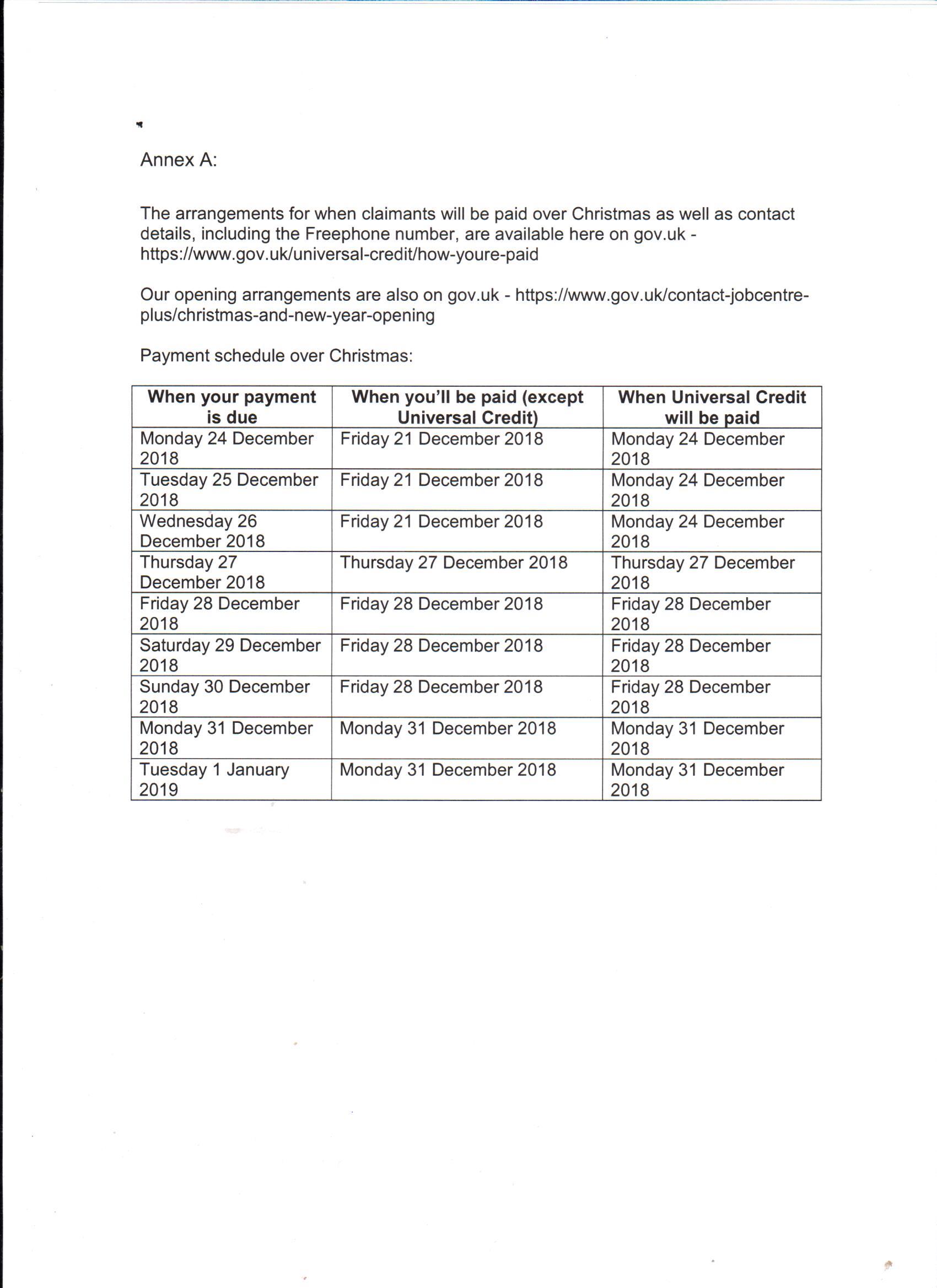
Universal Credit Arrangements During the Christmas Period
I have received this letter from the Secretary of State for Work and Pensions about Universal Credit payments during the Christmas period. The arrangements for when claimants will be paid over Christmas as well as contact details, including the Freephone number, are available at https://www.gov.uk/universal-credit/how-youre-paid and opening arrangements are also at https://www.gov.uk/contact-jobcentre-plus/christmas-and-new-year-opening

Wokingham Post Office
I have sent a letter to the Post Office telling them that many constituents wish to see the current Post Office counters remain open. I have urged them to consult not just on the range of services they could provide through a move to a local shop, but also on whether the idea of a move is a good one in the first place. We do not wish to lose the current facility to replace it with a worse one. There is space in the current building to expand the Counters, and tackle the queues.