Wokingham Borough opens Wokingham up to more development

I have worked with a group of MPs to secure the promise from Mr Gove of the ending of top down targets for more housing set in Whitehall. This now allows a Council like to Wokingham to have more say over how many new homes will be built in the years ahead in our area. In order to control the numbers the Council needs to produce a new local plan setting out how many, where and why.

The Councillors in charge of Wokingham Borough have wasted time and delayed   bringing  forward the necessary plan. If a Council does not have an up to date plan developers can apply for permission where they like and then appeal if they are turned down. On appeal the Inspector may well grant permission. Only if there is a clear modern plan covering forward years will the Inspector be guided by local wishes embodied in the plan. Without it the Inspector is more likely to be guided by the need to build more somewhere. The Council does not like the current ageing plan which expires soon, so why the delay? The current plan offers no protection  for building  after next year.

In opposition the Lib Dems were fiercely against too much development, and promised a No when it comes to Hall Farm as a location. Now in charge of the Council they fail to set out limits to development, and are reported  to be considering major housebuilding on Hall Farm. Why? Why do they always let us down and override clear wishes expressed by the pubic in consultations? Why have they not moved promptly to take advantage of the new approach?

Why do no other MPs want to stop the Bank of England mistakes?

The political classes seem incapable of understanding why we have so many boom bust inflationary cycles. I want more MPs to be demanding a change of policy by the Bank so we can have a growth policy with lower tax rates and better funded core public services.

It is no accident or external force which gave us an inflation in 1975. It was the  Bank conducting a policy called competition and credit control badly leading to fast money growth and a secondary banking crisis. In 1977 it was an overspending over borrowing Labour government which ended with a humiliating trip to the IMF to bail us out.

In 1990-92 it was Bank and Treasury policy to put us into the European Exchange rate mechanism which ballooned the money supply backed by PM Major and gave us more inflation.

In 2007-9 it was Bank and Labour government policy to allow commercial banks to lend much more which led to inflation, egged on by high public spending and borrowing.

In 2023-4 the inflation came from Bank Quantitative easing and a big boost to the money supply.

In each case the Bank over corrected  for its errors pushing us into recession.

Why doesn’t the Bank learn from  this string of errors and give better advice?

Gradual introduction of a smoking ban

The Commons is being offered a free vote on the introduction of a smoking ban. Over many years the ban would gradually extend from young people to older people.

I have received little feedback on this topic. I am interested to hear from constituents who have strong views either way on this proposal. I would like to take into account constituency opinion before voting.

The Bernanke Report

Let’s start with some agreement. I agree the Bank needs to improve its forecasting and the  communication of its findings.

I do not agree that all Central Banks made worse forecasts over covid and Ukraine. Mr Bernanke seems to ignore China, Japan and Switzerland who kept inflation down despite the swings of oil and food prices. Their forecasts remained nearer the mark.

I do not agree that more highly paid people and more spending will provide the answer. The Bank has a lot of intelligent well qualified people. They need to correct their errors and change their thinking. The models need improving, but they have the people to do that.

It would be a good idea for the Monetary Policy Committee to look at the quantity of money being created and the velocity of circulation, and to provide comment, if only to say they have a good reasons to think creating lots of money will not be inflationary or destroying lots of money will not be recessionary so others can challenge this. Those outside the Bank that did look at the ballooning of the Bank balance sheet and money supply and warned it could prove inflationary got the forecast right even if the Bank is still sure they got the reason wrong. It would be better to have this argument around the MPC table. Why did the MPC who think inflation comes from other sources not manage to predict what happened? The MPC itself needs greater diversity of economic thought. Having someone on it who got the inflation outlook right in recent years would be a good start.

It is also a big disappointment that Mr Bernanke did not consider the impact of the waxing and waning balance sheet of the Bank. Decisions about the bond buying and selling need careful consideration as well as the interest rates. Their strong connection to public finances is also important for their impact on the economy.


The Opposition needs to understand the problems with UK government

The UK public sector is letting many people down and upsetting a lot of voters. Opposition parties in Parliament are good at criticising. They blame Ministers, as our system invites them to do. Opposition parties fail to ask why so many of the failures are in so called independent bodies with highly paid public sector chiefs paid many times a Minister. They  claim just small extra sums – compared to the huge extra  sums this government has tipped in – would make all the difference.

If only. If extra money would bring the NHS  waiting  lists down or would fix the Post Office and the railway things should be improving well by now. Ministers have tried this. Any Conservative MP will vote for a few extra billions of spending if it could deliver the end of waiting lists, good border control or a new railway line on time and to budget. We have often so voted.

Blame the Minister, but sort out the system

It is a crucial part of our Parliamentary democracy that we do ultimately  hold government Ministers to blame for the many failings of public services and public bodies. We also expect government to intervene or to change the law when the private sector and or too many individuals miscarry.

I still believe  in that system. I fully understand why government gets the blame when inflation goes too high, but note that an independent Bank of England is responsible for inflation and brought high inflation on. There are so many areas now where government is blamed but in practice the decisions and budgets rest with independent bodies, or where national and international law and judges prevent Ministers carrying out what they want to do. There are even cases where Ministers change the law but are still thwarted by activist courts.

I will explore how far this removal of power has gone, how many of the independent bodies are behaving badly or incompetently, and how courts and treaties prevent Ministers implementing  the public will. As many blame Ministers, Ministers need to take back powers to solve the problems the current system fails to resolve or make worse. The doctrine of independent bodies is doing plenty of damage, from the Post Office to the railways, from Ofwat to the Bank of England. The EHCR stops us controlling our borders  and the WHO which had a bad covid pandemic wants more powers to control the NHS.

Bond yields and mortgage rates

In July 2022 the UK ten year interest rate was 2%. In early September it was 3% and by the time of the Kwarteng budget on 23rd September it was approaching 4%. It peaked on 9th October at 4.38%. In July 2023 it made another new peak at 4.65% and stayed high until November. It is now just over 4%.

This pattern was similar to the pattern in the USA and the Euro area. The main cause of large rate rises in all three places was the decision of their Central banks to go in for rapid and severe monetary tightening, as they belatedly woke up to the high inflation they had allowed or caused, depending on your view.

It is true that in the period September  26th to September 28th 2022 the UK had a  bad sell off in gilts . This was mainly caused by the Liability Driven Investment crisis.  The Bank has written of “severe dysfunction in  the UK government bond market when distressed forced selling of gilts by liability driven investment funds led to a fire sale dynamic”. The IMF also wrote  how  “liability driven investment funds were at the centre of the severe stress that emerged in the UK gilt (bond)  market”

There are those for political reasons who claim all this was brought on by so called unfunded tax cuts in the mini budget. They overlook the fact that the increases in  spending were considerably higher than the tax cuts, forget that the gilt market had fallen a long way that month before the budget because the Bank wanted a big rise in interest rates, and forget the role of LDI investors the following week in driving the market down more. The Chancellor did push the  deficit up more than I suggested  and could have done more to control spending. Nonetheless the pattern of rate rises and falls show that the main cause of the rate increases was Bank policy, and the main cause of the three day  meltdown was LDI troubles as owners of bonds they could not afford had to sell to pay their bills. It was very difficult finding buyers when they knew the Bank was about to sell £80 bn worth of bonds and LDI investors had to sell lots of bonds as well.

Further proof of this is how the Bank turned the gilt market round. By announcing purchases of bonds and suspending the planned sales the Bank brought the ten year rate back down to 3.1% by 20th November 2022.The fact that  the following year after a series of tax rises the rate went considerably higher than in September 2022 again underlines tax cuts were not the main issue.

The Bank of England losses stop a growth policy

I


The scale of Bank losses

In the budget figures we were told the Bank of England’s bond buying and selling will end up losing us £102 bn. In its early phases the Bank sent the Treasury profits of £124 bn, so on these OBR estimates there are astonishing total losses coming of £226 bn. As of March 2024  the Treasury had had to pay the Bank £49 bn to cover losses to date, so another £179 bn could become due if the OBR has  got a forecast right.

These losses are huge and unacceptable. A substantial portion of the loss is avoidable. The government needs to have urgent discussions with the Bank to slash these costs. Other major Central Banks including the US are not receiving any bail outs from Treasury whilst  China and Switzerland  did not buy too many bonds in the first place. The ECB  which made similar mistakes with bonds to the UK is now containing the losses much better with a different approach.

There are two simple changes needed.

1 Stop selling bonds in the market at low prices. The bonds repay on maturity when the Bank will get more for them than current prices, so stop selling.

  1. Copy the ECB approach to payments of interest to commercial banks on their deposits at the Central Bank . The Bank of England is losing too much on the costs of remunerating the reserves placed with it by  the commercial banks compared to the interest it gets on the bonds. As the rate paid to banks is a managed rate fixed by the Central Bank cut the losses.

These changes would lead to a good improvement in  the public sector deficit x Bank of England, the measurement they use to control the economy, and to lower mortgage rates.


Bernanke needs to be radical in his review of the Bank of England

Ben Bernanke knows a lot about Central banks getting things wrong. On his watch at the Fed he saw inflation hit 5.6% in 2008 before watching it collapse along with important parts of the banking system. He was there for  the banking crash and great recession of 2008-10. He pioneered the money printing and bond buying policy that lies behind the wild ride the UK has experienced in inflation and growth 2019-24.

Recommending the same people on the MPC be asked to publish their own differing forecasts will not solve the problem, as there is too much groupthink on the MPC. Telling them to publish a range of scenarios does not help much either, because what we need and want to guide money policy is a reliable base forecast. How else can they set a good interest rate if they have no idea what inflation is going to be. That is why I have set out the need to completely change their forecasting models, to take money and credit seriously, and to recruit different people to provide diversity of thought.

1.The Bank should immediately conduct an internal review into its
models and forecasting to find out why it got inflation so wrong and to
propose amendments that would have produced better outcomes. It should
back test changes to the model to make sure they would result in material
improvements.

2.The Bank should produce an analysis of the role of money and
credit in inflation and discuss how this can be monitored and used in helping
make policy decisions about rates and money creation going forward.

3.The Bank should ensure in its future recruitment to senior roles on
the staff and to external appointments on its committee that it appoints to
obtain a greater diversity of views about economics and inflation. It should
wish to have representatives of the main strands of economic thought on the
important topics around the table.

4.The Bank should reward staff when it hits targets for accuracy of
forecasts and success of out turns to policy decisions.

5.The Bank should reconsider its attitude to Quantitative
tightening. If it is unimportant as an influence on inflation as it says and the
purpose is technical or tidying up it should stop selling bonds and let
maturities gradually reduce its balance sheet. It should consider whether its
bond sales do depress markets in ways which can disrupt them, consider the
flow across to its tasks in maintaining banking sector stability and ask
whether too many bond sales might make a recession more likely. Selling bonds at huge losses and sending the bills to the taxpayer is encouraging recession and preventing a growth policy.

Reduce government interference in energy


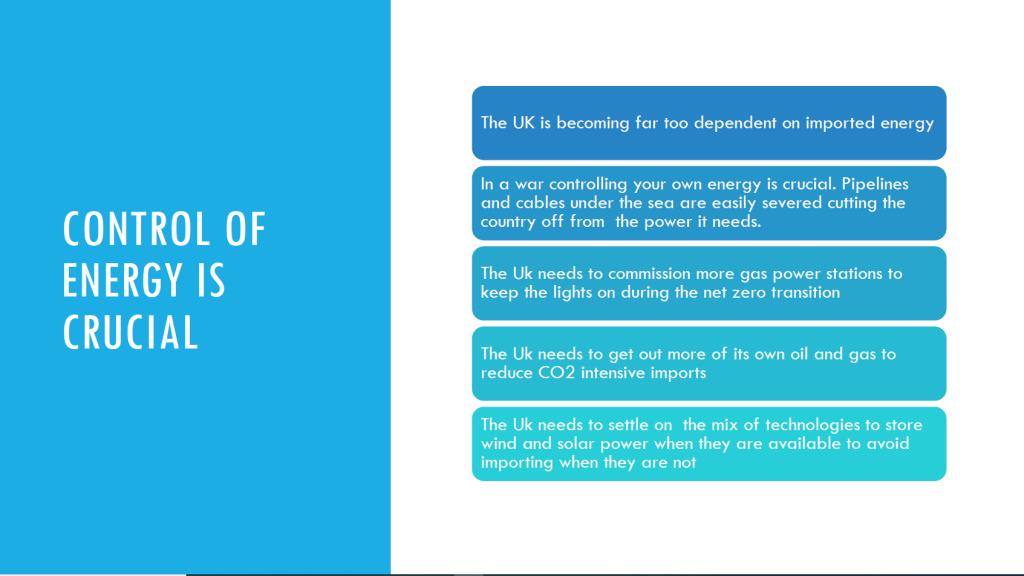
One subsidy leads to another. One windfall tax soon becomes several permanent tax rises on overtaxed energy. One price distortion tempts Regulators to do more. Instead of pursuing the three aims of security of supply, affordable power, and environmental requirements we end up with energy which is too dear and a growing dependency on imports and the goodwill of foreigners.

The boost to oil and gas prices caused by the decision to get Russian oil and gas out of our supply chains in retaliation for the invasion of Ukraine was used as an opportunity to increase taxes on oil and gas. It was called a windfall tax  though the government did not specify what element of the price/profit was windfall, nor did it promise to cancel the tax when oil prices fell back. This then caused super profits for older renewable electricity investments so they too were put under a windfall tax. Subsequently new investment in renewables was exempted .  All this reinforced dearer energy, so then the government decided to spend a fortune on subsidies to domestic consumers. The government introduced a price cap on domestic energy bills. As prices fell so the price cap held costs up until the next review point. All these interventions were backed by the Opposition parties who usually wanted them to go further, last longer and tax and subsidise more.

This is a wasteful and worrying model for energy. It has meant higher public sector spending and borrowing. It has deterred investment in  new capacity through the higher and unpredictable taxes. It has helped close factories in the UK thanks to high energy prices, increased energy imports, and increased the imports of energy intensive goods.

The same thing is happening with energy using products. It is wrong to  tax car producers for selling too many petrol vehicles that people want to buy, and for  selling too few battery cars which people do not want to buy. It would be wrong to tax gas boiler manufacturers or to ban their product if people do not want to buy heat pumps. Government did not need to step in to ban blackberries in  order to promote smart phones, or to boost computer pads by taxing home desktops. There was no subsidy to promote mobile phones or internet services. Good products sell because people want them.