To ask the Secretary of State for Business, Energy and Industrial Strategy, what steps he is taking to help support energy-intensive industries with rising energy costs

This answer fails to spell out what targeted help is offered to our struggling energy intensive businesses like steel, ceramics, glass, petrochemicals.  The UK is far from competitive in these areas and becoming ever more reliant on imports.


The Department for Business, Energy and Industrial Strategy has provided the following answer to your written parliamentary question (75743):

Question:
To ask the Secretary of State for Business, Energy and Industrial Strategy, what steps he is taking to help support energy-intensive industries with rising energy costs. (75743)

Tabled on: 01 November 2022

Answer:
Graham Stuart:

The Government is determined to secure a competitive future for its energy intensive industries (EIIs), providing them with extensive support, including over £2 billion to help with the costs of energy and to protect jobs.

The Energy Bill Relief Scheme was announced on 21 September 2022 to provide a discount on energy bills for all eligible non-domestic customers, including businesses, whose current gas and electricity prices have been significantly inflated in light of global energy prices. The scheme will initially run for 6 months covering energy use from 1 October 2022 to 31 March 2023.

The answer was submitted on 09 Nov 2022 at 17:02.

To ask the Secretary of State for Business, Energy and Industrial Strategy, if he will review the impact of the carbon tax on high energy usage industries in the UK

Our high energy using industries are suffering badly. Carbon taxation by whatever name is especially high in the UK and the government has so far refused to lower it. I will continue to urge them to complete their review and respond more urgently to the cost crisis hitting these important businesses.


The Department for Business, Energy and Industrial Strategy has provided the following answer to your written parliamentary question (75744):

Question:
To ask the Secretary of State for Business, Energy and Industrial Strategy, if he will review the impact of the carbon tax on high energy usage industries in the UK. (75744)

Tabled on: 01 November 2022

Answer:
Graham Stuart:

There is not an explicit carbon tax on high energy use industry. The UK Government and Devolved Administrations operate a carbon pricing scheme, the UK Emissions Trading Scheme. A consultation on developing this Scheme, including a review of the free allocation of carbon allowances within the scheme to support energy intensive industries (EIIs) was launched earlier this year. The Government and Devolved Administrations will respond to that consultation in due course. The Government is committed to securing a competitive future for its EIIs, providing them with extensive support, including over £2 billion to help with the costs of energy and to protect jobs.

The answer was submitted on 09 Nov 2022 at 17:02.

To ask the Secretary of State for Business, Energy and Industrial Strategy, which new oil and gas fields will be issued with production licences in 2022.

This is a disgraceful non answer. I asked about production licences so they respond about exploration licences. The quango they refer to reports to them and is meant to implement their policy. Ministers have made clear they do wish to see rapid progress on replacing imported LNG with more domestic gas, but clearly the Departmental drafters  are not entering into the spirit of this. 

The Department for Business, Energy and Industrial Strategy has provided the following answer to your written parliamentary question (75742):

Question:
To ask the Secretary of State for Business, Energy and Industrial Strategy, which new oil and gas fields will be issued with production licences in 2022. (75742)

Tabled on: 01 November 2022

Answer:
Graham Stuart:

Licensing is a matter for the North Sea Transition Authority which publishes all figures and statistics regarding licence awards for oil and gas exploration and development on its website.

While the 33rd UK Offshore Licensing Round officially opened in October, awards for licences under this round will not be made until next year.

The answer was submitted on 09 Nov 2022 at 17:02.

Preparing an Autumn Statement

Time was when a Chancellor prepared an Autumn Statement or budget in secret. He would of course listen to many representations and show interest in the many ideas that come into the Treasury without giving any hint as to which if any he favoured. MPs would be offered chances to voice their favourite requests to an inscrutable Minister.  Indeed, Chancellors took seriously the need for confidentiality, knowing that were they to let slip a Budget secret they would be expected to resign.

In the run up to the Autumn Statement on 17th November we have been bombarded by a series of stories in papers and on the media claiming the Chancellor is considering a wide range of specific tax rises and spending reductions. We have heard of moves  against benefit recipients to increase benefits by less than inflation, tinkering with the triple lock to lower the pensions uprating, eliminating the Enterprise zones, raising CGT rates, reducing pension saving allowances, freezing income tax thresholds for longer, bringing more people into higher tax bands, taxing electric car use, taxing dividends more, worsening the terms for Non Doms, increasing windfall taxes on energy, cutting grant to Councils  and others I may have missed.

I assume none of these stories came from the Chancellor and I have  no idea if any of them are true. I have not seen or heard the Chancellor give any indication of what he might do beyond the very general public statements we have seen..  I do not however think they were made up, so it does look  as if someone inside government who claims to know what the Chancellor is working on is talking too much. They may simply be reporting an unappetising list of options drawn up by officials. Most of these ideas seem to me to be most unlikely to make it to the announcement, given the obvious political difficulties many of them pose. It would be helpful if whoever is putting all this out was told not to do so, as it does not make for good government and it is worrying to the successive groups of people who feel threatened by these proposals.

There is never any briefing that they might cut out needless or wasteful public spending. So far this government far from cutting spending has announced a very undesirable £11 bn extra for the Bank of England to allow it to take losses on bonds it owns which it need  not sell. Surely that should be a first target for the axe. It has announced extra support for emerging economies with the costs of net zero programmes. It is apparently negotiating to offer more cash to the French to assist with border control across the Channel. We would want more proof of value for money before committing any extra cash to help them police their border. Where are the plans to help more people into work and off benefits, so both the individual and the state will be better off? Why not drive for more revenue from oil and gas by switching more of our demand from imports to domestic production? Where are the plans to build more of our own ships, to make a series of small nuclear reactors using UK factories and technology, to grow more of our own food diverting subsidies from wilding schemes to investment in larger scale market gardening?  There have been many more such ideas to grow our revenues and control our costs on this blog.

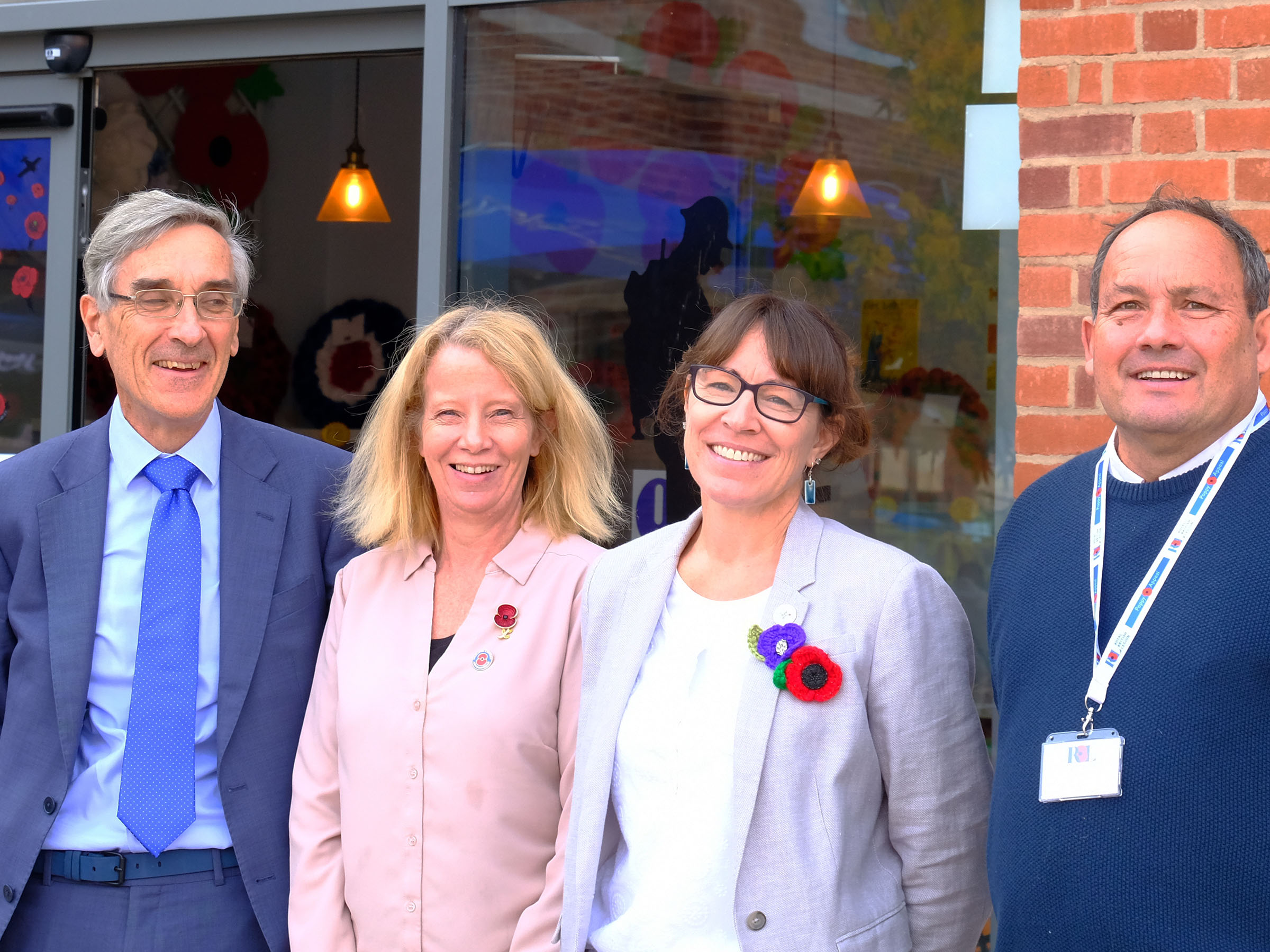
My Visit to the Royal British Legion’s Poppy Shop

I visited the Royal British Legion shop in Wokingham to thank the organisers for helping the charity. They have a good range of items that can help us remember the great wars and sacrifices made. The money raised goes to such a good cause. I bought some historical items for my family to help them understand and remember what their grandparents and great parents went through.


Just control our borders

Yesterday I joined a call with the Head of Border Force to discuss the extensive use of hotel accommodation and the large  numbers of asylum seekers and economic migrants crossing the Channel. I raised various issues in this call and with Ministers :


My constituents want to see some sense of urgency to transform this totally unacceptable situation.

Unacceptable to taxpayers having to pay £7m a day for hotel bills

Unacceptable to genuine asylum seekers caught in a long queue unable to get their case resolved so they can live and work here

Unacceptable that we allow tens of thousands of people at our expense to stay here not working because we do not get around to making decisions on their cases

Unacceptable that we do not change the law to prevent clever lawyers helping economic migrants pursue false asylum and trafficking cases  for too long and with too many appeals

Unacceptable to burden our hotels with people who should either be helped to find appropriate accommodation here or sent back to where they came from. We need the hotels for their intended purposes.


  1. When are we going to legislate to close the loopholes?
  2. When are we going to determine claims for people coming from a range of other countries in a timely way, especially those coming from safe countries like Albania?
  3. When are we going to do more to safeguard our communities from any criminal element that may be trying to use asylum cover to come here to  commit crimes?
  4. When are we going to arrest more of the people traffickers? Why is it so difficult to trade them given the open way they advertise their services? Can’t we follow the money?


My Letter to the Chief Executive at NatWest regarding the closure of their bank branch in Wokingham

Please see below my letter to Alison Rose, Chief Executive at NatWest:


Dear Ms Rose

Some of my constituents have expressed concerns about the closure of the Wokingham branch of NatWest.

The closure will disproportionately affect older customers who do not use online banking and who do not have access to transport to Bracknell.

While telephone services may be a suitable option for some there is the matter of long waits before speaking to a customer service representative.

Customers who are visually or hearing impaired will also be impacted by the closure of the Wokingham branch.

I should be grateful for your comments which I can forward to my constituents.

Yours sincerely

Rt Hon Sir John Redwood MP, DPhil FCSI


The true history of the bond market

There is a myth about the bond meltdown of September that political spin doctors are busily propagating. To understand the market we need to see that as the price of  bonds fall so interest rates rise. If a Central Bank wants to move the long term rate of interest up from 1% to 2%, the price of a bond with no repayment date halves. If you lent the government £100 at 1% there would be a fixed promise to pay the bond holder £1  interest every year. If people then want 2% interest they will only pay £50 for the £100 loan, so the £1 of interest is 2% of the amount they pay for the bond.

The spinners  claim the market fell away sharply owing to the Kwasi  Kwarteng decision to announce tax cuts without forecasts. They do not mention the fact that the energy price package was far dearer than the estimated impact of the tax cuts.  They claim the Kwarteng strategy damaged the economy and put up mortgage rates. They need to understand that mortgage and other rates were deliberately driven up by the Bank over a period of many months, as it battled to correct its over lax money policy of 2021. The ten year interest rate started 2022 at 1% and was at 3.5% before the Chancellor spoke. It is at 3.55% today.

I agree the Chancellor should have put all three elements of his growth Plan together – tax cuts, spending proposals and the supply side measures. It would have been sensible to have some forecasts of borrowing and show  interest in keeping borrowing to realistic levels. I do not agree that this was the only or  the  main cause of the falls in the bond markets. The main causes of the rises in rates were the actions the Bank of England and the US Fed.

The bond market was falling well before the Mini budget thanks to the stated intentions of the Fed and the Bank of England to put up interest rates. On 21 September the market fell in response to a very hawkish Fed, where the US was leading advanced country markets down and rates up. On 22nd September the bond market fell again on the announcements from the Bank of England. The market was particularly worried when the Bank announced its plans to get rid of £80 bn of its portfolio of UK government bonds, selling too many onto a falling market. On 23rd September concerns  about the mini budget led to further falls.

The falls were larger on 26th and 27th September . On those days the dominant conversation in markets and media was not the mini budget but the need for many pension funds to sell bonds or shares to find the cash to pay sums to LDI funds. These are funds bought by pension investors allowing them to own more bonds than the fund can pay for by buying bonds through the fund on margin. When bonds fall in price the funds demand more cash payments to cover the losses.

The Bank stepped in to reverse its position of selling bonds into a falling market and announced it would temporarily buy up bonds again to deal with the special selling pressures from the pension funds. the market rallied strongly on the news. By 27th October the interest rate on the 10 year bond was back below the level it had reached the day before the mini budget.


Dangers of too much development in Wokingham

I am publishing this press release from Wokingham Borough  Conservative Councillors  as I am also concerned about possible extra developments on appeal.


Wokingham Conservative Councillors have warned that the Liberal/Labour led Council have lost control of development across the Borough as appeals against planning decisions are increasing.


By halting work on the Local Plan, in progress under the previous Conservative administration, the Liberal Democrats, supported by Labour and the Independents, have opened Wokingham Borough up to a free for all for developers. The Conservative Opposition is now demanding that the coalition administration stops “dithering” and produces a Local Plan that residents can be consulted on.


Under the previous Conservative administration, the Council was on track to deliver its new Local Plan by December 2023. Officers of the Council have confirmed that the Local Plan will now not meet that deadline.


The National Planning Policy Framework (NPPF) requires local authorities to outline a five-year supply of specific sites to meet housing needs. Wokingham Borough now no longer has a five-year land supply, making the Borough increasingly vulnerable to developers.


Without the five-year land supply, the Council is more likely to lose appeals brought by developers. As a result, the wishes of residents will not be taken into consideration. Instead, planning decisions will be made by the National Planning Inspector, based in Bristol. On top of this, the Council loses the ability to ensure that necessary roads and local facilities are provided with new housing. Under the Conservatives, successful control of development meant that the Council only lost two planning appeals in the last four years.


At a meeting of the Council’s Community and Corporate Overview and Scrutiny Committee it was confirmed that as a result of not having a five-year land supply the Council is experiencing an increase in appeals for speculative housing development.


In September, the administration lost a planning appeal for new houses in Hurst. An increasing number of appeals against decisions to reject planning applications are in motion, such as a proposal for 54 new homes near St Anne’s Drive in Wokingham.


Liberal Democrat councillors have promised residents that they will lobby the Government to reduce housing numbers. Yet since they took office, there has been no progress to back up these words. By contrast, the previous Conservative administration worked with the Government to cut housing targets in half for Wokingham Borough.


Cllr Wayne Smith, Shadow Executive Member for Planning, said, “On the Lib Dems’ watch, the Council has completely lost control over development. Backed up by Labour and the Independents, they’ve undone the work on the Local Plan without presenting any credible alternative. When they were in Opposition, they promised every single community that they would stop new housing, in an attempt to win votes. Now they’re in power, they’re risking a free for all for developers – or else breaking promises to thousands of residents.


“The Conservatives believe in protecting our local communities from unsustainable development, which is why we made the tough choices and put together a Local Plan. The Lib Dem-led coalition needs to show some courage, stand up for the Borough, and get on with producing a new Local Plan.”


Cllr Pauline Jorgensen, Leader of the Conservative Group, said, “This is a ticking time bomb. The previous administration was set to deliver the Local Plan by December 2023. Without a plan and without a five-year land supply the Council is losing control of development”


“While Conservatives were in power we met with the Secretary of State and managed to reduce the number of homes being imposed on us by a half. Lib Dems say they are against unsustainable development, but their actions don’t match their words. This is the very opposite of what residents thought they were voting for.”