That article 50 letter

Yesterday the various amendments proposed to the Leaving the EU Bill were voted down. Labour decided not to press one of their main ones to a vote because the government offered assurances that Parliament will get to vote on the final deal, to be held before the European Parliament votes on it. That vote will be about whether to accept the new Agreement or to leave without one.

During the exchanges the fundamental question of whether sending the Article 50 is irrevocable or not came up.  I argued it is. The Treaty makes no provision to withdraw the letter or to cancel exit two years later, which is automatic with or without a deal. The Treaty says if you start to leave and change your mind you need to reapply for membership. You do not simply keep or reinstate the membership you proposed to quit.

I reminded the Commons that both the Attorney General and the Remain lawyer in the Supreme Court case argued that the  notice to leave is irrevocable. In finding against the government on one count the Supreme court had to rely on the irrevocability of the process. It is only because the change of leaving becomes inevitable when the letter is sent that allowed the Court to say Parliament therefore had to pass an Act and could not just do it by debate and vote. Predictably the Remain side who were so keen to use this argument to win in court now have changed their mind and say it may not be!

I will post the exchanges later today.

The Sustainable Drainage System (SuDS) Strategy

Wokingham Borough Council has adopted a new strategy to ensure new developments have appropriate sustainable drainage systems to manage the risk of flooding, improve water quality, and biodiversity.  Please find below their press release:
Suds now part of major builds

 
Wokingham Borough Council has adopted a new strategy to ensure new developments have appropriate sustainable drainage systems to manage the risk of flooding, improve water quality, and biodiversity.

 
The Sustainable Drainage System (SuDS) Strategy, approved by the borough council’s decision-making executive, is a blueprint based on national standards for developers and civic planning officers when designing developments ranging in size from minor schemes up to the scale of Strategic Development Locations.

 
SuDS mimic nature, dealing with rainfall where it falls; allowing it to evaporate or soak into the ground. Any remaining water is then drained to the nearest traditional watercourse or sewer at the same rate and volume that would have happened naturally before the new development was built.


“A healthy and safe water environment is fundamental,” said Cllr Angus Ross, executive member for environment.

 
“There are areas in our borough with increased risk of flooding, and some of our watercourses have poor water quality. This strategy shows how SuDS address these. SuDS use cost effective solutions with low environmental impact. They’re designed to be easy to manage, resilient, needing in some cases only sunlight to work, and are aesthetically attractive.”

 
SuDS are increasingly being used to counter the problems of flooding caused urbanization where natural surfaces and vegetation are replaced by concrete, asphalt, or roofed structures. Where this happens heavy rainfall cannot easily be absorbed back into the environment without overloading more conventional drainage systems, creating flooding, contaminating drinking water sources, and harming wildlife and the environment.

 
Examples of SuDS include basins (shallow landscape depressions that are dry most of the time when it’s not raining), rain-gardens (shallow landscape depressions with shrub or herbaceous plants), swales (shallow normally-dry, wide-based ditches), filter drains (gravel-filled trenches), bio retention basins (shallow depressions with gravel and/or sand layers), reed beds and other wetland habitats that collect, store, and filter dirty water along with providing a habitat for wildlife.

 
A consultation last summer into the borough’s SuDS Strategy was carried out, and the majority of those taking part were very supportive of it.
Now that the new SuDS strategy has been adopted by Wokingham Borough Council, planning applications for developments will need to meet the requirements of the local standards set out in it.
Planning application approval, if granted, will then need to include clear instructions on how the SuDS for that development will be maintained. 


Further information:More from Cllr Angus Ross, executive member for environment at email: angus.ross@wokingham.gov.uk 
More homes

The government’s White Paper today needs  to look at ways to provide more homes, all the time we remain in the EU and have to accept more than 300,000 additional people each year coming to stay in the UK. Even after we are out it is likely we still want to invite in a large number of people. Ministers have made clear we will still welcome talent from around the world, whilst controlling the numbers seeking low paid employment. It’s no good inviting people here if we do not provide homes for them to buy or rent, and if we fail to provide all the other public services people expect in a rich country.

Much has been made of the need for more homes to rent. We should not forget that there are many more people wanting to buy who currently rent, than there are people who currently own who want to become tenants. Many of the people who now settle for the rented option do so because they cannot afford the deposit or think they will have problems getting the mortgage to buy.

Nor should we forget that it is much dearer over a lifetime to rent than to buy. If someone needs a home for 60 years as an adult, it will be much cheaper to take on a 25 year mortgage and pay it off over the 25 years, leaving you free of any rent or mortgage costs for more than half your life, than to have to pay rent for all 60 years. The joy of owning comes in retirement when you have no rent or mortgage payments to make, and when you also have a capital asset which you can sell to pay the nursing home fees in a home of your choice if need arises. In rented accommodation you will be paying the highest rent of your life as a pensioner, because rents always seem to rise. You have no asset to fall back on if you need to move to a care home.

The good news today is more mortgages are available and mortgage rates of still very low  by historical standards. The bad news is house prices are high, and saving for the deposit even with the help of government schemes can be difficult.

Bias, balance and alternative facts

The BBC regularly says it must be getting it right because  both sides accuse it of bias. The problem is there are more than two sides in many cases.

I have never argued the BBC is biased against the Conservatives and in favour of Labour. I understand the lengths they go to criticise  both Conservative Ministers and Opposition Spokesmen, and grasp their idea of balance, offering an alternative  view in many cases.

The issue of bias and alternative truth takes more subtle forms. There is firstly the bias in the selection  of stories. The BBC loves running endless Brexit and climate change stories. It loves making other news items into Brexit or climate change stories, when many of us think there is little or no link. There is the endless sourcing of “the government should spend more” stories, because there are so many lobby groups with that as an objective.  People who want less government, who like Brexit, or are sceptical about the theory that man made C02 is driving damaging climate change do  not feel properly represented. Scientists are not interviewed with a view to highlighting errors, inconsistencies and poor research in the way politicians are.

Then there is the unintentional bias of the questions. Ministers are regularly put under pressure for not spending enough. It is very rare to hear Ministers under pressure for spending too much, for presiding over government waste, for failing to find cheaper and better ways of doing things. There is nearly always an automatic assumption that spending a lot in any particular part of the public sector is good, and spending more is even better. There is little probing behind the slogans to find out what the real numbers are, and to ask why in some cases so much is spent to so little good effect.

There is the permanent anti Brexit bias in many scripts and questions. The interviewer or journalist starts from the assumption that Brexit must be damaging. Good news is then recorded “despite Brexit”, often with a caveat that it could deteriorate in the future when Brexit  bites more. Never do you hear an interviewer asking the other side to comment on how the Brexit vote has triggered higher car output, more homes being built, higher consumer activity, better confidence levels.

Prior to the referendum there was always a bias against Brexit or Eurosceptic speakers. We had to be introduced with unflattering descriptions, interrupted more, and usually assumed to  be wrong. I remember when I was warning about the banking crash and had a proposal on how to handle it, I was competing with Lib Dem Vince Cable. I wanted controlled administration of overstretched banks – the system they now say they will use in future – whilst he wanted bank nationalisation. He got many more interviews than I did. He was often introduced as an expert because he had had a former job as an economist at Shell. I was introduced as a Eurosceptic with my past roles in  business and investment ignored, though they were more relevant experience.

I’m all in favour of them asking me tough questions, but I just want them to do the same for all the so called experts as well.


Double standards – no democracy on EU matters

Most people in the UK currently pay for and take instructions from at least  three or four governments – EU, UK, County, District or Unitary Council.  Many also have Parish Councils.

One of the reasons people voted to get rid of one of the layers of government is that we have too many competing layers, seeking more money and imposing more rules on us than are needed. Sometimes the competing layers seek to achieve different things or impose contradictory rules and requirements. Defra, the Agriculture Department, often lost cases in the ECJ because they found it impossible to implement EU policy in a way which did meet with the satisfaction of the European Court. They were trying to comply!

One of the odd things about UK Opposition politicians and the media that feeds off them was the complete absence of any informed opposition to the EU government whenever the Conservatives were in office. All the government had to do was to claim some law, payment or decision had come from Brussels, and the Opposition parties backed off. They either acquiesced in not even debating it, or they went through perfunctory motions of asking a few polite questions and then voted with the government or abstained  so the measure could pass. Bill Cash, aided by a few good Labour MPs who did wish to probe and question, led his European Scrutiny Committee to require the important issues to be debated in the Commons chamber itself. These debates were usually peopled by a stalwart group of Eurosceptics pointing out the problems or undesirable features to a disinterested House. Government Ministers whichever side was in office always sought to make the debates low profile and could avoid answering any difficult question, safe in the knowledge that there was always a front bench consensus so they would win easily any vote we forced . The media rarely covered them, on the grounds that government and the official opposition both supported whatever measure it was.

This lack of democracy on EU matters allowed Ministers to push through a vast library of new laws and controls, and large amounts of public spending with effectively no democratic check or balance. Whole areas of government, from fishing and farming, through the environment, to trade, energy and business received this treatment. The EU was  brilliant at extending the acquis by increasing the occupied field -their language for the process of establishing their dominance in area after area. Once the EU had legislated on a  subject, the UK Parliament then had to leave it alone or work round the EU laws and rules, never contradicting or modifying them in unapproved ways.

It will take years for successive Parliaments to review and modify where it wishes what was done in our name without our proper consent. Legislation and decisions are better for a probing and sometimes hostile opposition forcing Ministers to think things through and sell them to the public as necessary and desirable. EU laws were pushed through on a vast scale in a lazy way. It meant many people in our country had little idea just how much is now controlled by the EU, and how little room for change the UK has all the time it accepts this legal framework.

The Malta declaration on migrants

At Malta the EU once again paraded its lack of common decency. The 27 failed to reassure all UK citizens living in other member states that they are legally and morally entitled to stay! The UK of course has offered those assurances for EU citizens legally settled today in the UK on a reciprocal basis.


There are two main problems with the EU’s decisions on migrants at Malta.

The first is the EU has effectively shifted the responsibility to stem the rapid flow of migrants across the Mediterranean to the Government of National Accord in Libya. This government is struggling to exert its control over Libya, which remains a deeply divided country with a rival government in Tobruk and areas of the country under tribal and rebel control. No doubt it will welcome the money promised to strengthen its coastguard and for related purposes, but can it spend it nationally to achieve the EU’s aims? Will it be tempted to spend it for other purposes related to its own difficult position?

The second is the request for a policy to return people who have  already arrived  in the EU following illegal migration. How are they going to do this? Why do they bring people in to the EU in the first place if they want to take them back to countries like Libya? Will it be legal to require people to leave? What will they do if they refuse?


It is difficult to believe this statement will work to stop the flow. It is also difficult to see how it squares with the EU vision of itself as a home to welcome migrants as outlined by Mrs Merkel last year. How does this differ from Mr Trumps wish cut numbers crossing the Mexican frontier?

The Malta Summit

Today the EU  Heads of state and government will meet in Malta. Their background text will be the pessimistic and alarmist letter from Mr Tusk that we talked about on Wednesday.

The meeting will mainly be concerned with strengthening the EU’s external borders, with special emphasis on the problems of Libya. There are in the EU’s view too many migrants coming across the sea from Libya. The EU wishes to work with the Libyan authorities – to the extent that there are authorities in charge there – to reduce the flows. The EU may also wish to beef up its naval force, though so far this has been used to offer safe transit to the EU for those who have taken to the seas in dangerous and overloaded boats and got into trouble. The EU will wish to take stronger action against people smugglers, though that too will require co-operation with governments on the African continent.

All this illustrates the cruel dilemma of Mr Tusk’s letter. He does not wish the EU to give concessions to people he calls populists or to political parties that challenge the elite view of the EU. Yet he feels the need to hold a summit largely devoted to the populist issue of trying to reduce the flow of migrants and to strengthen the EU’s external borders.  He is ambiguous about the elite themselves, saying they genuflect too far towards populists, yet saying they are losing faith in the democracy which is driving the populist movements. I guess Mrs Merkel felt the need to change her permissive immigration policy owing to the pressure of public opinion. Does Mr Tusk think this was the wrong thing to do?

Important though Mr Tusk is within the EU, he is but the servant of the Council which is made up of the Heads of state and government. If they say they wish to shift policy in the so called populist direction, he has to allow them an agenda to do so. It will  be fascinating to see what emerges from their consideration yet again of migration and borders.

I do hope they take up the UK’s request to lift the uncertainty they have created for British citizens living in other EU countries. If they just agree they are all welcome to stay, the UK can confirm the same for all EU citizens legally settled in the UK. It is the right and decent thing to do, so why won’t they do it? I am sure Mrs May will ask them again. I thought civilised values were part of their idea of the EU, but they are  not showing them on this matter.

The later afternoon session will be for the EU 27 only. They plan to discuss how to celebrate the 6oth anniversary of the Treaty of Rome, which they think the UK could not help them with. It will be fascinating to see what celebration they want to hold, and what they think are their main achievements to trumpet.

Well done the Bank

I was delighted to read that the Bank now thinks the UK economy will grow by 2% this, year and confirms it did grow by 2% last year after all.  I trust the Treasury will now raise their forecasts as well, as they were too pessimistic at the time of the Autumn Statement as pointed out at the time.

I look forward to the comments of various bloggers who wrote in over the past year to tell me I was wrong to argue the UK economy would grow at 2% both years. Do they now think the Bank is wrong, having backed its much lower forecasts so strenuously?

Update from the Environment Agency

I have received the following update from the Environment Agency:

Maintenance programme

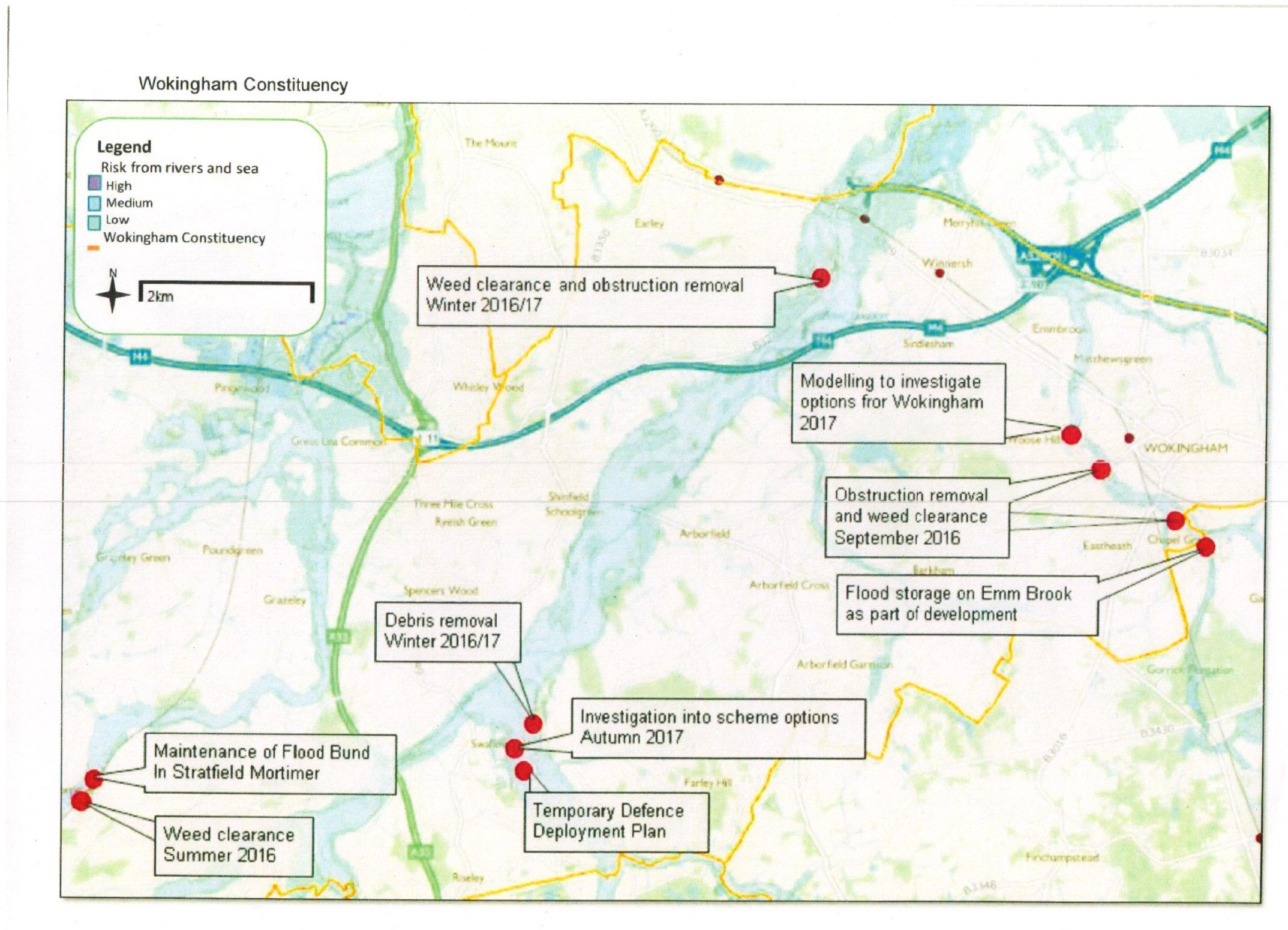
  • In 2015/16 we carried out river maintenance at 15 locations in your constituency. This work took place along 14.5km of rivers including the Loddon, Swallowfield Ditch, Emm Brook and the Kennet. It included removing obstructions, tree and shrub maintenance and carrying out selective weed and vegetation clearance. In 2016 / 17 we are carrying out a similar maintenance programme. The attached map shows the main locations and types of work we’re doing.

Emm Brook and South Wokingham Distributor Road

  • We have been engaging with Wokingham Borough Council (WBC) over the design of the South Wokingham Distributor Road (SWDR) since the early planning stages, and we will continue to work with WBC as the plans progress. The aim is that the SWDR reduces downstream flood risk from the Emm Brook, notably in locations which have historically been affected by river flooding. The developer anticipates completing the design for the relief road and residential development this calendar year with a view to start construction of the different elements of the scheme in 2018 and 2019.

Planning consultations and permitting

  • Since April 2016 we have commented on 78 planning applications within Wokingham. In line with our remit our responses ensured that the layout of development sites, where there is a risk of flooding from rivers, is appropriate; for example, siting dwellings where there is a low risk. Redevelopment does occur within floodplains and in these situations we provide advice so that floor levels are set above flood levels. In the vast majority of cases the local planning authority will take our advice on any flood risk objections. However if planning permission, for a major application, is given against our advice and the effects of flood risk are significant, we would use a call in process (through the Secretary of State) to reconsider whether planning permission should be granted. We did not call in any applications in 2016 in Wokingham.

Swallowfield Temporary Defence Deployment Plan

  • In 2016 the Government funded 32km of additional temporary barriers nationally (bringing our total national stock to 40km) to protect local communities during flooding. We have a draft deployment plan for Swallowfield where our assessments show there is potential to protect the community. We are consulting with partners and the community to finalise the arrangemen

Appraisals for future flood risk improvements

  • Our future programme for permanent flood defences includes Swallowfield and Lower Earley. We will appraise whether options such as flood walls and embankments are viable in these locations. River modelling is needed to make these assessments and we will test these options once the modelling is available. We will have the outcomes from the appraisal in autumn 2018.

Local Partnership Meetings

  • The Berkshire Flood Partnership is made up of all Berkshire Lead Local Flood Authorities, Thames Water and ourselves. The next meeting is on 7 March 2017. The meeting is chaired by Cllr Jesse Grey of Royal Borough of Windsor and Maidenhead.

We also meet with the Loddon Valley Residents Association and Loddon Basin Flood Action Group

Map1

The quiet rise of the pound

When the pound was declining a bit more after the Brexit vote we got daily commentaries from the media on this and how they thought  it was caused by the decision of UK voters. Most of the devaluation of the pound actually occurred between July 20165 and April 2016, long before the media thought we would leave the EU. There was a further leg down after June 23rd. Over the last month the pound has been rising against the dollar and the Euro. We rarely get news of this, and the rise is not attributed to the moves recently taken to press on with Brexit.

If someone believes Brexit was the crucial variable when it was falling, why do they change their view when it is rising? Why didn’t the pound fall this month, given the clear indication that the government does now  intend to send the Article 50 letter and has Parliamentary support to do so?