Skip to content
John Redwood's Diary Incisive and topical campaigns and commentary on today's issues and tomorrow's problems. Promoted by John Redwood 152 Grosvenor Road SW1V 3JL
John Redwood's Diary
  • Home
  • About
  • Contact
  • Local Issues
  • Debates
  • History
  • Press Releases
  • Articles

Search Site

John Redwood's Diary
Incisive and topical campaigns and commentary on today's issues and tomorrow's problems. Promoted by John Redwood 152 Grosvenor Road SW1V 3JL
@john.redwood.official
@johnredwood

Anyone submitting a comment to this site is giving their permission for it to be published here along with the name and identifiers they have submitted.

The moderator reserves the sole right to decide whether to publish or not.

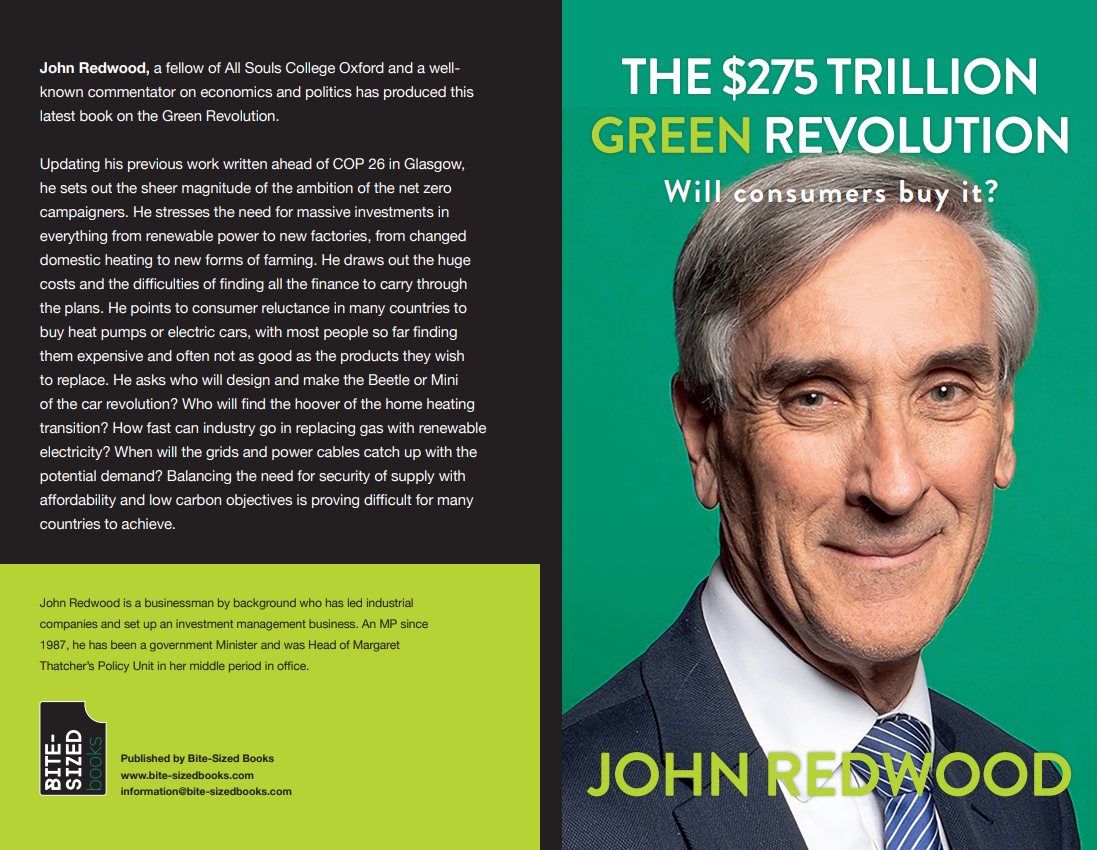
The costs of net zero policies

February 14, 2024 147 Comments

Labour’s decision to abandon most of its planned £28 bn a year extra investment programme for net zero has served to highlight the costs of the policy. It should also lead Labour to ask how they could both afford and achieve their wish to accelerate the UK’s progress to net zero compared to very exacting existing government targets. Under Mr Sunak the government has been relaxing some of the requirements, recognising that for the policy to work it has to be undertaken at a pace that people will accept. Much of the investment needs to be made by individuals and by private companies, so it needs to be realistic. The faster the government wants to go the more subsidy and direct public spending it will need to bring it about.

Labour say they are still wedded to the idea of zero carbon electricity generation by 2030. How can this be?  That would require the closure and write off of all our gas power stations and the remaining coal ones. If Drax is staying it would require a carbon capture and storage scheme to be up and running at great cost for that facility. It would require a massive expansion of the grid to handle more interruptible power and the planned expansion of electric heating and vehicles. It would need a major further investment in wind and solar power. It would require big battery installations to store power, and probably some new pump storage schemes as well. No-one seriously  believes this can be done by 2030. Nor could be it be done for part of a planned  £28bn a year let alone without £28 bn a year.

Two of the big areas where net zero requires different conduct by individuals are  transport and heating. Labour’s faster progress would mean ripping out far more gas boilers far sooner, which most people show no wish to do. It would require a fast replacement of diesel and petrol vehicles with electric. It would require an end to many holidays abroad or a rapid roll out of synthetic fuels for all aeroplanes. It is time interviewers on main media asked these crucial questions of those who advocate faster moves to net zero. It is simply wrong to be told wind energy is cheaper than fossil fuel energy when the figures do not take into account the costs of back up power today from fossil fuel. Nor do they take into account the full costs of extra grid, the costs of battery and pump storage , the costs of smart meters and the costs of rolling out charger points and extra cable capacity into homes for a more comprehensive renewables system.


facts4eu publish my article on budget

February 13, 2024 18 Comments

facts4eu.org/news/2024_feb_budget_ideas. publishes my budget article with their comments.

The Green revolution hits a democratic barrier

February 13, 2024 117 Comments

The Green revolution is a top down revolution. It is invented and enforced by governments and big companies. Whilst a majority of people say they think climate change is an issue, a big majority do not rush to change their own lifestyles in line with the requests and requirements of big government and the green revolutionaries. Most people are happy with gas or oil boilers and or solid fuel fires to heat their homes, and most of us still have diesel or petrol vehicles. Meat eating is still popular and people like flying abroad for their holidays.

Governments have understood that it is easier to force big business to comply with their green agenda than it is to get the public to accept the current approved products and changed lifestyles of green transition. Car companies queue up to undermine their successful past investments in making petrol and diesel vehicles, and to condemn their past products. They do however expect large subsidies to help pay for the very costly investment in making batteries and electric alternatives, and now expect governments to force people to buy these products as not enough want to buy them from free choice. Electricity generators rush to put in wind turbines and solar farms so they can close their cost efficient and reliable gas and coal power stations, but expect priority rules for interruptible renewable power and price structures that favour the new investments. Steel companies plan expensive electric arc recycling works to replace steel production in blast furnaces, but they too need large subsidies to try to get the sums to work.

Governments and companies need to work on how they could create affordable reliable good products that help them in their aim of cutting CO 2. They are going to need much more buy in from consumers to achieve their ambitious targets.  Consumers are making it very clear they expect the products to be better and cheaper than they currently are. Government does not  have to subsidise or regulate to get people to buy mobile phones or to switch to on line shopping, as those changes area popular with customers at market prices without intervention. Sales of electric vehicles to individual buyers are struggling in many places without large subsidies. Hertz has recently announced difficulties in renting out EVs and decided to sell one third of its present EV fleet to get more in line with public demand.

Worse still for governments and political parties that are keen on the drive to net zero is the growing evidence that parties in government that  go too far in forcing unpopular net zero changes lose elections. The Netherlands government lost heavily in the last election because it was trying to cut down animal husbandry and meat eating faster than the public thought acceptable. President Macron’s party has had some bruising encounters with public opinion over the level of fossil fuel taxes and diesel prices. The original gilets jaunes protests were about energy taxes which forced a climb down. Recently Macron has had to stop further taxes on agricultural diesel in the face of angry farmers.

When across Europe and the UK fossil fuel energy prices soared, doing the governments’ work for them forcing less use, governments rightly saw the need to cushion people from the price impact  on this essential. Germany has given into pressure to delay the ending of new diesel and petrol cars. In the US Presidential Candidate Trump is ahead of President Biden in the polls , His  policy of withdrawing from the Paris climate change treaty and targets compared to Biden who wants to go further faster is clearly no barrier to his possible victory and may be helping him. Many people do not want to be told by government how to heat their homes, what car to buy, and where to have their holiday.

My Intervention on NHS Dentistry: Recovery and Reform

February 12, 2024 75 Comments
John Redwood (Wokingham) (Con):

Wokingham has a fast-growing population based on building a lot of new homes. So as the Secretary of State rolls out her new plans, will she also ensure that there are incentives to provide dental services on the NHS in areas where a population is moving in and needs them?

Victoria Atkins, (Secretary of State for Health):

My right hon. Friend raises an interesting point. Indeed, that is exactly the sort of discussion I am having with my right hon. Friend the Levelling Up Secretary, because I am really interested in having that connected and joined-up approach between planning and health. I think it could bring dividends for us all.

Public sector inflation

February 12, 2024 46 Comments

The point I am making today is the trading public sector has got a lot dearer over the years. Ministers from governments of all complexions do not seem to exercise much control over costs and productivity of public bodies.

I looked at  the 1960 Guidebook to Dover Castle that my family  had bought on some long past visit. My computer tells me the Bank of England and successive governments have so devalued our currency that modern prices are 21.5 times higher than they were in 1960 on average. The Ministry of Works government Guidebook gave me some insight into public service inflation since then.

Dover Castle remains owned by the state with its visitor activities run by the charity English Heritage, an evolution from the Ministry of Works. The book says an adult visitor in 1960 would have paid 5p to see the Keep , lighthouse and ramparts, and another 1.25p to go into the tunnels. To do the same today the adult visitor buying a ticket at the site would pay £23.60. That is 377 times the cost in 1960, many times the rate of general inflation.

It is true there are now additional tunnels to see as in 1960 the Second World War tunnels were still out of bounds to visitors. The presentation of the Keep has changed, The collection of medieval armour and weapons adorning part of the interior has been replaced with modern soft furnishings and a  bit of wooden furniture with designs taken from contemporary illuminated manuscripts. Whilst as the old Guidebook notes the interiors and their windows had been changed over the centuries the current aim is to present it in its Henry II version as best judged.

The Guidebook itself has experienced a bit less inflation. The old one is considerably smaller with one  colour photo  and more smaller black and white photos. It cost 10 p compared to £5.50 for its modern and bigger counterpart. That is inflation of 55 times or nearly treble  the general inflation rate. There was plenty of good reading material in the 1960 version but the colour photos and art work are much better in the modern one.


Affording tax cuts Conservative Home article

February 11, 2024 137 Comments

A lot rests on the budget

          The polls show there are many former Conservative voters refusing to commit to Conservatives again who do not trust Labour or want a Labour government. They say they will not vote, or will vote Reform. When pressed they say they want the government to do what it promised and what they expect Conservative governments to do.
          Defining this and delivering is therefore the task of Prime Minister and Chancellor. They recognise they need to curb migration, as the 2019 Manifesto promised and as the Prime Minister has pledged. As they lower the excessively high rates of legal migration this year they need to make sure the Treasury and OBR accounts for this in an accurate way. They should put in many economies on public services, as cutting migration by 330,000 as promised (legal and illegal) reduces pressure for school places, for health treatments and above all for subsidised housing. It should make it easier to honour the pledge to get the waiting lists down in the NHS. The EU in 2016 said a new migrant cost a state Euro 250,000 in capital to provide a home, and in costs to offer good public services.
        The government understand that winning people back is above all about the economy. Three of the Prime Minister’s own five pledges are to lower the debts, halve inflation and grow the economy.  That is the right emphasis. People expect from a Conservative government prudent finances, lower taxes, more jobs and decent growth. They know from bitter experience that past Labour governments end with burgeoning debts, higher unemployment and downturns. The 1964-70 Labour government devalued the pound and had to go for austerity. The 1974-9 government ran out of money, had to borrow from the IMF and created a recession. The 1997-2010 government  allowed an inflationary banking bubble, created a deep recession and ran out of money. This government and its Conservative predecessors since 2010 have created 800 extra jobs every day they have been in office, got unemployment down, and presided over faster growth than the larger European countries. Even the shocks  of covid lockdown and the Ukraine war did not undermine the good record on jobs, essential to people’s living standards and self esteem.
         All this makes the budget crucial to plans to win back lost voters and to show the economy is on track to deliver that faster growth, lower inflation and controlled debt people expect. The big inflation was a blow delivered by the Bank of England, making similar mistakes to the US and EU Central banks. If only they had kept money under better control as Japan and China did we could have been spared that agony. Labour of course supported the  Bank’s bad policies throughout.


           The task of growing the economy with low inflation is made very difficult by the very institutions that are meant to bring stability, wisdom and competence to the task. The Bank has followed its inflationary monetary policy phase with overdoing the correction. It now needlessly sells bonds at big losses to sandbag the Treasury and taxpayer with huge bills.The OBR pads the figures with bad news, usually exaggerating the future deficit and borrowing and acting as a shop steward for more public sector spending. It ignores the productivity collapse in the public sector and assumes all the current spending is worthwhile.
         The Chancellor needs to cut through all this unhelpful policy and commentary. It is not money well spent to send the Bank of England £34 bn so far this year to pay for their losses. They should stop selling the bonds they bought so badly at a loss and hold them to redemption. They should copy ECB policy on the payment of interest on commercial bank reserves to curb the running losses on their ill judged portfolio.
          He should demand more care with quango and nationalised industry spending. Why are Post Office managers paid so much for losing the state a small fortune and for treating their sub postmasters so badly? Why do the railways need £12bn a year of subsidy when they run so many near empty trains that people do not want to use, and fail to run trains people do want because they cannot get on with their staff?  Why do large projects like HS 2 and the nuclear plants overrun so badly?
           He should speed up and intensify the work he has asked the Chief Secretary and Cabinet Office Minister to do to win back the big losses of productivity in public services. There is around a £30bn extra cost to deliver the same things as in 2019 before allowing for all the extra costs of inflation on top. Where is the stop to all external recruitment into the civil service and administration of other public services to start winning  back lost productivity? Why has the explosion of managers and Directors in the public sector resulted in so much worse productivity?
           He needs to review value for money and desirability of the various policies for net zero. £20 bn for carbon capture and storage is a huge sum. This idea should be largely financed by the private sector with limited and phased taxpayer money. The Government car service has one third of its fleet now as electric cars, which cost 18% more than the ICE cars they would otherwise have bought. Is this value for money?  Why can’t the government concentrate its net zero spend on obvious wins like proper insulation and controls on heating and lighting in its vast public estate? Spend to save money as well as cut energy use would be a win win.


             Labour tells us we need more nationalisation, starting with the railways. As they are largely nationalised already they see a way to do this without having to compensate existing owners. Which features of nationalised HS 2 management does Labour think would help with the rest of the railway? Or is it the Post Office model of computerisation and treating staff that appeals?
           Armed with better cost controls and an attack on some  of these areas of needless spending Chancellor and PM could show how you get more public service for less cost under Conservatives. That would mean money left over  for tax cuts to boost living standards and make it more worthwhile working. That is what all these reluctant Conservatives want.

A modern growing railway

February 10, 2024 93 Comments

Greens like trains. They seem to think they are free or low on CO 2 though all the time there diesel trains and electric trains running on power from a  fossil fuelled power station that is a lie. One day when all the trains are electric, and when all the electricity is from renewables maybe this will be a sensible view of theirs. In the meantime we can harness their enthusiasm for trains with plans  to maximise use of the substantial railway assets the nation owns.

The best green and commercial use of rail capacity could be for goods movement. Taking many more lorries off the road and using rail tracks more at night would be a double win. To work well there needs to be more track spurs from mainline to retail and industrial parks. The rail businesses need to offer good pricing for waggon loads , not just whole train loads. There needs to be a network of tractor units to collect  from stations and do the last few miles  where there is  no track direct to factory or warehouse.

To win back commuter travel the industry needs to find the best way of charging. Flexible season tickets where the more you travel on the specified journey the cheaper per journey it becomes is the obvious way to go. Discounts could be bigger for Mondays and Fridays the less popular days.

The railway needs to experiment with  events,leisure, short breaks and holiday travel. This is  becoming  the most common, with huge discounts in fares to win heavily loss making business. This is a very bad model  for the taxpayer and generates more CO 2 creating discretionary travel. Prices need  to be more realistic, and entrepreneurs need to  venture with event, hospitality and travel organisers to make it an attractive package.

The current losses on rail are unacceptable. Too many little used passenger trains run, whilst some popular times  and routes lack capacity. Freight could be economic.


Labour’s net zero disaster

February 9, 2024 153 Comments

Labour’s big difference with the Conservatives was going to be a big programme of net zero state investment and subsidy. This would be backed up by stricter targets to be enforced by tougher and earlier regulation to force us out of our cars and into our heat pumps. How they complained when the PM made a speech favour of a slower and less regulated  pathway to low carbon. Conservatives want the PM to do more to show he has turned away from unrealistic targets, dirigiste regulations and wasteful subsidy.

The Labour approach was full of lies and implausibilities. Where did they get £28 bn a year from to pay for the programme?  They now admit there was no £28 bn and they cannot find it.

They say they will have moved over fromfossil fuel electricity by 2030. No way. We still cannot store much wind and solar for wind and sun free hours and still lack grid to handle so much more interruptible  power.

They say many more people will insulate , buy  heat pumps and switch to electric cars. You cannot achieve that  by just spending more taxpayer money on subsidies and tax cuts. Half the country will not even accept a “free” smart meter let alone have their  homes made into a building site for a heat pump.

Maybe they would get us to deindustrialise at a faster pace to make us ever more dependent on imports whilst cutting CO 2 produced here. As for the favoured  green jobs they would create plenty of those in China.No sign of realistic plans to wrestle the manufacture of solar panels, wind turbines, big batteries or electric cars away from now well established Chinese dominance.

Paying for the BBC

February 8, 2024 134 Comments

The BBC is both a national broadcaster providing public service broadcasting in return for special tax, and a commercial  broadcaster in the world market operating through commercial subsidiaries BBC Commercial Ltd, BBC Studios Ltd and UK TV Media Ltd. It has a valuable back book of programmes and a well know brand worldwide.

BBC Commercial is small, turning over just £2bn. Licence fee activity brought in another £3.74bn. After selling its main property assets the BBC has a small balance sheet for a world media company, with just £2.66bn of capital and reserves on the balance sheet.

If we look at the US media majors we see far larger and better capitalised groups.  Amazon, parent of Amazon prime entertainment, has a full group market capitalisation of $1760 billion. Disney is worth $177bn, Comcast $178bn, Netflix $243 bn and Thomson Reuters $98 bn. These all dwarf the BBC in a very competitive world market.  The turnover of Netflix, Comcast and Disney at $240 bn is 31 times BBC total turnover and 92 times BBC Commercial turnover. Even Amazon prime videos on its own has a  turnover double that of  BBC Commercial.

The BBC sold off TV Centre and entered into a complex sale and leaseback or bond issue financing for Broadcasting House to raise £813 million.

The BBC Commercial arm to compete with the main media world players needs to raise capital and scale up. It could be spun off with commercial contracts to use and pay for BBC back material and any other privileged links. The new commercial company should be free to raise both equity and debt to be able to spend on more and better programming and routes to market.


My Interventions on the Finance Bill

February 7, 2024 90 Comments

John Redwood (Wokingham) (Con):

I have declared my business interests in the Register of Members’ Financial Interests.

I rise to support the Government’s new clause 5. I think it is good that they are considering what more they can do to promote investment in the United Kingdom’s generating capacity. We import far too much power already, especially when the sun does not shine and the wind does not blow, and on the basis of the Government’s ambitious forecasts and targets for much more of our energy to be delivered by electricity, I think that the position will get a lot worse quite quickly. Anything that the Government can do to encourage that additional investment in generating plant will be very welcome.

We will, of course, need a similar positive approach to grid and cable, because the more we electrify, the more we will need to convey that power from the rather remote locations where much of it comes from to the parts of the country that will need it. So my only worry about new clause 5 is that I am not sure it goes far enough. I think it is helpful in this limited number of cases, but I trust that the Chancellor, when it comes to the Budget—quite soon, on 6 March—will consider that the new clause is just a stepping stone and that we need to review again the very large tax impositions on energy of all kinds in this country. We now have double corporation tax in many cases and a range of windfall taxes that are often not really windfall taxes because they do not come off when the prices go down, although they are put on when the prices are going up.

That whole area needs considerable review, because we need to take seriously the fact that we are short of energy overall. We are short of electricity generating capacity and short of the means to route power from generation to use, and it would be an important stimulus for the British economy if we produced more of our own energy and generated more of our own electricity, and if we were thinking about having a surplus to export again instead of all too often being cruelly reliant upon imports of liquid natural gas and electricity, particularly from the continent.

I would also like briefly to refer to new clauses 4 and 6. They are wide-ranging new clauses that invite the Government to make assessments or reviews of features of this legislation, but they also wish to broaden it out to get the Government to review the impact of their general fiscal strategy on equalities, on investment, on the state of the corporate sector and on inequalities in our society. I am quite sure that the Government will be reviewing all those things as a matter of course, as this is often a continuous process. Indeed, many of the items covered in this request for special review are already reported on and form part of the normal process of policy preparation, and rightly so. If the Minister were to tell me that he would be grateful if I did not vote for these new clauses, I would have no problem with that—I am not sure that it would help to embody them in the legislation anyway; I think it would be a bit of an abuse of the legislation—but the Government need to respond to the general thirst for knowledge that these new clauses represent, and to understand that there are some serious issues here that need to be returned to. I trust that the Chancellor will return to them at the Budget.

Looking at the fiscal impact that these new clauses cover, I trust that in the preparation of the Budget we will have analysis in the Treasury of these particular measures, which are still going through from the last time, but I also hope that the Government will review the extraordinary losses of the Bank of England—I think that they have already run up to £34 billion in the current financial year. These are losses that the Treasury, and therefore the taxpayer, have to pay as they are incurred, and that is completely unacceptable. It imposes strains on the public accounts and on the Treasury at a time when we really do not need them and when we need that money for other purposes.

There are two simple measures that the Bank could take to stem the magnitude of those losses. First, it should not be selling bonds at a big loss in the market. The European Central Bank is not doing this, although it has a similar problem with a portfolio of very expensively acquired bonds. There is also the issue of the running losses on these holdings where the Bank of England is paying the full, much enhanced, short-term interest rate following its increases in it. This now greatly exceeds the revenue on the bonds because the Bank paid far too much for the bonds and there is a very low rate of interest on them. Those running losses are a problem. I think the Bank should look at what the European Central Bank is doing, in paying different interest rates on reserves held under this system so that it does not have such a large running loss.

Richard Fuller:

Can my right hon. Friend tell me if I have got this right? In the commentary ahead of the Budget, we talk about wiggle room and the Office for Budget Responsibility forecast and about £5 billion or £10 billion here and there, but I think I heard him say that this matter was completely out of the control of the those on the Treasury Bench and this Parliament; that the Governor of the Bank of England could unilaterally decide to crystallise losses on whichever extent of bonds he wished to, and then put that loss into the calculations of the Chancellor of the day; and that the Chancellor would then have to work around that in order to work out what the fiscal expenditure, public expenditure and taxation would be. Is that actually the case? It sounds mightily undemocratic to me.

John Redwood:

That is an interesting point of debate, but my understanding of the constitutional position is that it is not as bad as my hon. Friend is suggesting because all the bonds were acquired with the express permission of the then Chancellor of the Exchequer. The Bank of England’s website says that the bond portfolio is held on behalf of the Treasury. Successive Chancellors of the Exchequer—beginning with the Labour Chancellor who first undertook quantitative easing and carried on by successive Conservative Chancellors—all signed an agreement with the Bank to say that they would indemnify against loss. So, given that the Government and this Parliament empowered the purchase of the bonds and now take responsibility for any losses on them, it seems perfectly reasonable for there to be a proper conversation about whether we want to take the losses.

I see nothing wrong with us here challenging the idea that, uniquely among the big quantitative easing programmes, it is the Bank of England that not only insists on selling the bonds at big losses but gets reimbursed. The ECB does not sell them in the market at big losses. The Federal Reserve Board sells them in the market at big losses but gets no money back; it simply puts on its balance sheet that it has lost a lot of money and takes the view that, as it is a central bank, it does not really matter if it loses a lot of money, because central banks create money and it is therefore not like a normal commercial business. So I hope that Ministers will look at this as part of the general assessment that is being invited by these new clauses.

I hope also that Ministers will look at the expenditure items in the overall accounts covered by new clause 4 on the public finances, because there has been a marked decline in public sector productivity in the years 2020 to 2023. It was quite without precedent in my experience of following public finances over the years, and this very sharp decline represents at least a £30 billion loss to our system, in that it now costs at least £30 billion a year more to run the group of public services covered by these figures than it did before the collapse in productivity. On top of that, there has also been the need for much bigger sums to cover inflation. This is not the inflation figure; this is the real loss figure from the productivity.

We are all sympathetic to the difficulties that lockdown and the transition out of lockdown caused, and there was bound to be disruption. Our public services were badly affected by that, as children could not go to school and hospitals were disrupted by covid, but that is now some time behind us and it seems perplexing that we cannot get those public services back to 2019 levels of productivity. I hear comment that maybe artificial intelligence will do it and that there needs to be a big investment in computers. Well, that should be on top. All that I am saying to the Government is that we can surely get back to 2019 productivity levels using techniques from 2019, which was very much pre-artificial intelligence and before the latest round of computerisation. Again, this is a big area that needs to be looked at as part of any review of the public finances.

The third area, which is also very large and very much in the news today, is that even more people in our country do not feel they can go back to work and that they need help at home because they are no longer able to work. The Government are working on some important programmes, through the Department for Work and Pensions, to show people that through a combination of part-time flexible working and working at home with proper support and training, and maybe with additional financial support to help them, they could go back to work for part of the time and make a contribution. We desperately need them, and I think their lives would be more rewarding. They would also be better off because we now have a benefits system that means it is always better to work. This should be a cross-party matter, because it is a problem that our nation as a whole faces. We can enrich those people’s lives, help to reduce the burden on the taxpayer and improve the net income of those concerned. Again, this involves many billions.

My point in making these three simple points apparent to the House is that there are very large sums of money indeed involved in bond losses and productivity, which we need to review because that would help in the formation of the next Budget. It would create more headroom, both for the tax cuts that we need if we are to promote growth, and for improved public service provision in the areas where the shoe is still pinching. I trust that will be part of any review that might emerge from these new clauses, or from the spirit of these new clauses. I hope that my right hon. Friend the Chancellor is thinking about this, as we will have a Budget hard on the heels of this Finance Bill, which came out of the autumn statement. In these conditions of recovery, and given the need for faster growth, I welcome having more than one Budget a year, and the fact that we may have three fiscal events quite close to each other, if all goes well. They must promote growth and reduce taxes, and this is a good start.

I welcome new clause 5, but can we please have more? Can we please look at the headroom that I think I have helped to identify?

Posts navigation

Older posts→
←Newer posts

Free Email Alerts

You can sign up to receive John's blog posts by e-mail for free by submiting your email address in the box below.

The e-mail service is powered by Automattic's Jetpack service. Your information is not shared.

Social

Brexit Facts4EU.Org
↻Brexit Facts4EU.Org@Facts4euOrg13h
Huge impact report from Facts4EU. Please re-post! ...
💬1↻11♥13❝0
Brexit Facts4EU.Org
↻Brexit Facts4EU.Org@Facts4euOrg14h
Our hugely important report on @GBNEWS . EXCL: The 5 charts that leave Burnham boxed-in over Brexit. Direct challenge issued to Andy Burnham. Essential reading: ... Pls re-post! ...
💬1↻23♥36❝1
John Redwood
John Redwood@johnredwood15h
When Andy Burnham saw the Defence Plan he should have asked how it would be paid for. Why doesn't he say where he is going to find the money? If he wants to succeed he needs to know and to answer questions. He looks as if he has no idea what to do.
💬26↻59♥279❝0
John Redwood
John Redwood@johnredwood19h
If a Number 10 office in Manchester is going to boost the North West, will other regions need a similar arrangement to get a boost for themselves?
💬27↻28♥203❝0
John Redwood
John Redwood@johnredwood19h
If more money and power is to be given to City region mayors, what happens to the rest of the country that does not have such an office holder? This could become a divisive and unfair policy.
💬20↻51♥233❝1
John Redwood
John Redwood@johnredwood19h
In two thirds of local referendums voters rejected the idea of an elected mayor. In four cases voters have voted to get rid of one after seeing what a bad idea it was. Andy Burnham’s idea of more devolution to mayors will not produce more UK growth and will be unpopular.
💬38↻176♥805❝2
John Redwood
John Redwood@johnredwoodJul 1
@tigahope Indeed. Most delays and cancellations caused by fully nationalised Network Rail.
💬0↻0♥2❝0
John Redwood
John Redwood@johnredwoodJul 1
@PieroPasset Cheaper to go home to sleep than charging taxpayers for an overnight stay, returning to Parliament the next day.
💬2↻0♥1❝0
John Redwood
John Redwood@johnredwoodJul 1
If Andy Burnham wants to boost UK industry he should cancel the steel tariffs. Were he serious about national security and our defence industries he should say how he will pay for the Defence Plan and how he will hit NATO defence targets.
💬16↻47♥208❝1
John Redwood
John Redwood@johnredwoodJul 1
UK government intensifies its attack on UK industry today with 50% tariffs on steel imports. Expect more factory closures, lost jobs and lost orders in steel using industries.A further blow to a car industry being shut down by coming bans on making petrol and diesel vehicles.
💬17↻253♥770❝3
John Redwood
John Redwood@johnredwoodJul 1
US has given $300 m to help rescue people from the disaster in Venezuela, the UK just £2 m. Why was the UK so uncaring? Why do we find so many bad ways of spending overseas aid, then fail to offer enough help when it is needed?
💬22↻49♥278❝1
John Redwood
John Redwood@johnredwoodJul 1
Is Andy Burnham’s only growth policy to employ more staff for two Number 10 s? More taxpayer costs of rail fares to help his nationalised industry? Hardly efficient to shuttle between No 10 North and South, with the need for more security.
💬28↻59♥315❝1
John Redwood
John Redwood@johnredwoodJun 30
Last night on GB News Jacob Rees Mogg set out the case against City region devolution, breaking up England. I explained why extra government in City regions would be more cost and regulation, a brake on growth. Tourist taxes all round to put off visitors?
💬29↻78♥376❝0
John Redwood
John Redwood@johnredwoodJun 30
Andy Burnham said more unspecified devolution would boost growth. So why have Scotland and Wales grown much more slowly than England this century with their devolved governments? see ... and @Facts4euOrg
💬32↻193♥788❝2
John Redwood
John Redwood@johnredwoodJun 30
Andy Burnham will not devolve the powers Councils need to reflect local opinions about key issues. Whitehall will still decide where illegal migrants will be housed, where new homes will be built, where greenfields will be filled with solar panels or pylons.
💬9↻75♥326❝1
John Redwood
John Redwood@johnredwoodJun 29
@RDGray No, he did not speak in the Commons where he can be cross examined. No questions, no clarifications, no debate, no detail.
💬1↻0♥0❝0
John Redwood
John Redwood@johnredwoodJun 29
@bodman_mike @GrumpyLofty I did not criticise him for no election. I asked when he wanted one, pointing out he needs to fight and win two to get his 10 years.
💬1↻0♥7❝0
John Redwood
John Redwood@johnredwoodJun 29
Andy Burnham proposes a ten year plan. That would require him to win two general elections. When will he try to win his first?
💬145↻481♥4,011❝16
John Redwood
John Redwood@johnredwoodJun 29
When will Andy Burnham announce a budget and plan that can rebuild our defences?
💬57↻36♥263❝4
John Redwood
John Redwood@johnredwoodJun 29
Major devolution of power in Wales to a Labour government all this century meant Wales fell further and further behind England for economic growth. To boost growth in England and rebuild industry you need lower energy prices and lower taxes, not more government.
💬27↻131♥650❝2
John Redwood
John Redwood@johnredwoodJun 29
Andy Burnham is now an MP. He should make a speech or hold a debate in Westminster setting out his agenda, allowing cross examination of his proposals. He wants to become PM without a proper agenda. What has he got to hide?
💬110↻332♥1,695❝6
John Redwood
John Redwood@johnredwoodJun 29
Many want a nationalised water industry again. In 1976 our state water industry cut many people’s mains water off. They had to queue to fill a bucket from a standpipe in the road. Not great service, as the state did not put in enough reservoirs or mend leaky pipes.
💬53↻78♥390❝1
John Redwood
John Redwood@johnredwoodJun 28
The North needs better transport. Spin out the much delayed HS 2 a bit longer, reallocating some of the money 2026-8 to the North.The irony of HS 2 is they want to spend huge out of control sums on a southern railway we do not want and cancelled a Northern rail that was wanted.
💬21↻37♥243❝3
John Redwood
John Redwood@johnredwoodJun 28
I want Andy Burnham to revitalise the North and cities. First slash energy prices, removing net zero taxes and skewed investment. Great cities need industries with well paid jobs. Bans on oil,gas,petrol vehicles stop industry. Dear energy is a jobs killer.
💬33↻113♥689❝3
John Redwood
John Redwood@johnredwoodJun 28
The Haigh agenda of taxing more and borrowing more will lose us more jobs, keep interest rates higher for longer, harm the economy and lead to early disappointment with the new PM.
💬22↻123♥603❝2
John Redwood
John Redwood@johnredwoodJun 27
Glad to hear Andy Burnham wants to cut Whitehall spending. Not a good idea to boost Mayoral budgets. If he wants economic revival the UK state needs to spend less and tax less not spend and borrow more.
💬13↻73♥461❝3
John Redwood
John Redwood@johnredwoodJun 27
Will Andy Burnham make the easy cuts in wasteful public spending? Cancel the Chagos give away. Stop the carbon capture and storage costs. Stop new external recruitment into the civil service. Tighten rules about granting sick notes for life.
💬40↻121♥706❝3
John Redwood
John Redwood@johnredwoodJun 27
The government cuts our defence forces, freeing bases for other uses. It then spends big sums in adapting the military buildings and providing free board and lodging for illegal migrants. Why?
💬240↻493♥2,045❝22
John Redwood
John Redwood@johnredwoodJun 26
I set out in a speech the way the UK’s net zero policies will increase world CO 2 and cost a fortune. This is self defeating self harm on a huge scale. see ...
💬23↻69♥268❝2
John Redwood
John Redwood@johnredwoodJun 26
Labour MPs who backed Burnham fail to tell us what changes will follow to improve things. They liked his ability to win Makerfield but it was a win to sack Starmer. His win did not endorse clear policy change for the better or mean voters like the Labour government.
💬24↻117♥637❝1
John Redwood
John Redwood@johnredwoodJun 26
Labour’s dumping of Starmer was about politics and MP fears of losing their seats. Burnham has presented no clear policy on taxes, growth, defence spend, welfare reform or anything else that matters. The public wants change for the better.
💬63↻237♥1,401❝8
Brexit Facts4EU.Org
↻Brexit Facts4EU.Org@Facts4euOrgJun 25
Last 2 days on @GBNEWS , we’ve ranked 2nd & 4th for our 2 reports on EU Ref’s 10th b'day! Exclusives from Nigel, Boris, Priti & many more! Wed: ... Tues: ... Pls re-post GBN’s tweets: ... And: ... ...
💬1↻12♥31❝0
John Redwood
John Redwood@johnredwoodJun 25
The BBC is not a trustworthy news source. It fails to present criticisms of the damaging net zero policies. It loads its news in favour of the EU and the “international rules based order.” That’s why many conservatives are turning to other news services.
💬174↻680♥3,487❝25
John Redwood
John Redwood@johnredwoodJun 25
Overnight 66% of our electricity came from gas. Still the government bans producing more of our own gas. Renewables are unreliable and dearer than gas power. With renewables you need to pay to keep gas power on stand by and get no carbon tax revenue from wind or solar.
💬42↻292♥1,082❝6
John Redwood
John Redwood@johnredwoodJun 25
Glad the EU Re set summit is delayed. The new PM should cancel it. Starmer’s re set was a surrender, giving the EU money we cannot afford to damage our growth with their rules. The Re set could not possibly pass the Makerfield test.
💬15↻138♥607❝2
Kemi Badenoch
↻Kemi Badenoch@KemiBadenochJun 24
This is a disgrace. Labour’s lame duck Attorney General, Lord Hermer, is once again trying to force through his vindictive pet project: the Chagos Island surrender. Hermer is the only person who wants this deal. Conservatives rejected it. The Americans have serious concerns ...
💬407↻2,209♥10,791❝60
John Redwood
John Redwood@johnredwoodJun 24
@Dougmacd9826 The HS 2 nationalised company was set up by Gordon Brown as PM
💬0↻0♥0❝0
John Redwood
John Redwood@johnredwoodJun 24
@hmv666 Solar has now picked up. Gas was 59% earlier this morning.
💬37↻0♥27❝0
Brexit Facts4EU.Org
↻Brexit Facts4EU.Org@Facts4euOrgJun 24
We asked Nigel and 10 key Brexit figures for their views, on the 10th anniversary of the announcement of the victory. @GBNEWS covers this in full, below. Please read and please re-post! ...
💬4↻10♥27❝0
John Redwood
John Redwood@johnredwoodJun 24
@CSPolicies I opposed it
💬4↻0♥6❝0
John Redwood
John Redwood@johnredwoodJun 24
Gas is supplying 59% of our electricity this morning. Those expensive wind turbines are having another day off.
💬294↻1,129♥4,984❝26
John Redwood
John Redwood@johnredwoodJun 24
Yesterday I and others pointed out the huge estimated cost of £35 bn a year for the government’s net zero carbon strategy is not value for money. It is also probably a bad underestimate of the amount taxpayers and energy bill payers will have to pay.
💬20↻114♥543❝1
John Redwood
John Redwood@johnredwoodJun 24
A Minister told me in the Lords that HS2 is now expected to cost £87.7 billion to £102.7 billion. The first trains will run Euston to Birmingham maybe May 2040 or December 2043.This project remains out of control, still running massively over budget and endlessly delayed.
💬84↻200♥858❝12
John Redwood
John Redwood@johnredwoodJun 24
Is Mr Burnham’s enthusiasm for more nationalisation based on the record budget overruns and delays of nationalised HS 2 or on the dreadful treatment of staff at the Post Office ? How many loss making businesses like British Steel does he think taxpayers can afford?
💬18↻79♥346❝1
Brexit Facts4EU.Org
↻Brexit Facts4EU.Org@Facts4euOrgJun 23
‘The Long Road to Brexit’ “Your readers were totally right!” Boris tells us on the Referendum 10th Anniversary. Our 2-part Special shared with @GBNEWS ! ... Pls re-post! ...
💬1↻24♥40❝1
John Redwood
John Redwood@johnredwoodJun 23
Will Andy Burnham today praise the majority of electors in Makerfield for voting for Brexit? Will he now set out how he will renounce the planned bad deal Re Set and start to use Brexit freedoms to back British business and growth?
💬38↻104♥597❝3
John Redwood
John Redwood@johnredwoodJun 23
I am proud of voters voting for Brexit. The EU and single market damaged our economy badly. ...
💬57↻112♥769❝6
John Redwood
John Redwood@johnredwoodJun 23
Mainstream defines Manchesterism for us to warn us of what Burnham may do. It is a plan for massive state borrowing to nationalise large chunks of the economy. They think if they borrow through state corporations the bond market might not notice the surge in debt. Dream on.
💬9↻78♥310❝2
John Redwood
John Redwood@johnredwoodJun 23
“To borrow and to borrow and to borrow is not Macbeth with a heavy cold. It is Labour party policy” . Margaret Thatcher’s famous summary of Labour economics sums up what many in Labour want from Burnham.
💬18↻99♥418❝0
John Redwood
John Redwood@johnredwoodJun 22
Mainsteam's statement of Manchesterism says it is about a big increase in borrowing. Borrow to nationalise assets. Borrow for the state to invest in more projects. Borrow to pay for any losses and mistakes like HS 2. Then say this state borrowing is outside the state debt rules!
💬15↻49♥212❝0

About John Redwood

John Redwood won a free place at Kent College, Canterbury, and graduated from Magdalen College Oxford. He is a Distinguished fellow of All Souls, Oxford.
  • Read more about John Redwood

John’s Books

Previous Next

Links open an Amazon product page in a new window/tab.

2026 © John Redwood's Diary Theme by EccentricCoder