John Redwood's Diary
Incisive and topical campaigns and commentary on today's issues and tomorrow's problems. Promoted by John Redwood 152 Grosvenor Road SW1V 3JL

Anyone submitting a comment to this site is giving their permission for it to be published here along with the name and identifiers they have submitted.

The moderator reserves the sole right to decide whether to publish or not.

Russian money

There are wild allegations circulating about dirty Russian money in London and in U.K. politics.

U.K. law is very clear. U.K. parties cannot accept donations from overseas residents and companies. All donations with their source have to be registered. If anyone has evidence of a party breaking this rule they should send it to the police.

U.K. law is also clear about Foreigners with wealth coming to live,work and invest in the U.K. They need to meet the Home Office rules on rights to live and work here. When transferring money into the country they need to satisfy banks receiving the cash or securities that they comply with anti money laundering rules. These rules are designed to stop people depositing any proceeds of crime. This ranges widely from drugs and arms dealing money  through theft and bribery to tax avoidance. Again if anyone has evidence of a rich foreigner resident here breaking these laws they should inform the authorities.

We should not want to live in a society where it is a crime  to be rich or where any rich foreigner living legally here is automatically branded a crook.  There will be rich Russians in London who have  obeyed our laws and who oppose Putin’s thuggery. If they wish to give money to political parties they need to comply with our donation laws. Many rich settlers in the U.K. make welcome contributions by investing, creating jobs and supporting good causes. It will now be illegal to do business with Putin cronies now on the sanctions list.

(I pay for my own election leaflets and political support.)

Letter to the Business Secretary

Dear Kwasi

I see you wish to help the PM apply pressure to Russia as Putin prosecutes an illegal and murderous war against Ukraine.

There is  a major way in which you can make a difference. The PM’s wish to see stiffer sanctions has been impeded by Germany and Italy owing to their dependence on Russian gas. A single western country cannot bring much pressure to bear without all other countries undertaking the same measure so it is watertight.  The UK needs to help ease the energy squeeze in Europe.

You should invite in  the leading oil and gas investors and licence holders in the UK industry and work with them to increase the output of UK oil and gas. This should be a series of immediate short term measures to maximise output from existing fields in production, and work to move through exploration to production investment and licences for new fields and field expansions. Over the next couple of years the UK could achieve a substantial increase in output which can replace UK imports at the moment or could be exported to help displace Russian gas in the EU.

Burning our own North Sea gas rather than imported LNG more than halves the amount of CO 2 generated, gives us a big increase in domestic tax revenues from the existing higher corporation tax rate applied to oil and gas production and helps ease the squeeze on European energy markets. In due course nuclear and renewables will provide more of our energy, but only once these plants are built and once many more people have switched from gas to electricity to power factories and heat homes. You need a plan for this decade which remains the decade of gas in the UK and Europe. That plan must cut reliance on Russian gas and oil.


Yours


John


Main points from the Net Zero lecture

The world will make little progress to reduce CO 2 this decade owing to the likely increases in Chinese, Indian, and Russian output. Protesters for net zero need to concentrate on these  large emitters set out in the slides.

Removing carbon dioxide from human activity needs buy in from most people living in the world so they change their lifestyles and jobs. To do this we need a new generation of green products which people want to buy. They need to be cheaper or better than current technologies. The digital revolution is the model. Governments don’t make people buy smartphones, shop on line or use the internet. They choose to do so.

Governments will not force the transition they want by bans, subsidies and taxes. These breed resentment and will lead to unpopularity for parties associated with limiting consumer choice, hiking prices and overtaxing.

Slides from my Net Zero lecture

Please see below my lecture at All Souls College, Oxford, titled ‘The Long Road to Net Zero’:

Slide 1

Solutions to CO 2 output  have to be multilateral  not unilateral. With the exception of China, no country is big enough to make a difference to world output by its own actions without buy in from others.

Reducing  CO 2 substantially will only be possible if people want the new green products and services. It cannot be delivered by bans, subsidies and taxes.

Current net zero policies rely heavily on making the use of fossil fuels dearer running the danger of increasing inequalities and allowing the rich to buy themselves pardons for continuing use of fossil fuels.

Slide 2

From UN Report October 2021:


Total estimated Green House Gas emissions       2025    54.7 Gt    58% above 1990 level

2030    54.9Gt     58.7% above 1990 level    15.9% above 2010

UN says GHG emissions need to be 43% lower than 2010 by 2030 to hit 1.5 degree C increase, or 25% lower to hit 2 degrees.

This decade will see a further increase in the amount of CO2 generated by the world economy with an increase in the annual use of fossil fuels.

The main producers will be China, India and other emerging economies. The USA and the EU accounting for a quarter of current CO 2 will reduce their output a bit.

Slide 3- The Scale of the Problem
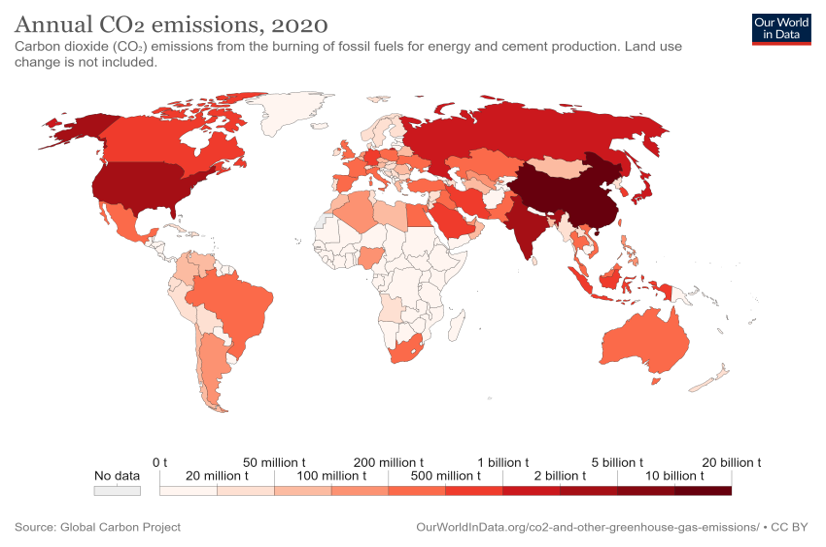
 

Slide 4 –  The main sources of CO2

China         30.65%  10,670,000m tonnes

USA           13.5%     4,700,000m tonnes

EU              9%          2,600,000m tonnes

Germany   2%          644m tonnes

Russia       4.5%       1,580,000m tonnes

UK              1%          329m tonnes

Slide 5

Sources of energy for China

Coal – 57%

Oil – 20%

Gas – 8%

Main fossil fuels total – 85%

Sources of energy for USA

Oil – 37%

Gas – 32%

Coal – 11%

Main fossil fuels total – 80%

Sources of energy for EU

Oil – 37%

Gas – 25%

Coal – 11%

Main fossil fuels total – 73%

Slide 6 – Gas – a transition fuel?

Natural gas versus coal

EU designation

Mixing hydrogen with natural gas

Blue and green hydrogen

Slide 7 – How do you power homes and factories when the wind does not blow or blows too hard?

The dangers of over reliance on wind energy – the UK has days when wind only supplies 2% electricity

Need for electricity storage

Pump storage systems

Green hydrogen as an energy store

Battery storage

Time shifting of power use

Slide 8 – Carbon accounting

Is it sensible to shift from a petrol to an electric car?

Total carbon generated by manufacture of new vehicle and destruction of old vehicle.

Over what time period do you amortise that excess carbon

What mileage would you need to do each year to make the vehicle switch worthwhile?

How do you guarantee that your battery is only recharged with renewable power?

Slide 9

Carbon accounting

Putting in a heat pump

CO2 produced in manufacture of equipment and installation

Nature of the electricity to fuel the heat pump system

Need for heating and immersion heating back up to secure sufficient temperature to water and air ?

Slide 10

Carbon accounting for wind energy

The carbon dioxide produced during fabrication and installation of the turbines and towers

The carbon dioxide generated for replacement turbines and parts

The carbon dioxide generated for the stand by power capacity needed

The carbon dioxide produced when stand by generation is used during low or high wind periods

Slide 11 – What would make the green products fly off the shelves?

Cars –  range, refuelling and recharging, cost, style

Heating systems – Average temperatures, cost,  degree of intrusion

Diets – taste and appearance of alternatives to meat/ social acceptability

Slide 12  

Technologies for the 2030s and 2040s

Green hydrogen for storage of renewable power

Green hydrogen to drive internal combustion engines

Nuclear power and small nuclear reactors

Nuclear fusion?

Large battery storage

More use of water power and pump storage

Hydrogen for home heating and industrial processes

 

The U.K. needs to look to its national security

NATO were right. The Intelligence reports, shared widely with the public, pointed to a major invasion of Ukraine. Putin assembled the majority of his country’s substantial military forces around the borders of Ukraine for a purpose. We had to await the ending of the winter Olympics and the interviewing of a succession of western leaders, presumably to reassure him that NATO would not go to war. Only now has Putin decided to set some aims for his violent mission. He says he wants Ukraine to change its government to become a neutral state that would effectively be a puppet of Russia. If he does not get his way easily he may well turn to complete conquest to enforce his will.

Putin has revealed the strategic weakness of the European position. Short of energy, reliant on Russian gas, the Europeans gave the Minsk Agreement and a possible new settlement their best efforts. It was in  vain. Putin did not want to see Ukraine remodel its constitution as a single state looking towards the West. He  ripped up what remained of Minsk by recognising the rebel states as independent countries.

The UK is right to work with our US and European allies in NATO to do the best we can in  a grave situation. What this must  now do is make the UK take some hard and good decisions about our future national security. It should start with a National Security Council review of our energy supply with a view to re establishing self sufficiency as soon as possible. It needs to include a further military review to expand our forces. We could spend the extra tax we collect on producing more of our own oil and gas to pay for a larger military. It needs further work on our cyber defences, on protecting our networks for utilities and better defence of core technologies and industrial competences. We have been too free with our best ideas, and too careless about keeping domestic production and intellectual property in core areas like steel, special metals, ceramics, electronic chips and the rest.

My intervention to the Minister at the Opposition Day debate on Non-commissioned Exempt Accommodation

Rt Hon Sir John Redwood MP (Wokingham) (Con): Has the Minister made sure that all future contracts are properly set up and policed at the beginning, so that the Government know what they are buying?

Eddie Hughes (Parliamentary Under-Secretary of State, Department for Levelling Up, Housing, Communities and Local Government): My right hon. Friend makes an interesting point, but we leave those decisions to councils that are commissioning locally. I guess it is up to us to try to ensure appropriate standards against which such accommodation is measured and then to give them the necessary powers to enforce that. Personally, I think that councils already have a considerable number of powers. I am not disagreeing with Opposition Members about what powers are required; I am just saying that I would like to see the existing powers used to the absolute max before we necessarily go reaching for others. If people feel they do not have the necessary powers, I would consider it not inappropriate for the Government to legislate, but we need to consider that carefully.

We are committed to finding the right approach to this issue, and we invested £5 million in a number of pilots in recent months to support the worst-affected areas, including Birmingham, Blackburn with Darwen, Blackpool, Bristol and Hull. Through the injection of those funds, we have been working with local authorities to test approaches to improving the quality of this type of accommodation. We chose these specific areas partly because of the existing commitment to tackle these issues, and I pay tribute to the local authorities, which have worked collegiately and collaboratively with us during the pilots.

To take Bristol as an example, it has been conducting thorough assessments of new schemes and providers for some time. The council was able to use its funding to complete its work in summer last year. Meanwhile, Hull’s supported accommodation review team was implemented in 2019, and the council has already shown a strong commitment to making the changes needed to solve the problems besetting exempt accommodation. Through the pilot, it was able to fund a large part of its programme and to take its approach to that programme one step further. As the House would expect, we know that the need stretches beyond these pilot areas and that local authorities in other parts of the country want to invest in tackling these problems, too.

The long road to net zero

Tomorrow I will give my lecture at All Souls College Oxford on net zero policies at 11 am.

If you would like to attend in person or by on line link please contact the College at   https://www.asc.ox.ac.uk/event/long-road-net-zero

President Biden takes on President Putin

President Biden suffered a major reversal when he left Afghanistan with too much haste and secrecy, failing to inform or win over his allies to his chosen course of action. Afghanistan soon fell to the Taliban once US forces had gone, reversing the hard won gains of many years of strife and loss of life in a few days.

He has been more willing to consult NATO allies over Ukraine, and has warned Mr Putin of serious adverse consequences if he presses ahead with an invasion. The President and the US intelligence and military services have kept the whole world advised of Russian troop and weapon deployments near to Ukraine and have forecast early invasions. They seek to win the information war and to make it more difficult for Russia to seek to occupy Ukraine.  President Biden did let slip the view that the retaliation would not be so tough were Mr Putin to make a limited incursion into Ukraine. Although his staff did their best to correct this and he himself changed his words, it looks as if Mr Putin decided the US President meant what he had let slip. So Russia has made a more limited incursion than a direct invasion with massed forces aiming at the capture of Kiev and the toppling of the Ukrainian government by force.  The US has led a response based on targeted sanctions against individuals and certain banks, whilst stressing there would be much worse to come for Russia if she plans a bigger military attack.

The USA is still concerned about a further Russian attack using the large firepower Mr Putin has assembled. It is possible that Russia will foment the strife and tensions within the two provinces that she has now recognised as independent, seeking to drag Ukraine into a war in the east. It is is also likely Russia will look at how to destabilise the government of Ukraine, adding political pressures to military challenges created in Donbas. What is clear is the Franco-German initiative to reach a diplomatic peace through creating two self governing provinces within Ukraine is now badly damaged by pre emptive Russian action. What do you think the USA should do next?


Update   Russia has decided to bomb  military installations and provoke a wider internal  war. Putin says he will not invade and occupy Ukraine but clearly plans  to use his military resources to effect regime change and  create  a more submissive Ukraine. His military actions are expanding, inviting Ukrainian retaliation which he might then use to give him the  excuse as he sees it to widen his use of Russian forces. NATO will condemn these unprovoked  aggressions but will not commit its own forces to the fight.


Rebuilding our fleets as a maritime nation would bring more Brexit wins

During our time in the EEC/EU our merchant fleet and our fishing fleet suffered a bad decline. The ECJ striking down an Act of Parliament designed to promote our maritime activities did not help. The Common Fisheries Policy invited many more foreign fishing boats in to plunder our fishing grounds. The EU then imposed ever stricter quotas on U.K. fishing boats to reduce the impact of over fishing. A vicious circle was created denuding many of our great fishing ports of most of the trawlers that used to put to sea to fish our waters.

Rebuilding our fishing fleet should be an urgent priority. During the so called transition period we should be tougher on fishing by banning all the super trawlers of over 100 m in Length to help our fish stocks to rebuild. The government should work with private sector to put together boat finance, crew training and permits to fish to rebuild our lost fleet.

We should also reform the licensing, flagging and tax arrangements to make it more attractive for vessels to register in the U.K. Creating a larger flagged merchant fleet would stimulate more bunkering, victualling, repairs and refits in U.K. docks and yards. The MOD and other government buyers of vessels should usually buy from UK sources, to boost our shipbuilding capability. This could stimulate more private sector orders and construction. Some of our seaside towns need revival as they miss many of the maritime activities that used to be part of their commercial life.
