Please find enclosed below the Dear Colleague that I have received from the Minister concerning the Storm Overflow Action Plan:
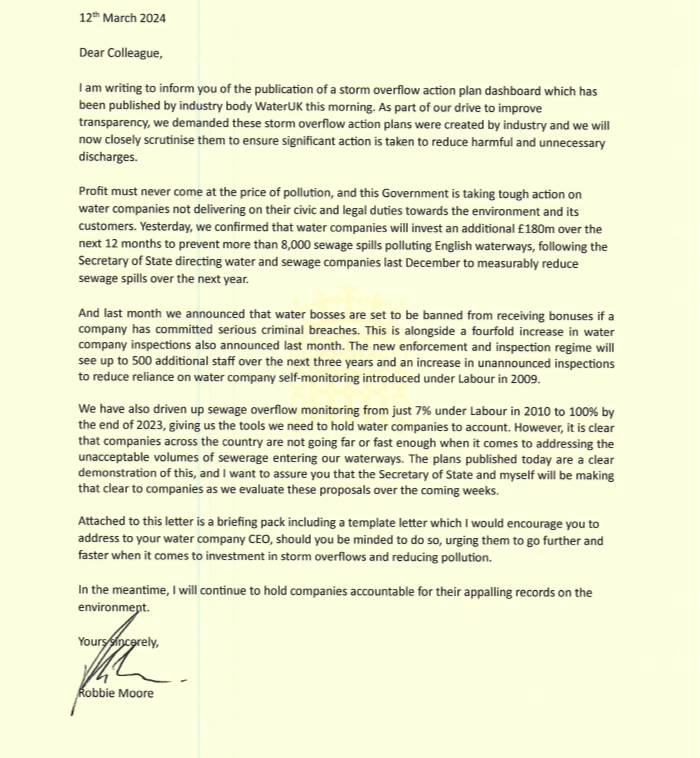
Please find enclosed below the Dear Colleague that I have received from the Minister concerning the Storm Overflow Action Plan:
Beveridge nationalised the popular and successful contributory or insurance principle. Working men in the 1940s paid weekly into “the club”, “the social” or “the sick”, charities and societies that paid them assistance if they fell ill or lost their weekly wage. They believed in working to keep their families and thought it right to pay for insurance against worklessness.
Beveridge created a national insurance scheme which provided subsistence payments if someone could no longer get a weekly wage. It also added in the state pension when they retired. State pensions were included in the sickness and redundancy insurance scheme which depended on a single regular payment out of income.
Subsequent changes understandably saw us want more generous sickness, unemployment and pension payments .Gradually more of the non pension payments were made out of general taxation and no longer depended on contribution records. As the triple lock policy drove the real value of pensions up so pensions came to dominate the NI fund .
I do not wish to reproduce arguments over the fact that the NI fund has always been pay as you go, not funded. It receives a favourable audit certificate every year because current payments in exceed payments out. The current working generation pays the pension of the older generation in the knowledge that their children will pay their pensions in due course. I will look at the impact of abolition of employee NI tomorrow.If you wanted to convert to a funded scheme the current generation of workers would need to pay twice.
I do not recall MPs and constituents calling for a further reduction in National Insurance. Readers of this site will remember the list of targeted tax cuts I requested, led by IR 35, VAT Threshold, and energy taxes . Others urged Income tax thresholds, Stamp duty and the tourist tax.
I have been willing to back a further NI cut as it is on offer. It does relieve some pressures on working individuals and families and provides a modest offset to the Bank of England recession inducing money policy. It does make it worthwhile working which is a good thing.
It does not poll very well and has not led to a big Conservative poll bounce. Many disenchanted Conservative voters are over the age to pay NI but subject to more Income tax if they wander over the tax threshold. There is some bemusement over the longer term aim of abolishing NI, which came out of nowhere. It is clearly not affordable on current policies.
Maybe they mean to abolish just employee NI, leaving in place employer NI which would remain as a tax on jobs. That makes it more affordable. I will look in more detail at the wider impacts were they in due course to abolish employee (and self employed) NI.
Please find below the audio recording of my lecture delivered at All Souls College, Oxford.
It starts at 00:13.
The People’s Bank of China is cutting interest rates and creating more liquidity in markets to boost growth. They did not buy up bonds in past years and have low inflation.Growth is around 5%
The Fed, the US Central Bank , is busy selling bonds at a loss but does not send the bill to the Treasury and taxpayers. Meanwhile the Administration and Congress has boosted the budget deficit by $1 trillion to offset the contractionary effects. Growth hit 5% but is now slowing as the stimulus fades.
The ECB is not selling bonds at big losses, though it made the same mistake as the Bank of England in printing too much and causing inflation. They do not want to weaken their economies more.
The Bank of Japan is still creating more money and buying more bonds, with low inflation.
Only the Bank of England is continuing to tighten into a downturn with large sales of bonds, sending huge bills for the losses to taxpayers.
Why?
Wokingham Borough has found another great way to annoy us and waste our money. The Borough is littered with yellow Diversion signs and red road closure signs everywhere you try to drive. Have they bought in bulk or are they hiring all those in at huge fees? What action do they take when they blow over or fall down?
The Lib Dem yellow Diversion signs are particularly vexatious. Because there are so many whole and partial road closures there are lots of different diversions. The signs do not tell you where that particular diversion began or where if you follow it it might take you to. I am glad I know my way around and do not have to rely on them. For anyone new to the Borough, or a visitor or driving in a part they do not regularly use it is a nightmare. It is so thoughtless not to put on signs what it is a diversion from and to so people can be reassured they will get back to where they want to be.
They are doing considerable damage to local traders with premises affected by the closures. Will they immediately offer them rate relief? What other action could they take as many are losing large amounts of turnover? Do they not care ? Do they not understand the community values its local traders and wants a Council which helps them, not one which tries to prevent us getting to the shops to use them.?
The Department for Environment, Food and Rural Affairs has provided the following answer to your written parliamentary question (15536):
Question:
To ask the Secretary of State for Environment, Food and Rural Affairs, what the carbon dioxide output of the Government estate was in (a) 2019 and (b) 2024. (15536)
Tabled on: 26 February 2024
Answer:
Rebecca Pow:
Since 2011 the Greening Government Commitments (GGCs) have set targets for greening the government estate and reported progress against them.
In financial year 2018-2019 the estate within the scope of the GGCs emitted 1,641,131 tonnes of CO2, 46% less than financial year 2009-2010. Full data is available in the 2018-2019 Greening Government Commitments annual report.
We will continue publishing CO2 emissions data in future GGCs annual reports. Data for financial year 2020-2021 is the latest year for which data is available and can be accessed here.
The answer was submitted on 04 Mar 2024 at 15:14.
The green revolution, led by governments and big business and informed by the green movement and decarbonising parties, is encountering consumer and political resistance as soon as it tries to get people to spend more money on replacing their transport or heating.
Voters often object to paying higher prices for fossil fuel-based ways of doing things when they are taxed, or to incurring more fines and penalties for not being green enough.
The Dutch government was thrown out of office for trying to stop farmers farming to cut rural methane and CO2; the French have demonstrated against dearer diesel; half the British refuse to have “free” smart meters.
Meanwhile, the American electorate is taking a shine in the polls to Donald Trump’s belief in having more cheap oil and gas and allowing people to drive their internal-combustion-engine cars, vans and pickups; Joe Biden has intervened to get the price of petrol (gasoline) down, even though dearer gas would push more people to electric.
The sheer magnitude of the task to get to net zero means that, for governments, it will only get tougher from here. They picked the low-hanging fruit first, concentrating on closing coal power stations as they persuaded and regulated the power sector to cut its emissions and ensuring big business takes measures to curb its own appetite for fossil fuels.
Now they have to persuade the consumer voter that it is time they banished the diesel or petrol car and ripped out the gas boiler – and many people will say that whilst they accept the climate change message, but they cannot afford an electric car or a heat pump.
There are only 18 million battery-electric cars in the world out of a total of 1500 million vehicles. It tends to be the rich who buy the battery cars, as they can afford the up-market Tesla or the more expensive electric versions of other well-known brands.
Putting in a heat pump is especially costly. In an older house a lot of work has to be undertaken first to insulate to much higher standards, before the disruptive work to install the heat pump system.
Some governments are offering high subsidies to people to get over these cost problems. The Chinese have the biggest numbers of electric cars thanks to early large subsidies and considerable pressure against buying new fossil-fuel vehicles. Norway for many years offered electric cars free of 20 per cent VAT and free of road taxes which gave them a boost there.
Yet such subsidy schemes can still leave many people unwilling as they worry about range, battery life, repair costs and ability to recharge on long journeys.
Heat pumps require even higher capital subsidies. Even so, many are reluctant. They fear big bills when they need to use plenty of electricity to keep the home warm, given the much higher prices of electricity than gas. They are concerned that on really cold days the home would not be sufficiently warm, as there would be less heat to pump successfully to its destination in the home.
There are issues with how green these preferred products are. If a person plugs in a car to recharge when there is too little wind or solar energy, a gas- or coal-fired power station has to supply the juice. That does not make the electric car green.
Such is also the case with a heat pump: on very cold still days, a lot of fossil fuel will be burned at power stations to keep the grid going.
Making the new electric car and heat pump generates a lot of carbon dioxide itself, and scrapping the old petrol car and gas boiler uses energy. The world only starts to win from your switch after many miles have been driven or many hours have passed with the heating, (assuming they are running on renewable power).
There are always problems with top-down revolutions. Governments may back the wrong technology: some of the smart meters given out free to users in the UK do not work properly and have to be replaced. It may run out of money and have to cut or end the subsidies designed to sustain the green changes; democratic governments may lose too many votes if it becomes clearer some of these changes mean paying more for such essentials as energy, transport, and heating.
Enthusiastic Greens portray a world full of wind farms where electricity is cheaper, powering homes, cars and industry. They claim energy is only dear today because oil and gas has gone up.
The truth is that today’s green electricity has needed much subsidy, paid for by taxpayers, to get it introduced. Whilst the average cost of wind power has now fallen a long way from the original peaks, it still needs substantial back up power to be available from fossil fuel generators for the low-wind days, the cost of which must be added to the overall cost of wind energy.
If we are to transfer much home heating and car transport from fossil fuel to electricity, there needs to be a massive expansion of generating capacity, and of grid and cable capacity to get the power to every home.
All this requires huge outlays to put in the generators and cables, to span the pylons across the fields and place the wires on the seabed to get to offshore wind. We need better answers to how much this will cost and who will pay.
In the meantime, it is very important we keep enough generating capacity available to meet our needs on days of no wind and little sun. The other day 26 per cent of our demand was met through imported energy even though demand was quite low – and the continent, grappling with its own problems from shortages and transition, will not always have the power to supply us.
Treasury has provided the following answer to your written parliamentary question (15530):
Question:
To ask the Chancellor of the Exchequer, what estimate he has made of trends in public sector productivity since 2019. (15530)
Tabled on: 26 February 2024
Answer:
Laura Trott:
ONS publish annual National Statistics on public service productivity up to 2020. The next annual statistic for 2021 will be published on 26 March. ONS also publish estimates of public service productivity which currently include annual estimates for 2021 and 2022 and quarterly estimates up to 2023 Q3. These are official statistics in development.
The answer was submitted on 04 Mar 2024 at 12:37.
Treasury has provided the following answer to your written parliamentary question (15529):
Question:
To ask the Chancellor of the Exchequer, what steps he is taking to increase public sector productivity. (15529)
Tabled on: 26 February 2024
Answer:
Laura Trott:
The government has a relentless focus on getting the most out of every pound spent by boosting public sector productivity and by focusing spending on the government’s priorities.
In June, the Chancellor announced the Public Sector Productivity Programme as a means of assessing how productivity can be improved and to ensure the long-term sustainability of our public services.
The programme has focused on embracing the opportunities presented by Artificial Intelligence, reducing the amount of time our key frontline workers spend on administrative tasks and strengthening preventive action to reduce demand on public services.
The answer was submitted on 04 Mar 2024 at 12:50.